A poorly adjusted truck headlight is not just an inconvenience, but a direct hazard on the road. At night or in fog, a single misaligned lamp can blind oncoming traffic, while the driver themselves experiences reduced visibility. Improperly adjusted lighting can also lead to fines, posing a significant risk at the fleet level. This article guides you step-by-step through checking and adjusting truck lighting, highlights the most common mistakes, and summarizes relevant legal requirements. We also offer professional tips useful for both fleet managers and drivers.
Table of Contents
- Overview of Necessary Tools and Prerequisites
- Step-by-Step Guide to Truck Lighting Adjustment
- Common Faults, Problems, and Troubleshooting Tips
- Legal Regulations, Inspections, and the Risk of Fines
- Why Is Just Starting Not Enough? A Professional Perspective on Truck Lighting Adjustment
- Everything You Might Need for Safe Trucking
- Frequently Asked Questions
Key Takeaways
| Point | Details |
|---|---|
| Proper Preparation | It is advisable to ensure the appropriate tools and location are available in advance for lighting adjustment. |
| Precision in Adjustment | Following the adjustment guide step-by-step minimizes the possibility of errors. |
| Regular Inspection | Regular checks of the lighting reduce the risk of fines and accidents. |
| Compliance with Regulations | Adherence to traffic regulations affects both monetary fines and road safety. |
Overview of Necessary Tools and Prerequisites
Now that we understand its importance, let's move on: what will we need first?
Professional checking and adjustment of truck lighting does not require a workshop, but some basic tools and appropriate conditions are essential. The quality of preparation directly determines the final result.
Required tools:
- Screwdriver set (both Phillips and flathead)
- Measuring tape or steel ruler
- Headlight adjustment tool (most trucks require a Torx or hex key)
- Masking tape and marker for wall marking
- Level (digital or traditional bubble level)
- Cleaning agent and microfiber cloth for the lamp housing
The workspace is at least as important as the tools. Choose a darkened, covered hall or garage space where the light pattern projected onto the wall is clearly visible. The floor must be level, otherwise measurements will be distorted. Many drivers make a fundamental mistake: they perform the adjustment in the yard, on uneven ground, and then wonder why the result is not satisfactory.
The legal background is also not negligible. The KRESZ (Hungarian Highway Code) mandates the use of dipped headlights at night, in fog, in tunnels, and in conditions of reduced visibility. This means that not only the operation of the lamp, but also its precise angle and intensity can be subject to inspection. Truck accessories are closely related to maintaining proper lighting for safety.
| Tool | Use | Notes |
|---|---|---|
| Screwdriver | Cover fastening, adjustment screw | Multiple sizes needed |
| Measuring tape | Headlight height measurement | At least 3 meters long |
| Level | Checking vehicle horizontal alignment | Digital is more accurate |
| Cleaning agent | Lamp surface treatment | With scratch-free cloth |
Important: Before adjustment, always check that the truck's fuel tank is full, tire pressure is correct, and the vehicle is unladen. All these factors influence the headlight angle.
Common preparation errors include neglecting damaged covers, dirty lamp housings, and loose mounting screws. These must be repaired before adjustment, otherwise the entire process is meaningless.
Step-by-Step Guide to Truck Lighting Adjustment
Armed with the necessary tools and knowledge, let's proceed with the adjustment process itself.
Adjustment is not complicated, but it requires precision. One misplaced step can ruin the entire job, so it's worth proceeding in order.
1. Preparing the Vehicle
Position the truck on a level surface, at least 7-10 meters from a smooth, light-colored wall. Check tire pressure and ensure the vehicle is unladen. If the truck regularly operates with a full load, it's advisable to perform the adjustment with a half-full tank, as the load affects axle height.
2. Marking the Reference Line on the Wall
Measure the height of the center of the headlights from the ground and mark this height on the wall with masking tape. This will be your horizontal reference line. The top of the dipped headlight beam should generally be 5-10 cm below the center of the headlight.
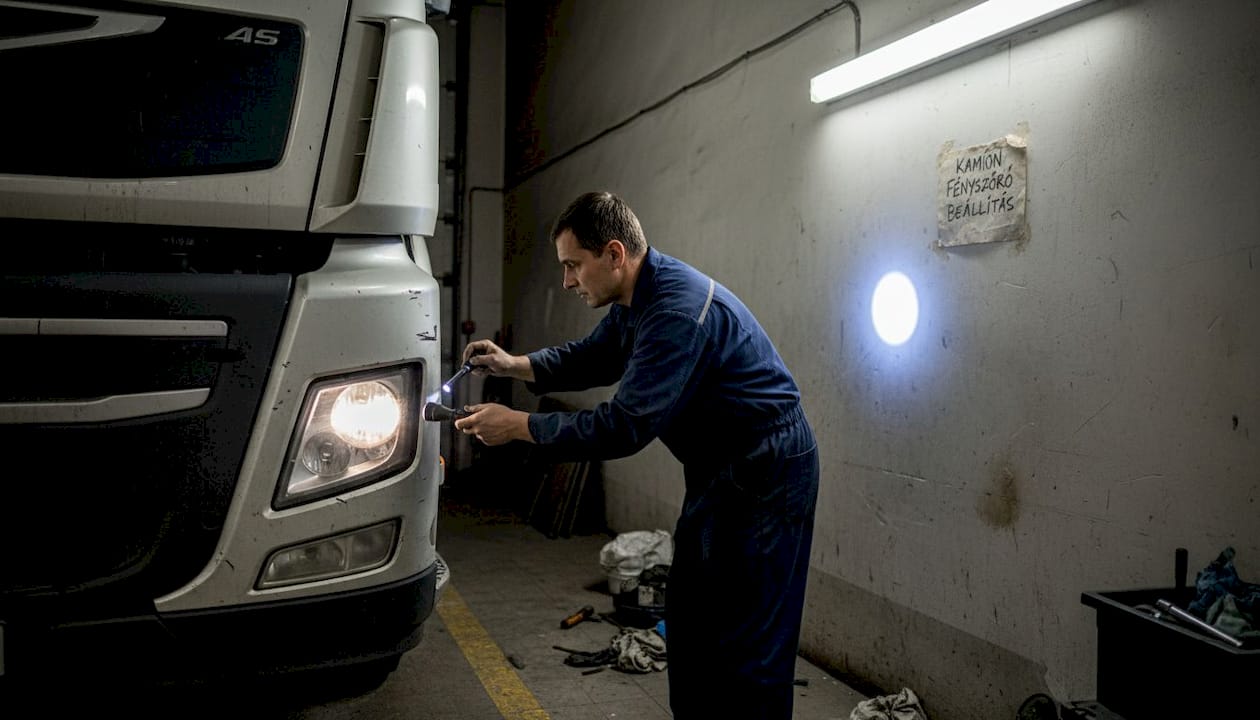
3. Adjusting the Headlight Angle
Turn on the dipped headlights and observe where the light projects onto the wall. Using the adjustment screw (usually at the back of the headlight), set the top of the light beam to the marked line. Perform this on both sides and compare the two. The deviation should not be more than 2 cm.
4. Checking Lateral Alignment
The dipped headlight beam should tilt slightly to the right (away from oncoming traffic) to avoid blinding drivers. This is especially important for trucks, where the headlights are higher than on passenger cars.
5. Function Check
Check in sequence: dipped headlights, main beam headlights, turn signals (front, rear, side), parking lights, brake lights, reverse lights, and fog lights. Test each component individually, ideally with the help of an assistant.
Outside built-up areas, DRL or dipped headlights are mandatory during the day, meaning daytime running lights should also not be overlooked during adjustment. Professional headlight adjustment is also closely related to the general condition of the bodywork.
Pro tip: Always replace bulbs in pairs, even if only one has burned out. Bulbs of different ages will produce different light intensities, leading to uneven illumination and reduced night vision. Among the practical truck tools, you'll find aids that make this work easier.
Common Faults, Problems, and Troubleshooting Tips
After correct adjustment, it's worth addressing the most common potential issues.
Even a carefully performed adjustment is worth little if a fault occurs in the meantime. Trucks operate under harsh conditions: vibration, dust, and temperature fluctuations all contribute to the deterioration of the lighting system.
The most common problems:
- Loose or poorly secured cover: Vibration can loosen mounting screws. Regularly check that the cover fits snugly.
- Different headlight angles on two sides: If one side's bulb was replaced but the angle not readjusted, asymmetry will result.
- Dirty, yellowed lamp housings: A yellow, hazy cover can reduce light intensity by up to 70%. Polish regularly.
- Aged bulbs: A bulb's performance gradually decreases throughout its lifespan, even without burning out completely. If the bulb is older than 2 years, it's worth replacing.
- Faulty electrical connection: Corrosion, a loose connector, or damaged cable can cause flickering or complete failure.
| Fault | Symptom | Solution |
|---|---|---|
| Loose cover | Vibration, displaced light | Tighten screw |
| Yellowed cover | Weak light | Polish or replace |
| Aged bulb | Dim, yellowish light | Replace in pairs |
| Corrosion | Flickering, failure | Clean connector |
| Different angle | Asymmetrical light | Re-adjust |
Pro tip: Keep a maintenance log for each vehicle. Record the date of bulb replacement and when adjustment was performed. At a fleet level, this simple habit can prevent unexpected breakdowns and associated fines.
Faulty lighting can result in fines of up to 50,000 HUF, which can be a significant amount for a fleet with multiple vehicles. Lighting maintenance is not a separate task but an integral part of regular external maintenance.

During troubleshooting, remember: if a light flickers, always check the connection first before replacing the bulb. Most flickering issues stem from corrosion or a loose connection, not the bulb itself.
Legal Regulations, Inspections, and the Risk of Fines
Now that we've covered the technical details, let's look at the legal and inspection background.
During roadside inspections, police and traffic authorities also examine the truck's lighting system. It's not enough for the light to simply work; its condition and adjustment must also comply with regulations.
What is checked during inspections:
- Operation of headlights (dipped, main beam)
- Angle and height of the light beam
- Condition of turn signals and parking lights
- Cleanliness and integrity of the lamp cover
- Operation of brake lights and reverse lights
- Proper use and adjustment of fog lights
Incorrect lighting can result in fines ranging from 6,500 to 50,000 HUF, depending on the severity of the violation. A broken lamp cover or a burned-out turn signal can even lead to an immediate fine.
| Violation | Fine Amount | Note |
|---|---|---|
| Burned-out parking light | 6,500-15,000 HUF | Minor violation |
| Faulty headlight angle | 15,000-30,000 HUF | Moderately severe |
| Non-functioning headlight | 30,000-50,000 HUF | Severe violation |
| Missing fog light | 15,000-30,000 HUF | Depends on visibility conditions |
For fleet managers, proper documentation is particularly important. Keep records of when maintenance and adjustments were performed on each vehicle. This can serve as evidence during inspections and reduce liability. Preparing for inspections requires a comprehensive approach, not just limited to lighting.
Police pay special attention to ensuring that headlight light is white or yellow (blue is prohibited), that paired lights function symmetrically, and that light intensity is adequate. An old, dim headlight can also be considered a violation, even if it technically works. Knowledge of the details of legal consequences is a fundamental duty of every driver and fleet manager.
Why Is Just Starting Not Enough? A Professional Perspective on Truck Lighting Adjustment
Many drivers and fleet managers think that if the light is on, everything is fine. This attitude is one of the most dangerous misconceptions in the industry. The reality is that a poorly aimed headlight can pose a greater risk than a completely burned-out light, because it gives a false sense of security.
Professional adjustment is not a one-time task. Trucks are constantly vibrating, suspension wears out, and loads change. All this continuously shifts the angle of the headlights, slowly, almost imperceptibly. An annual check is not enough, especially for vehicles operating on difficult terrain or in winter conditions.
Experience shows that most fines are not caused by completely broken, but by slowly deteriorating, neglected lighting. Everything depends on small details: a loose screw, a dirty cover, a bulb that expired a few months ago. Individually, these seem negligible, but together they constitute a serious violation. The professional approach is not to do it and forget it, but to build a system around it.
Everything You Might Need for Safe Trucking
Professional experience can be complemented by products that provide everyday assistance during operation.
At Convoy.hu, you'll find all the tools and accessories needed for truck lighting maintenance and daily operation. Whether it's cleaning agents, gloves, or practical accessories, the selection keeps professional needs in mind.

For example, a truck towel is ideal for removing dust and dirt from lamp housings, while safety gloves protect your hands during bulb replacement and electrical connector checks. By reviewing the full range of Convoy.hu, you can find the products that help you operate your fleet legally and safely, in all seasons.
Frequently Asked Questions
How can you tell if a truck's lighting is correct?
Headlight adjustment should be checked in a darkened area, in front of a wall: the height and direction of the light beam can be accurately determined by measurement and compared with manufacturer specifications.
How often is it recommended to check truck lighting?
It is advisable to check the condition of the lighting before every longer journey or during regular maintenance, as the condition and adjustment of the headlights can be inspected at any time during roadside checks.
What fine does one risk by driving with faulty lighting?
The fine ranges from 6,500-50,000 HUF, depending on the severity and nature of the fault, and in the most serious cases, immediate withdrawal from traffic must also be expected.
What should be done if a headlight bulb burns out?
The bulb should be replaced as soon as possible, always replacing bulbs in pairs for balanced lighting, and the headlight angle should also be checked after replacement.