Many people think that external vehicle accessories only serve aesthetic purposes: a nice spoiler here, a decorative strip there. However, this approach can cost a fleet operating company serious money and risk. The reality is that properly selected external accessories have a direct impact on accident prevention, cargo security, fuel consumption, and legal compliance. This article shows what tools are available, what they are for exactly, and how they can bring measurable savings in the daily life of fleet management.
Table of Contents
- Why are external vehicle accessories important in fleet management?
- The importance of cargo securing devices: stability and legal compliance
- Fuel savings and fleet costs: the role of aerodynamic accessories
- Digital and advanced external accessories: AI dashcam systems and safety technology
- What most fleet managers miss: the true importance of durability and customization
- How can Convoy help develop your fleet?
- Frequently Asked Questions
Key Takeaways
| Point | Details |
|---|---|
| Foundation of safety | Well-chosen external accessories significantly reduce the risk of accidents and cargo damage. |
| Cost-effectiveness | Aerodynamic and digital accessories can provide a quick return on investment, reducing fleet costs. |
| Benefit of customization | Quality accessories tailored to the vehicle provide more durable protection and higher returns in the long run. |
| Legal compliance | The use of standard securing devices is essential due to regulatory and insurance requirements. |
Why are external vehicle accessories important in fleet management?
One of the most underestimated areas of fleet management is the optimization of a vehicle's external equipment. It is not enough to focus solely on engine maintenance or driver training if the vehicle itself does not have the tools to make daily operations safe and efficient.
External accessories serve three main strategic goals in fleet management:
- Accident prevention and active safety: Rearview mirrors, warning lights, corner protectors, and camera systems all contribute to the safety of the driver and their surroundings.
- Cargo security and legal compliance: Without straps, cargo nets, and anti-slip mats, cargo can shift during transit, causing accidents and legal consequences.
- Fuel efficiency and fleet cost reduction: Aerodynamic accessories, such as side skirts and rear fairings, can noticeably reduce fuel consumption on longer hauls.
Truck safety accessories are not luxury items, but business tools. For a fleet, every accident or damaged cargo not only means direct financial loss but also the "downtime" cost associated with the vehicle being out of service. If a truck is out of operation for even a few days, it can easily cause losses of several hundred thousand forints.
“Proper external equipment not only protects the driver's safety but also the company's reputation and financial stability.”
The issue is also not negligible from the perspective of logistical efficiency. A well-equipped vehicle can operate with fewer breakdowns, fewer official fines, and lower insurance premiums. Many insurance companies offer discounts to fleets that are documented to comply with safety regulations and regularly maintain their vehicles.
Studies in the field of truck safety equipment show that fleet costs can be reduced by 15 to 20 percent if the company systematically invests in appropriate external accessories. This is not a theoretical figure but an estimate based on real operational experience.
Regular execution of external maintenance steps also reduces unexpected breakdowns. A proactive approach, which includes checking the condition of accessories, is much cheaper in the long run than reactive repairs.
The importance of cargo securing devices: stability and legal compliance
Now that we understand why external accessories are strategically important, let's focus on cargo securing devices, which form one of the most essential groups. Cargo securing devices reduce the risk of injuries and accidents, and this is not just theory: improperly secured cargo plays a significant role in a large percentage of road accidents.
The most commonly used basic tools and their role:
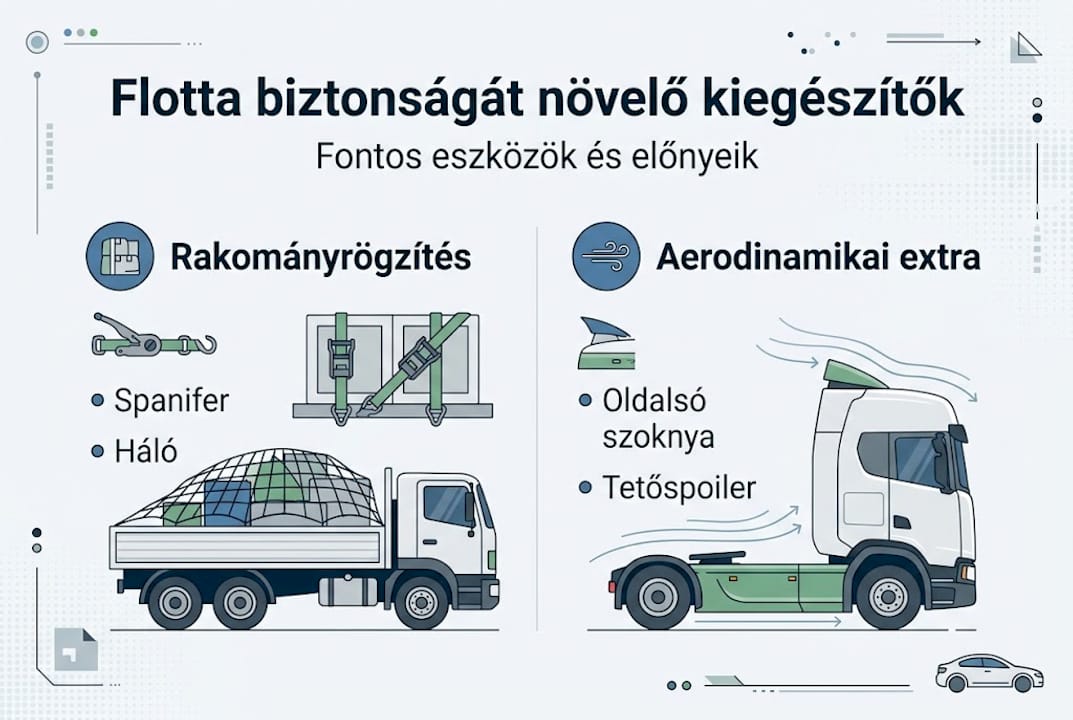
- Ratchet straps: The most common securing device, which holds the cargo tightly with its tensioning mechanism. Correct tensioning technique is particularly important.
- Cargo net: Ideal for bundling smaller, loose items, preventing goods from sliding apart or falling off the flatbed.
- Anti-slip mat: Placed between the cargo and the flatbed surface to prevent slipping, even during heavy braking.
- Corner protectors: Protect the goods at the contact points of the straps and cargo from cutting the material and damaging the rope.
- Load bars: Used for containers and boxed goods, they support the cargo by resting against the inner walls of the vehicle.
The use of straps, nets, and ratchet straps reduces the risk of damage and logistical risk, while also helping to comply with official regulations. In Hungary, the Highway Code (KRESZ) and ADR regulations clearly define which securing solutions can be used for each category of goods.
| Accessory type | Advantage | Disadvantage |
|---|---|---|
| Universal ratchet strap | Cheaper, fits various vehicles | Less precise fit, faster wear |
| Vehicle-specific securing device | More precise, durable, better fit | Higher initial investment |
| Cargo net | Easy to handle, flexible | Not suitable for heavy, unique cargo |
| Anti-slip mat | Simple, cheap, effective | Can only be used as an auxiliary device |
The correct use of ratchet straps is particularly important, as improper application can lead not only to cargo damage but also to accidents. The tensioning direction, the number of securing points, and the load capacity of the device are all factors that every driver must be familiar with.
Pro tip: Always check the expiry dates and wear condition of ratchet straps and nets before each journey. A broken securing device during transit can have catastrophic consequences and can result in severe fines during an official inspection.
The importance of anti-slip mats cannot be underestimated either: a simple rubber mat can prevent thousands of forints worth of damage in a single journey. Cargo stability becomes critical especially in winter, on wet or icy surfaces.
Fuel savings and fleet costs: the role of aerodynamic accessories
After cargo security, let's look at how appropriate aerodynamic accessories can provide added value and cost reduction. This is an area where many fleet managers are still skeptical, yet the numbers speak for themselves.
The most important types of aerodynamic accessories:
- Side skirts: Reduce turbulence around the wheels on the side of the trailer or semi-trailer, leading to a direct reduction in fuel consumption.
- Rear diffuser: Used to mitigate air eddies at the rear of the vehicle, particularly effective on highways.
- Roof deflector: Placed on the cab roof, it directs air over the trailer, reducing air resistance.
- Front spoiler and side deflectors: Optimize airflow around the cab section.
Aerodynamic accessories can provide fuel savings of between 1 and 2 percent, especially during long hauls. This may seem small at first, but for a fleet of 50 vehicles traveling 500 kilometers daily, this amounts to millions of forints in annual savings.
| Accessory type | Estimated savings | Payback period |
|---|---|---|
| Side skirt | Between 0.5 and 1% | Between 1 and 2 years |
| Rear fairing | Between 0.3 and 0.8% | Between 1.5 and 3 years |
| Roof deflector | Between 0.5 and 1.5% | Between 1 and 2.5 years |
| Combined package | Between 1.5 and 2.5% | Between 1 and 2 years |
Pro tip: The effectiveness of aerodynamic accessories becomes truly measurable at speeds above 80 km/h. If your fleet primarily operates in urban traffic, the payback period will be significantly longer. In this case, it is worth focusing on other accessories to optimize your investment.
Another important aspect is the environmental footprint. The European Union is introducing increasingly stringent CO2 emission regulations for heavy-duty vehicles. Aerodynamic developments not only save money but also help meet greener operational requirements, which is becoming an expectation for more and more clients when choosing partners.
Fuel anti-theft devices also contribute to reducing fleet costs, as fuel theft is one of the most common and damaging problems for fleet operators. A well-designed external security system therefore reduces not only consumption but also losses.
Digital and advanced external accessories: AI dashcam systems and safety technology
After reviewing the classic tools, let's move on to the most modern, highest efficiency-boosting digital accessories. AI-based dashcam systems have brought a real revolution to fleet safety in the last few years.
Key benefits of AI dashcam systems:
- Real-time alerts: The system immediately signals if the driver is distracted, drowsy, or not maintaining a safe following distance.
- Automatic event recording: In the event of an accident or emergency braking, the system automatically saves footage, which serves as evidence in insurance and legal matters.
- Driver performance analysis: Based on collected data, risky driving habits can be identified, and targeted training can be organized.
- Fleet-level reports: Management receives real-time and aggregated data on the performance and risk profile of the entire fleet.
AI dashcam systems have reduced fleet accidents by 52 percent and distraction by 80 percent. These are not marketing figures: they come from real fleet operational data, and the savings far outweigh the system's implementation costs.
“After implementing the AI dashcam, our fleet's insurance premium decreased by 18 percent in the first year, while the number of accidents fell by half.”
However, there are pitfalls to implementing digital safety tools that are worth knowing in advance. One of the most common mistakes is that a company buys the hardware but does not invest the time in properly informing its drivers. If drivers feel that the system is merely a monitoring tool and not a help, resistance to its implementation may arise.
Another typical mistake is improper integration. The AI dashcam system only achieves the expected results if the data is actually processed and used as the basis for action plans. A well-designed implementation process includes driver training, regular review of management reports, and the establishment of a feedback culture.
These systems are also playing an increasingly important role from a compliance perspective. Several European countries have already made the use of certain camera systems mandatory on heavy-duty vehicles, and this trend is expected to continue in the coming years.
What most fleet managers miss: the true importance of durability and customization
Based on decades of experience, it can be said: most fleet managers focus on immediate returns, and this is understandable. But this is exactly the approach that makes operations more expensive in the long run.
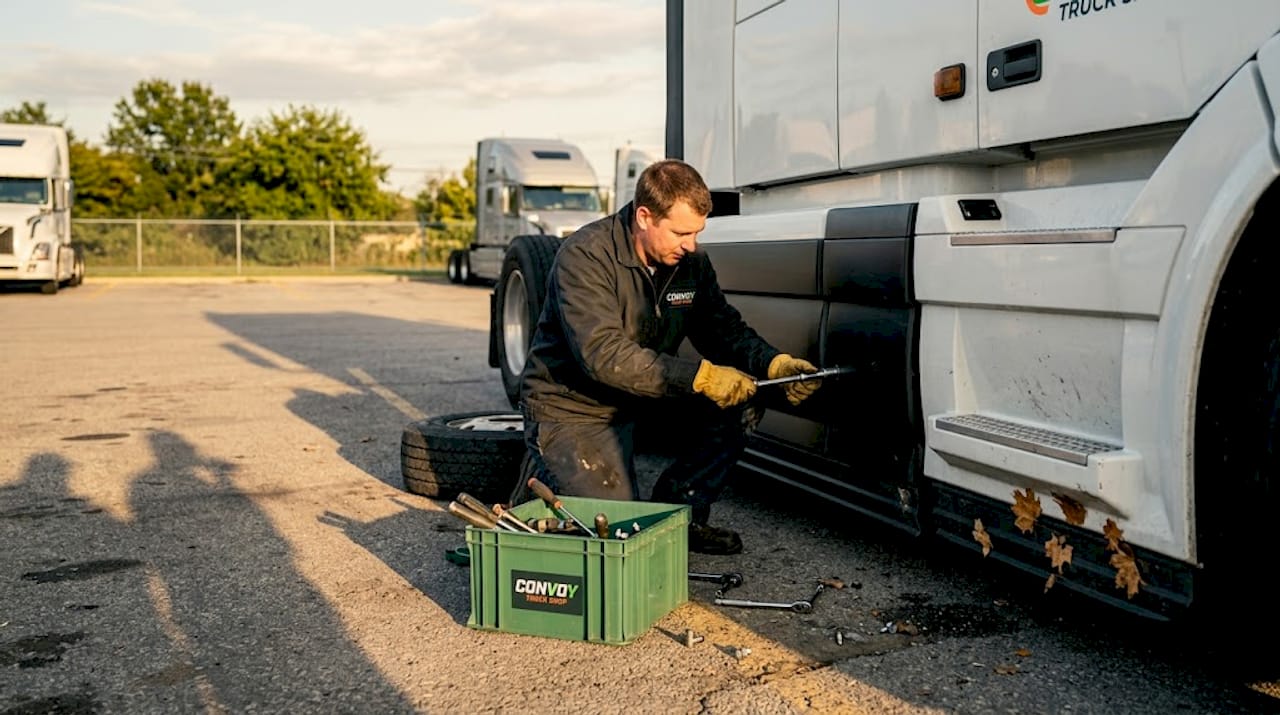
For universal and vehicle-specific tools, material quality and weather resistance are crucial factors. A cheap, UV-sensitive plastic fastener will become brittle in two summers and will need to be replaced. A quality, vehicle-specific piece will still be in good condition in the same amount of time and will not cause any surprises during an official inspection.
The trap of half-solutions is particularly dangerous. Many people buy universal accessories thinking that "it will be good enough." This may seem like saving money in the short term, but a poorly fitting tool wears down the vehicle, does not provide optimal protection, and needs to be replaced sooner. Vehicle-specific developments have a higher initial investment cost, but the lifespan and performance are proportionally better.
We have also found that fleet managers tend to underestimate the importance of weather resistance. For a fleet operating in Hungary, accessories are exposed to temperature fluctuations between minus 20 and plus 40 degrees Celsius annually. Only materials that can truly withstand this will last.
How can Convoy help develop your fleet?
For each of the solutions presented in this article, we offer reliable, tested products in the Convoy.hu range, which we have specifically designed for the needs of the professional transport sector.
Whether it's cargo securing devices, aerodynamic accessories, or digital safety tools, you'll find what you need with us. For example, a puncture repair kit should always be on hand on the road, and high-visibility gloves support the daily occupational safety of drivers. A smaller but important detail: a quality truck towel can also contribute to a professional appearance. As a fleet manager, you can also request personalized advice from us to make the best decision.
Frequently Asked Questions
What are the legal requirements for cargo securing in Hungary?
Depending on the vehicle category and the type of goods transported, the use of standardized restraints is mandatory, with the main regulations outlined in the KRESZ (Hungarian Highway Code) and ADR (European Agreement concerning the International Carriage of Dangerous Goods by Road). Non-compliance with legal requirements can result in significant fines and insurance problems.
Are aerodynamic accessories effective on all vehicle types?
They primarily pay off quickly for large, long-haul trucks, but their effect is less significant on smaller vehicles used in urban areas. The effectiveness of aerodynamic accessories is truly realized primarily at highway speeds.
How long does it take for an AI dashcam system to pay for itself?
According to practical examples, it can pay for itself in as little as 44 days through savings from reduced accidents and insurance premiums. The rapid return on investment of AI dashcam systems is particularly noticeable in large fleets, where even a single avoided accident can cover the investment.
What is the difference between universal and specific accessories?
Universal devices can be used with various vehicles, but vehicle-specific parts are more durable and provide a better fit. When choosing between universal and specific accessories, long-term operating costs and material quality should be the primary considerations.
Recommended
- Vehicle Servicing: 40% Cost Reduction and Safety – Convoy Truck Shop HU
- Truck Safety Equipment: 50% Fewer Accidents – Convoy Truck Shop HU
- Examples of Trucker Accessories: Safety and Functionality – Convoy Truck Shop HU
- Truck Exterior Maintenance: Durable Vehicles Step by Step – Convoy Truck Shop HU