Many people only notice that their "truck doesn't stop like it used to," or that fuel consumption is increasing, when in fact, the actual safety and economy of commercial vehicles depend most on the quality of their parts. Far more people misunderstand important basic concepts than we might think: a poorly chosen part not only costs money but can also pose a serious accident risk. This guide will walk you through the most important component groups, introduce their function, typical failures, and help you make confident, informed decisions at your next purchase.
Table of Contents
- Main Groups of Commercial Vehicle Parts
- Role and Characteristics of Engine and Drivetrain Parts
- Characteristics of Chassis, Suspension, and Brake System
- Introduction to Chassis, Body, and Other Accessory Elements
- What Most People Overlook When Selecting Commercial Vehicle Parts?
- Procuring Commercial Vehicle Parts and Accessories from a Reliable Source
- Frequently Asked Questions
Key Takeaways
| Point | Details |
|---|---|
| System of main component groups | Engine, drivetrain, chassis, brakes, and chassis all are crucial and deserve special attention. |
| Importance of OEM compatibility | Long-lasting and trouble-free vehicle operation can be ensured by choosing model-specific parts according to OE numbers. |
| Importance of chassis and brakes | The condition of the chassis, suspension, and brake system directly affects safety and cost-effectiveness. |
| Maintenance prevents problems | Regular inspections and timely part replacements can significantly increase operational safety and vehicle lifespan. |
Main Groups of Commercial Vehicle Parts
Trucks are not simply "bigger cars." A heavy-duty truck's system is complex, consisting of interdependent units, where the failure of a single component compromises the operational safety of the entire vehicle. A recurring theme even in discussions about the benefits of truck rental is the parts problems fleet managers face during daily operation.
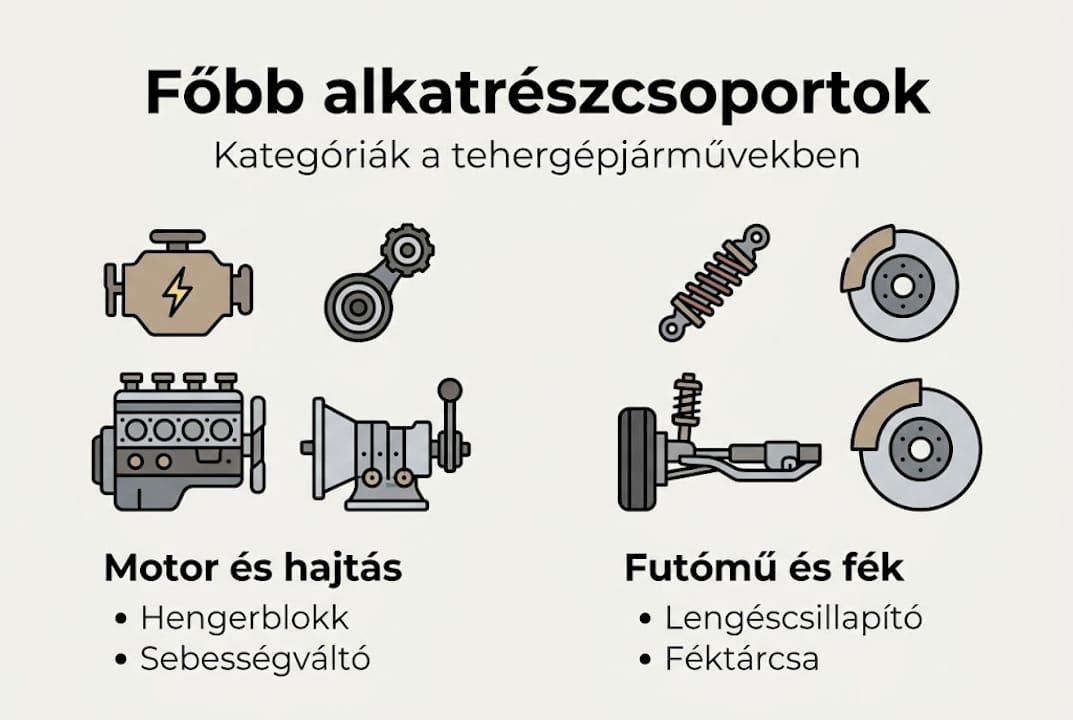
The main categories of commercial vehicle parts are: engine parts, drivetrain parts, chassis parts, brake parts, body and chassis elements. Each of these performs a different function and has different maintenance requirements. Detailed information on part types can be found in professional sources, but the table below provides a quick overview:
| Component Group | Main Function | Typical Failure Symptom |
|---|---|---|
| Engine Parts | Energy generation, combustion | Increased fuel consumption, smoke |
| Drivetrain Parts | Torque transmission | Slipping clutch, transmission failure |
| Chassis and Suspension | Stability, load bearing | Knocking, unstable driving |
| Brake Parts | Deceleration, stopping | Longer braking distance, squealing |
| Body and Chassis | Structural support, protection | Corrosion, deformation |
| Electronic Units | Control, diagnostics | Error codes, malfunctioning indicators |
The main component groups briefly listed:
- Engine parts: cylinder block, cylinder head, piston, crankshaft, drive belt
- Drivetrain: gearbox, clutch, driveshaft, differential
- Chassis: shock absorbers, springs, wheel hub, bearings
- Brake system: brake drums, brake discs, air compressor, brake caliper
- Chassis and body: longitudinal members, cross members, cabin coverings
- Accessories: tachograph, lighting, fasteners, aerodynamic elements
For example, the vehicle's usage in refrigerated transport particularly stresses the suspension and chassis, as continuous load and temperature fluctuations accelerate component wear. After this comprehensive overview, let's delve deeper into each group, starting with the engine.
Role and Characteristics of Engine and Drivetrain Parts
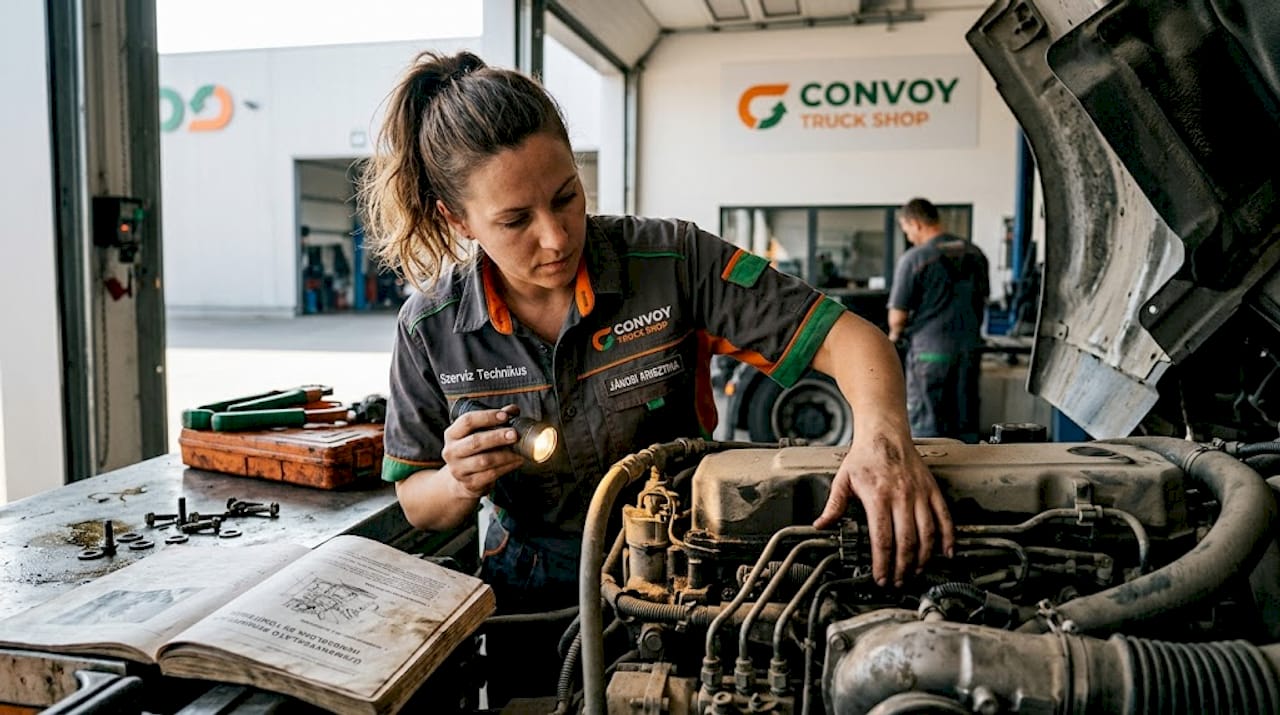
The engine is the heart of the truck. The main structural components of a heavy-duty truck's diesel engine are the cylinder block, cylinder head, pistons, crankshaft, and drive belt system. Each element is made from a different material and technology, and each has precise technical parameters.
The table below shows specific examples:
| Part | Material | Characteristic Parameter | Reason for Replacement |
|---|---|---|---|
| Cylinder Block | Cast iron, aluminum | Cylinder bore diameter | Crack, corrosion |
| Piston | Aluminum alloy | Compression ratio | Wear, ring failure |
| Crankshaft | Steel | Crank angle, diameter | Bearing failure |
| Drive Belt | Rubber, timing belt | Number of teeth, width | Crack, stretching |
| Clutch Disc | Friction material | Diameter, thickness | Slippage, wear |
Based on the description of engine parts, the cylinder block is the engine's supporting structure, providing both combustion processes and cooling. The cylinder head's task is sealing and controlling valve movement. The piston converts combustion energy into mechanical work, while the crankshaft converts this motion into rotational motion.
The drivetrain system transmits engine torque to the wheels. The gearbox, clutch, and driveshaft collectively ensure that the right power reaches the driven axles at the right time. For example, a slipping clutch not only causes inconvenience but also significantly reduces fuel efficiency.
OEM compatibility is crucial: the OE number specified by the manufacturer guarantees that the part fits the specific model exactly. A non-compatible drive belt tensioner, for instance, can cause vibration, which over time can destroy the entire timing system. Regular maintenance also increases lifespan, as confirmed by experienced service centers.
Steps to check part selection:
- Identify the exact model, year, and engine code of the vehicle.
- Find the part's OE number in the manufacturer's catalog or on the existing part.
- Compare the OE number of the offered part with the required one.
- Check the material quality and manufacturer's references.
- Request a warranty and invoice for every purchase.
For example, regular use of injector cleaner extends the lifespan of injectors and reduces consumption. For fuel security, it is also worth considering additional protection solutions, especially for fleet operations. The proper condition of tachograph parts is also a basic requirement for regulatory compliance.
Pro tip: Before purchasing, always ask for the part's OE number and compare it with the manufacturer's datasheet. A reliable source is one that provides this information automatically, without having to be asked. If a web store or wholesaler cannot provide an OE number, it is a serious warning sign.
After the drivetrain, one of the most critical safety systems is braking. Let's see what to pay attention to here.
Characteristics of Chassis, Suspension, and Brake System
The task of the chassis and suspension is to ensure the vehicle drives stably, bears the load evenly, and the driver can always control the vehicle. In commercial vehicles, two main suspension technologies are widespread: leaf spring and air spring systems.
Leaf spring suspension is simpler, cheaper, and extremely robust. It is mainly used in heavy off-road or construction vehicles where simple maintainability and shock resistance are more important than comfort. The advantage of air springs is adjustable height and better ride comfort, which is a decisive factor for long hauls and transporting sensitive goods. Furthermore, the air spring system reduces the load on the body and cargo, which means lower maintenance costs in the long run.
The braking system is a vital safety element in commercial vehicles. Air brakes are the most common in heavy vehicles because they can exert greater braking force than hydraulic systems. Air brakes use compressed air from a compressor, and in case of failure, the vehicle automatically enters a braking position, which is safer than hydraulic system failure. The hydraulic brake system is typical for smaller trucks and light commercial vehicles where the braking force requirement is lower.
"Neglecting brake system maintenance is not economy, but risk-taking. A worn brake pad or a leaking air brake system endangers not only the driver's life but everyone else's on the road." (Professional recommendation for heavy vehicle operators)
Warning signs that every driver should pay attention to:
- Unstable, "floating" driving on a straight road
- Knocking or squealing sound in turns or on uneven ground
- Uneven tire wear (one side wears more than the other)
- Longer braking distance, or the vehicle "pulls" when braking
- Visible oil leak at the shock absorber
- Increased steering effort, difficult change of direction
Regular inspection of safety equipment and carrying a tire repair kit in the vehicle is a basic requirement. Among the body repair tips, it is a recurring theme that the condition of the chassis directly affects the load on the bodywork.
Pro tip: When replacing worn shock absorbers or springs, never replace only one side. Paired replacement ensures even load distribution and stable driving dynamics. If only one side is replaced, the two sides will have different stiffness, leading to instability and faster wear.
After the main systems, we must not forget the role of the chassis and body units.
Introduction to Chassis, Body, and Other Accessory Elements
The chassis is the backbone of the commercial vehicle. All other systems are built upon it, so the condition of the chassis determines the long-term reliability of the entire vehicle. There are significant differences between ladder and box-section chassis: the ladder chassis consists of two parallel longitudinal members and cross-members, making it extremely strong and easily repairable. It is mainly used in heavy-duty trucks, tractors, and special vehicles. The box-section chassis is lighter and stiffer, common in smaller trucks and vans.
Body elements serve not only aesthetic but also aerodynamic and protective functions. A well-designed roof spoiler, for example, can reduce fuel consumption by 5-8 percent on long hauls. Detailed knowledge of vehicle structures helps understand why it's worth paying attention to the condition of body elements, not just mechanical systems.
The body repair guide discusses in detail the steps required to repair a damaged element and when it is advisable to choose replacement over repair.
Frequently replaced smaller parts and accessories that many underestimate:
- Headlights and marker lights: Aged or damaged lighting is not only a traffic violation but also a serious accident risk.
- Exterior mirrors and mirror heating: In winter, it is particularly critical that mirrors are clearly visible.
- Door and window seals: Leaking seals allow moisture into the cabin, causing corrosion and electronic failures.
- Fasteners, screws, and mounting elements: Loose or corroded fasteners can be precursors to serious structural problems.
- Aerodynamic covers: Damaged side covers increase air resistance and thus fuel consumption.
- Steps and handholds: Worn anti-slip surfaces can be a source of accidents when entering the cabin.
These elements may seem minor at first glance, but in the long run, they significantly affect maintenance costs and accident prevention effectiveness. For example, an aged seal can be replaced for a few thousand forints, but if neglected, internal corrosion can lead to repairs costing hundreds of thousands of forints. Before the final summary, let's highlight some lesser-known, extra tips from an expert perspective.
What Most People Overlook When Selecting Commercial Vehicle Parts?
One of the most common misconceptions in fleet procurement is that "cheaper aftermarket parts are just as good as OEM." This is not always true, but not always false either. The reality is more nuanced: some aftermarket parts are high-quality and reliable, while others are made from inferior materials and have a shorter lifespan. The key is to buy from a reputable manufacturer, from a verified source, and always ask for the OE number.
The importance of model-specific parts is particularly true for vehicles like the Ford Transit, Mitsubishi Canter, or Volvo FH series, where manufacturers change sizes and fittings with each generation. A seemingly identical part for a different model year might have different mounting points, causing installation problems or premature failure.
A recurring problem in truck rental experiences is that fleet managers do not keep records of the parts history of individual vehicles. This leads to the same fault being repaired multiple times without identifying the root cause. A well-maintained parts inventory and service log can reduce maintenance costs by up to 15-20 percent annually.
Another hidden cost is secondary damage due to inappropriate parts. If a poor-quality seal fails, oil can enter the engine, potentially requiring a complete engine replacement. A bad bearing can destroy the wheel rim and other suspension components. Thus, a cheaper part often turns out to be a more expensive solution.
Procuring Commercial Vehicle Parts and Accessories from a Reliable Source
At Convoy.hu, we have over 30 years of professional experience, and we know exactly that professional drivers and fleet managers cannot afford uncertainty when purchasing parts.

Our webshop offers premium quality engine oil, tire repair kits, and many other products available with fast delivery. The full range of parts can be browsed in one place, organized into clear categories. If you have specific questions regarding the compatibility of a particular part, our team provides professional support to help you make the right decision.
Frequently Asked Questions
What is the difference between air brake and hydraulic brake systems in trucks?
Air brakes are used in heavy vehicles, providing greater braking force with compressed air, and automatically engage the braking position in case of failure. Hydraulic systems are mainly characteristic of smaller trucks where less braking force is required and the system has a simpler structure.
Why is it important to choose parts by OE number?
The OE number guarantees precise fit and compatibility, thus avoiding installation problems, premature failures, and secondary damages. Purchasing without an OE number poses a serious risk, especially for safety-critical components.
What are the signs that the chassis or suspension is worn out?
Unstable driving, leaning, and knocking sounds are the most common warning signs. Uneven tire wear is also a clear indication that a suspension component needs to be replaced, and it is advisable to consult a specialist as soon as possible.
How often do engine parts need to be replaced?
The replacement of engine parts is primarily tied to mileage and operating conditions, and the regularity of maintenance significantly affects their lifespan. Always follow the manufacturer's specified service intervals and do not delay planned maintenance, as this multiplies the risk of failure.