At first glance, a truck emblem might seem like mere decoration that no one takes seriously. In reality, a well-chosen and maintained emblem simultaneously identifies the manufacturer, communicates the company's image, and can even become a valuable collector's item. Many workshops and fleet managers only realize this when a worn-out sticker or missing logo mars the uniform appearance, or perhaps when the hood ornament of a vintage Csepel truck unexpectedly fetches a significant sum at auction. This article will explain what you need to know about emblem types, installation, maintenance, and how all this supports a professional fleet image.
Table of Contents
- What does a truck emblem actually mean?
- Main types and functions of truck emblems
- Installation, maintenance, and replacement process from a workshop perspective
- Truck emblem as a fleet-friendly branding tool
- What few people notice about the significance of a truck emblem
- Useful products for truck emblem maintenance at Convoy
- Frequently Asked Questions
Key Takeaways
| Point | Details |
|---|---|
| Emblem is more than decoration | The emblem is simultaneously an information carrier, a part of identity, and a marker of prestige. |
| Main types and functions | There's a difference between metal hood ornaments, manufacturer logos, and stickers – each serves a different function. |
| Importance of workshop care | Professional installation, maintenance, and replacement increase durability and value. |
| Fleet image advantage | A uniform emblem aids brand building, customer trust, and fleet management. |
What does a truck emblem actually mean?
In everyday language, the word "emblem" means a logo, ornament, or manufacturer's badge. In trucking, however, it plays a much more complex role. The emblem can be a hood ornament, a manufacturer's logo sticker, or a branding element, each with a different function, targeting different audiences, and requiring different maintenance.
The most common misconception relates to the emblem of Csepel trucks. Many believe that the shape seen on the Csepel logo is a red star, thus considering it a communist symbol. This is a mistake: the Csepel emblem depicts a spark, referring to the ignition process of an internal combustion engine. This small detail clearly illustrates that emblems hide serious design intent and industrial symbolism, not just mere aesthetics.
Why does this matter to workshops? Because emblems identify the vehicle's manufacturer, generation, and sometimes even its trim level. An experienced mechanic can tell at a glance which Csepel series a hood ornament belongs to, or what edition a Mercedes or Volvo logo is. This saves time in both diagnostics and parts ordering.
From a historical perspective, it is also worth dwelling on this topic. The emblems of the Csepel Automobile Factory, especially the nickel-plated, enamel-fired hood ornaments, are now considered genuine antiques. They regularly appear at auctions, and in the collector's market, these pieces are part of Hungarian industrial heritage. Anyone who carefully preserves an original hood ornament of a restored Csepel in their workshop is not just keeping a beautiful piece, but also preserving an industrial document.
The commercial branding guide summarizes how the consistency of brand elements affects the image created about a company. The emblem is one of the most important visual elements of this system.
“The emblem doesn't just decorate, it sends a message: it communicates reliability, professional identity, and belonging to every driver and customer."
In the case of modern trucks, the emblem most often takes two forms. Firstly, the manufacturer's own logo, which appears on the cab, radiator grille, or wheel arch. Secondly, the transport company's own image, which is applied to the vehicle as a sticker or custom badge. Both forms have their own role, and an experienced fleet manager pays attention to both.
- The emblem identifies the manufacturer and model
- Helps with quick identification in service
- Communicates the transport company's image on the roads
- Has collector's and heritage value on vintage vehicles
Pro tip: If you are also interested in the value of truck memorabilia, it is worth preserving original manufacturer emblems, especially if you are working on restoring a vintage vehicle.
Main types and functions of truck emblems
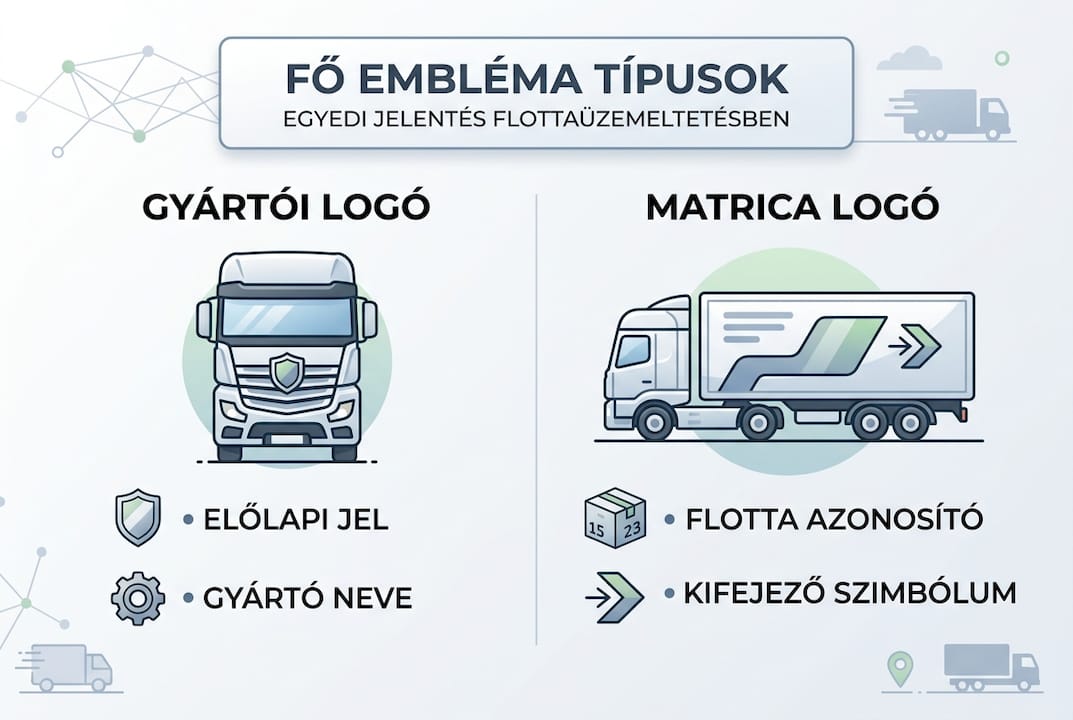
Not all emblems are the same, nor do they serve the same purpose. Three main categories are worth distinguishing: the hood ornament, the manufacturer's logo, and the sticker. Each addresses a different target group and has a different application area.
The hood ornament
The hood ornament mainly appears on vintage and classic trucks. Made of metal, often chrome or nickel, it is located on the front of the vehicle. The enamel-fired, nickel-plated hood ornaments of the Csepel Automobile Factory are now valued as antiques. These pieces are irreplaceable in restoration and are crucial for preserving the original condition.

The manufacturer's logo
This is the most common form on modern trucks. It is usually made of plastic or metal and follows the manufacturer's standard designs. Its function is twofold: to identify the manufacturer and to ensure the visual uniformity of the vehicle. Replacement is usually required if it suffers mechanical damage or if the material ages.
The sticker and custom logo
For fleets, this is the most common branding tool. It is flexible, easily updated, and perfectly suitable for implementing uniform fleet design. It allows the transport company to display its own logo, contact information, and brand elements on each of its vehicles.
| Emblem type | Material | Primary function | Replacement frequency |
|---|---|---|---|
| Hood ornament (vintage) | Metal, enamel | Identity, heritage | Rare, during restoration |
| Manufacturer's logo | Plastic, metal | Manufacturer identification | 5-10 years |
| Sticker, logo | Vinyl, adhesive | Company branding | 3-5 years |
The choice is not always obvious. Cost-effectiveness, aesthetic expectations, and the age of the vehicle all influence the decision. Some important considerations:
- For a vintage truck, the primary goal is to retrieve and retain the original hood ornament.
- For a commercial fleet, a combination of stickers and manufacturer logos provides the best branding effect.
- For a unique appearance, a custom-designed logo is also an option, which can be custom-made.
Pro tip: Your own branded beanie and other accessories can also display elements of the fleet's image, strengthening team unity and professional appearance beyond the vehicles.
The value of vintage emblems steadily increases over decades, especially if the original material and manufacturing technique remain authentic. An enamel-fired Csepel hood ornament is not just beautiful, but also an industrial historical document.
When developing a truck fleet branding strategy, choosing the type of emblem is one of the first and most important decisions. This determines the long-term visual character of the vehicle.
Installation, maintenance, and replacement process from a workshop perspective
Emblems don't just stick themselves on. Adhering to the correct installation process is essential for the emblem to remain in place durably and aesthetically. For fleet managers, this is particularly critical, as if a single vehicle's emblem peels off, bends, or fades, it detracts from the uniform appearance of the entire fleet.
Step-by-step: installing emblems
The installation process typically takes between 30 and 45 minutes if all preparation steps are followed.
- Surface cleaning: The surface receiving the emblem must be thoroughly cleaned with a degreaser. All dirt, old adhesive residue, and dust must be removed. If this step is omitted, the emblem will not adhere properly.
- Precise positioning: Before final attachment, it's advisable to temporarily position it with adhesive tape and check for straightness and symmetry from multiple angles.
- Fastening: For stickers, the film should be gradually removed while expelling air bubbles with a squeegee. For mechanically attached emblems, screws need to be tightened evenly to avoid pressure point discrepancies.
- Post-check: After 24 hours, it's worth checking if the emblem has lifted at a corner or if any air pockets have formed under the sticker.
Maintenance routine
Emblem maintenance is simple but requires regular attention. The correct choice of cleaning tools is critical: a brush that is too stiff can scratch the surface, especially on glossy or enameled pieces.
| Maintenance task | Frequency | Tool |
|---|---|---|
| General cleaning | 1-2 times a month | Soft sponge, neutral detergent |
| Deep cleaning | Quarterly | Interior cleaner |
| Polishing, protection | Bi-annually | Wax, polish |
| Condition assessment | Annually | Visual inspection |
Pro tip: Do not use strong solvents like acetone or gasoline near emblems. These can damage the adhesive layer, scratch the enamel, and discolor plastic components. Gentle car cleaning is always a safer choice.
Replacement timing
Several factors influence the need for replacement. Weather conditions, exposure to chemicals, and physical damage to the emblem all shorten its lifespan. Generally, it's advisable to review sticker-based solutions every 3-5 years and plastic logos every 5-10 years.
Typical signs for replacement: edges are lifting, color has faded, cracks or breaks have appeared, or the emblem has loosened and is moving. If these signs are noticed in time, it can prevent the emblem from falling off while driving and potentially causing damage.
Truck emblem as a fleet-friendly branding tool
Consistent emblem usage is not a luxury, but a tool. Serious fleet management experience is needed to recognize that visual uniformity generates direct economic value.
The manufacturer's logo and sticker communicate a unified image that is immediately recognizable on the roads. Think about it: if a transport company operates 40 trucks, all equipped with a uniform emblem and logo, the company's name is essentially seen by hundreds of thousands daily on the roads. This is organic, invaluable advertising.
Why customer trust matters?
A professional, branded fleet creates a first impression. A potential client or partner who sees a well-organized, uniformly appearing convoy of trucks on the highway unconsciously judges that company as more reliable. This association is quick and unconscious, but real.
- Visual recognizability: A uniform emblem makes fleet vehicles instantly identifiable in traffic, parking lots, and during loading.
- Customer trust: A neat, consistent image conveys reliability.
- Internal identification: Fleet elements can be easily grouped by emblem or logo, simplifying administration.
- Accident management and complaints: In the case of vehicles with a unique, identifiable image, tracing and administration are faster.
Vehicle tracking and administration
From a fleet manager's perspective, a uniform emblem also offers a lesser-known advantage: it simplifies internal record-keeping. If vehicles are equipped with different branding elements according to different units or regions, maintenance and operational data can be more easily associated with them. This reduces administrative errors and the chance of misunderstandings.
Pro tip: It is advisable to replace the emblems of the entire fleet at once, not piece by piece. Uniform replacement not only yields a visually cleaner result but is also more logistically efficient: one dedicated workshop day is sufficient for the entire fleet, and material procurement is also cheaper in bulk.
Corporate branding practices often deal with how to build and maintain the visual identity of a fleet. The emblem is the cornerstone of this identity.
What few people notice about the significance of a truck emblem
Many smile when we talk about the emblem as a strategic tool. They see it as decoration. Something minor that you stick on once and then forget about. This attitude hides a serious mistake.
A Csepel hood ornament, treated as an antique, fetches significant sums at auction today, while decades ago someone might have thrown it in a corner because it was "just a piece of metal." Professionals in workshops know exactly that details determine long-term value. A vintage vehicle with an original emblem, when restored, commands a much higher price than a replaced or incomplete piece.
In modern fleets, the strategic neglect of emblems also backfires. A faded, torn, uneven sticker-emblem erodes the trust that the company builds with other means. Details communicate even when no one is consciously paying attention to them.
A shift in perspective is needed: the emblem should be seen not as an accessory, but as an investment. Well-maintained, uniform, well-chosen emblems work for the company's reputation for many years. The truck memorabilia review also highlights that conscious preservation can be a rewarding decision in the future.
Useful products for truck emblem maintenance at Convoy
Proper care of emblems does not require a complex toolkit. Convoy's range includes the key products truly necessary for everyday maintenance. Whether it's sticker logos, metal hood ornaments, or simply regular cleaning of the truck's exterior, the right tool will make the job quicker and safer.
A cleaning sponge and brush are basic tools for emblem care, ensuring surfaces are not scratched. To strengthen fleet identity, it's worth checking out the trucker T-shirt, which reinforces team spirit and brand presence beyond the roads. For vehicles embarking on longer journeys, a tire repair kit is an essential safety item, providing greater peace of mind for the fleet manager.
Frequently Asked Questions
What is the difference between a vintage and a modern truck emblem?
A vintage emblem is typically a metal or enamel hood ornament that holds collectible value, whereas a modern logo is most often plastic or a sticker, whose primary purpose is corporate identity.
How often should a truck emblem be replaced?
Replacement is generally recommended every 3-7 years, but the exact period depends on weather conditions, material, and daily wear and tear.
Is the Csepel emblem really a red star?
No, this is a common misconception: the Csepel emblem depicts a spark, referring to the ignition process of an internal combustion engine, not a communist symbol.
What are the steps for applying an emblem?
The application process takes 30-45 minutes: first, the surface must be degreased and cleaned, then the emblem is positioned, finally secured, and a post-application check is performed.