Since the introduction of digital tachographs, the number of serious accidents in freight transport has decreased by 15-30%, yet surprisingly many fleet operators and transport companies are unaware of what this device actually records, when it is mandatory, and how it assists daily operations. The tachograph is not just a regulatory control tool, but one of the most important pillars of safe, legal, and economical transport. This guide will show you what a tachograph actually means, what types exist, when your fleet might be exempt from the obligation, and how to manage data effectively.
Table of Contents
- What does a truck tachograph actually mean?
- How do tachographs work and what types are there?
- Key role in road safety and compliance
- Practical challenges: exemptions, administration, light commercial vehicles
- Data management for fleets: archiving, downloading, compliance
- Behind expert advice: the dilemmas of routine and digitalization
- How your fleet can become safer and more sustainable
- Frequently Asked Questions
Key Takeaways
| Point | Details |
|---|---|
| The tachograph is key | The tachograph is essential for safety, regulatory compliance, and transparent fleet operation. |
| Significant accident prevention | Digital tachographs have reduced the number of serious accidents by over 15%. |
| Exemption rules apply | Not all trucks require a tachograph – administrative exemptions must be known. |
| Data management = fine prevention | Regular data downloading and archiving reduces the chance of inspection fines. |
What does a truck tachograph actually mean?
The word tachograph is of Greek origin: "tachys" (fast) and "graphein" (to write). In everyday professional jargon, it is also commonly referred to as a "menetíró készülék" (travel recording device), and this term accurately describes its purpose: to continuously and reliably record a vehicle's journey.
However, this device is much more than a simple GPS tracker. While a tracker only indicates the vehicle's current position, the tachograph records speed, route, start and stop times, driving and rest periods, thus providing a complete picture of the driver's work and the vehicle's operation.
The most important data recorded by the tachograph:
- Speed: Continuously measures and records, so any speeding or irregular maneuvers can be traced back.
- Distance traveled: Stores accurate mileage data, which can be used for both service tracking and route planning.
- Time intervals: Records driving time, rest periods, waiting, and other activities.
- Driver identification: With a digital tachograph, the driver's card identifies who is behind the wheel.
- Start and stop data: All journey segments are documented, which is crucial for official inspections.
Why is it a key tool in road transport? Because according to EU regulations, transporters must prove that drivers comply with mandatory rest periods and maximum daily/weekly driving times. If this cannot be substantiated, fines can easily amount to hundreds of thousands of forints, and repeated infringements can even lead to the withdrawal of the license.
It's worth considering that among truck safety equipment, the tachograph is the only device that simultaneously protects the driver, the company's legal standing, and other road users. Other safety devices are reactive, while the tachograph is preventative, encouraging disciplined driving by continuously documenting compliance.
From the perspective of daily operations, the tachograph is not just an administrative burden but also a valuable source of data. A well-maintained and regularly read tachograph system helps optimize fuel consumption, plan service appointments, and facilitates the objective evaluation of driver performance.
How do tachographs work and what types are there?
Now that we understand the purpose of the device, let's look at the types a fleet operator might encounter in practice. Technological advancements have created three generations, each with its own application areas and regulatory background.
| Type | Data recording | GPS | When mandatory? |
|---|---|---|---|
| Disc (analogue) | Paper disc | None | Older vehicles |
| Digital | Smart card + internal memory | Optional | Vehicles registered after 2006 |
| Smart Tachograph 2 | Smart card + internal memory | Yes, automatic | New registrations from August 2023 |
Disc (analogue) tachograph: The oldest version, where a rotating paper disc records speed and time mechanically. Although increasingly rare, it is still actively used on some older vehicles. Its disadvantage is that the discs are easily lost, difficult to retrieve, and official inspections are slower with them.

Digital tachograph: The modern successor to the analogue device, which stores data in an encrypted, tamper-resistant format. A driver card is essential for its use, and data can be downloaded and archived, simplifying administration. Tachograph ribbon supplies for digital tachographs are essential for replacing the paper rolls needed for printing.
Smart Tachograph 2 (ITS2): The most modern generation, which automatically records border crossings, loading locations, and GPS data. ITS2 is not just a passive data recorder but actively communicates with nearby enforcement devices, allowing for roadside checks without stopping. From August 21, 2023, it is mandatory for all newly registered heavy goods vehicles over 3.5 tons.
The phasing of the smart tachograph transition is important for fleet development plans:
-
- From August 21: ITS2 is mandatory in all newly registered trucks over 3.5 t.
-
- From August 19: Existing digital tachographs must also be replaced with ITS2 for vehicles operating in international transport.
- By 2026: Affected fleets must be fully compliant with the ITS2 standard for cross-border transport.
Pro tip: If the calibration deadline for several vehicles in your fleet is approaching soon, it is worth combining it with the transition to ITS2. This way, you simultaneously address compliance obligations and technological development, which is a more cost-effective solution in the long run.
Key role in road safety and compliance
After understanding the types, let's see what concrete results tachograph usage yields in everyday transport. The numbers speak for themselves, but it's important to understand the underlying connections as well.
| Indicator | Change after digital tachograph |
|---|---|
| Number of serious accidents | 15-30% reduction |
| Risk due to fatigue | 40% reduction |
| Measured infringements | 90% reduction |
These data are not random. The 90% reduction in infringements measured after the introduction of digital tachographs shows that drivers behave more consciously when they know that every move is recorded. This is the so-called "observation effect," which is not coercion but a natural human reaction.
Reducing accidents due to fatigue is particularly important, as this is one of the biggest risk factors in long-haul transport. When a driver knows that rest periods are verifiable, they avoid voluntary overtime and shortening rest.
The most important EU and Hungarian legal frameworks:
Regulation (EC) No 561/2006 of the European Parliament and of the Council prescribes the maximum daily and weekly driving times, while Regulation (EU) No 165/2014 contains the specific technical and administrative requirements for tachograph use. In Hungary, these rules are transposed into national law by Act I of 1988 on Road Transport and related decrees.
Keeping track of tachograph regulation changes is particularly important in 2026, as the smart tachograph rollout schedule and the regulation of lower categories are continuously being refined.
Pro tip: During official inspections, tachograph data can be checked retrospectively for at least 28 days on the card and 365 days in the device's memory. If this data is incomplete or manipulated, the fine amount can even double.
It is worth knowing that control authorities can hold not only the driver but also the fleet manager accountable if it can be proven that the company regularly ignored tachograph data. The "I didn't know" argument does not protect against sanctions.
Practical challenges: exemptions, administration, light commercial vehicles
After outlining the main guidelines for compliance, let's address the specific situations that leave many transporters and fleet operators with questions.
Not all heavy goods vehicles are required to use a tachograph. Precise knowledge of the exemptions can save smaller companies a lot of unnecessary administration and investment.
When is tachograph usage not mandatory?
Exempt cases include:
- Vehicles under 3.5 tons: Smaller heavy goods vehicles are generally exempt from the obligation, although different rules may apply in some member states and for certain types of activities.
- Short international journeys: If the journey does not exceed 6 hours of driving time and 100 km, some exemptions may apply.
- Rare, occasional use: If the vehicle is not involved in regular commercial traffic, but only sporadically, for example, for agricultural transport.
- Non-commercial transport: For example, humanitarian transport by volunteer organizations under certain conditions.
Light commercial vehicles and the 2026 challenges:
The regulation of vehicles around 3.5 tons is constantly tightening. Although the smaller category is currently exempt, based on EU trends, more and more member states are extending the tachograph obligation to smaller commercial vehicles, especially in urban delivery and last-mile delivery segments.
The role of the tachograph sensor is crucial for accurate measurement, as a sensor failure affects the accuracy of the entire recording system. In smaller fleets, this component can be particularly easily overlooked during maintenance.
Administrative best practices for fleet operators:
- Maintain up-to-date records of which vehicle falls under which tachograph category.
- Document the legal basis for exemptions as well, do not rely solely on "it hasn't been demanded before."
- Designate a responsible person for regular downloading and archiving of tachograph data.
- Conduct at least one internal audit annually to check compliance.
Pro tip: If you are uncertain whether a tachograph obligation applies to a particular vehicle, it is advisable to consult a transport law expert, as subsequent fines and legal costs can often far exceed the cost of preventive advice.
Data management for fleets: archiving, downloading, compliance
After exceptions and challenges, let's conclude with the most administrative, but perhaps most neglected, area: data management. Many fleets have modern tachograph systems, but data management falls short of the required standard.
Steps for data downloading and archiving:
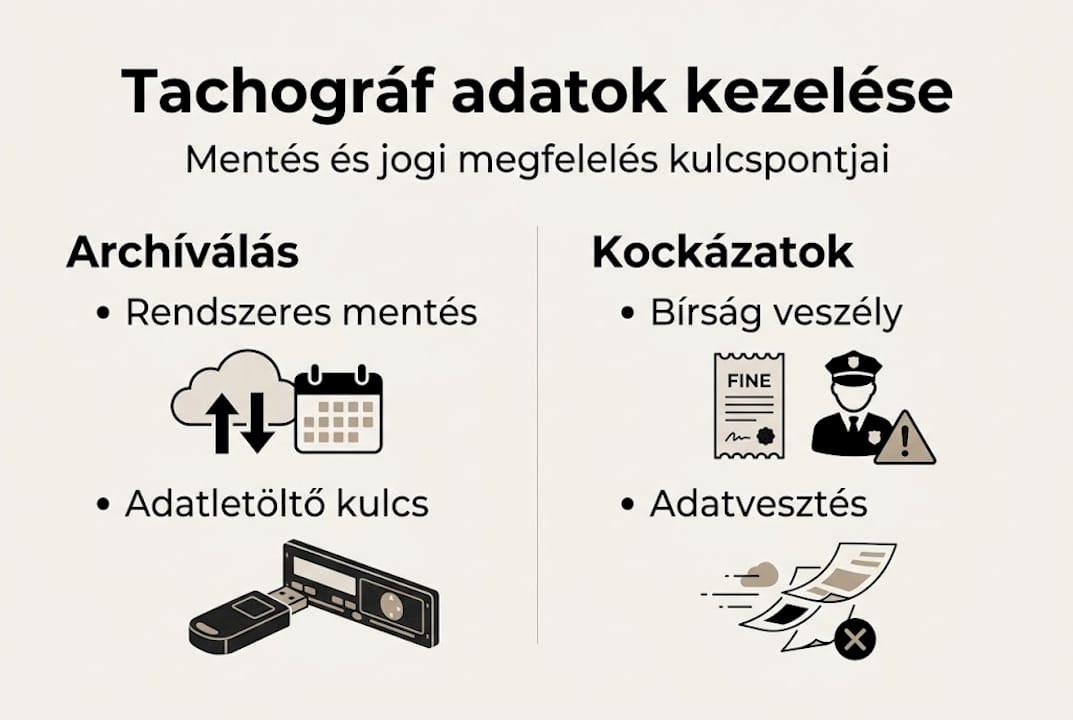
- Driver card download: It is mandatory to download the driver's card at least every 28 days, but in practice, it is recommended to do so weekly to ensure no data is lost.
- Device memory download: The memory of the vehicle's built-in tachograph must be downloaded every 90 days, but a bi-weekly download is safer.
- Data archiving: Downloaded files must be retained for at least 1 year, but a 2-3 year archive is recommended for legal security.
- Data review: It is not enough to download; data must also be regularly analyzed to identify infringements in a timely manner.
- Backup copies: Store data in at least two different locations: on an on-site server and in a cloud-based solution.
Regular data downloading and archiving not only reduces the risk of fines but also enables efficient route planning and significant cost reduction, as actual driving and rest times can be analyzed retrospectively.
What does legal compliance mean for data management?
GDPR also applies to tachograph data, as it qualifies as personal data (the driver can be identified from it). This means that the data processing policy must record the legal basis, purpose, and retention period for tachograph data processing. In case of negligence, the data protection authority can also impose sanctions, in addition to the transport authority.
The use of a tachograph data download key is essential for quick and reliable data backup. This device allows the driver's card and the device's memory to be downloaded in minutes, even on the road.
What problems does neglected data storage cause?
The consequences of neglected downloads are twofold. Firstly, data can be overwritten if the device's memory becomes full, leading to untraceable periods. Secondly, the authority treats data deficiency as an existing infringement, and the burden of proof falls on the transporter.
Pro tip: Automatic download systems, which instantly download data via Wi-Fi when the vehicle arrives at the depot, have become affordable for smaller fleets by 2026. Implementing such a system can save several hours per week compared to manual administration.
Behind expert advice: the dilemmas of routine and digitalization
After the detailed practical introduction, let's consider what all this means in everyday life. Many people think that digitalization simplifies tachograph administration. This is partly true, but the reality is more nuanced.
ITS2 and automatic data download have indeed reduced manual errors. At the same time, the installation, updating, and troubleshooting of new systems have created new types of challenges that smaller haulage companies are not prepared for. The biggest challenge in 2026 will be the administration of smaller vehicles, and the market is also shifting towards groupage transport, where managing smaller, mixed fleets is a particularly complex task.
In our opinion, technology can never fully replace human experience and the discipline of daily routine. A reliable system only protects if someone regularly monitors it. Keeping up with tachograph innovations, responding in a timely manner to regulatory changes, and maintaining internal audits are more important than anything. Technology is a tool, but it is up to the decisions of a forward-thinking fleet manager whether it truly brings benefits.
How your fleet can become safer and more sustainable
Finally, we offer some specific tools and suggestions to help you achieve compliance and convenience. Convoy.hu offers everything a professional fleet operator needs for the efficient operation of a tachograph system.
With data download tools, cards and devices can be saved in minutes, while the replacement of tachograph chart paper and sensors ensures accurate measurements in all conditions. In addition, Convoy.hu offers a wide range of truck safety equipment, truck cleaning products, and comfort accessories that make drivers' daily work more comfortable and safer. As a reliable partner, we have been serving the needs of the domestic transport industry for over 30 years.
Frequently Asked Questions
What are the exceptions to mandatory tachograph use for trucks?
Exceptions typically apply to vehicles under 3.5 tons, rarely used, short international or non-commercial vehicles, but these must be documented in all cases.
How often must a tachograph be calibrated?
Calibration is mandatory every two years, or after any chassis or wheel size modification, to be carried out at an authorized workshop.
What are the legal consequences of incorrect or incomplete tachograph data?
Incorrect or incomplete data can lead to serious fines and administrative proceedings, and the failure to regularly archive increases the risk of liability for the fleet manager as well.
Why is it advantageous to archive digital tachograph data?
Regular archiving helps with regulatory compliance and traceability, while reducing the risk of fines and providing opportunities to optimize route planning and fuel costs.