During a roadside check, it can quickly become apparent that the fire extinguisher in the cargo area is expired, the protective gloves are missing, or the orange marking plate is incorrect. These seemingly minor deficiencies not only result in fines but also pose real accident risks. The quality and safety of working days spent in a truck are fundamentally determined by the equipment surrounding us during the journey. Regulations are becoming stricter, and authorities are becoming more precise about what to look for, so every driver and fleet manager must know exactly what they are required to carry on board and why.
Table of Contents
- Types and Function of Truck Equipment
- Regulatory Compliance and Mandatory Equipment
- Impact of Truck Equipment on Safety and Functionality
- Practical Tips for Choosing Truck Equipment
- Expert Perspective: What Few Consider Regarding Truck Equipment
- Featured Equipment and Accessories from Convoy Truck Shop
- Frequently Asked Questions
Key Takeaways
| Point | Details |
|---|---|
| Safety First | Proper truck equipment reduces the chance of accidents and complies with regulations. |
| Regulatory Compliance | The list of mandatory equipment for ADR transport is stricter, but it is also critical for daily operations. |
| Efficient Operation | Well-chosen accessories increase vehicle functionality and driver comfort. |
| Regular Inspection | Always check the condition of the equipment before departure and during maintenance. |
| Practical Tips | Prioritize quality and regulatory compliance when purchasing. |
Types and Function of Truck Equipment
Now that we've covered the importance of equipment, let's look at the main categories of this equipment and why each plays a different role.
The equipment used on trucks meets a wide range of needs. Some serve solely a safety function, others enhance daily comfort, and some are directly mandated by law. It is worth getting acquainted with the types and functions of individual accessories in detail, as the right choice saves time and money in the long run.
Safety Equipment
Safety equipment includes all tools that provide the first line of defense in an emergency. The fire extinguisher is the most well-known example: it can handle fires in engine compartments and materials ignited in the cabin, if it is of the appropriate type and valid. The high-visibility vest also falls into this category, as does the first aid kit needed for immediate assistance.
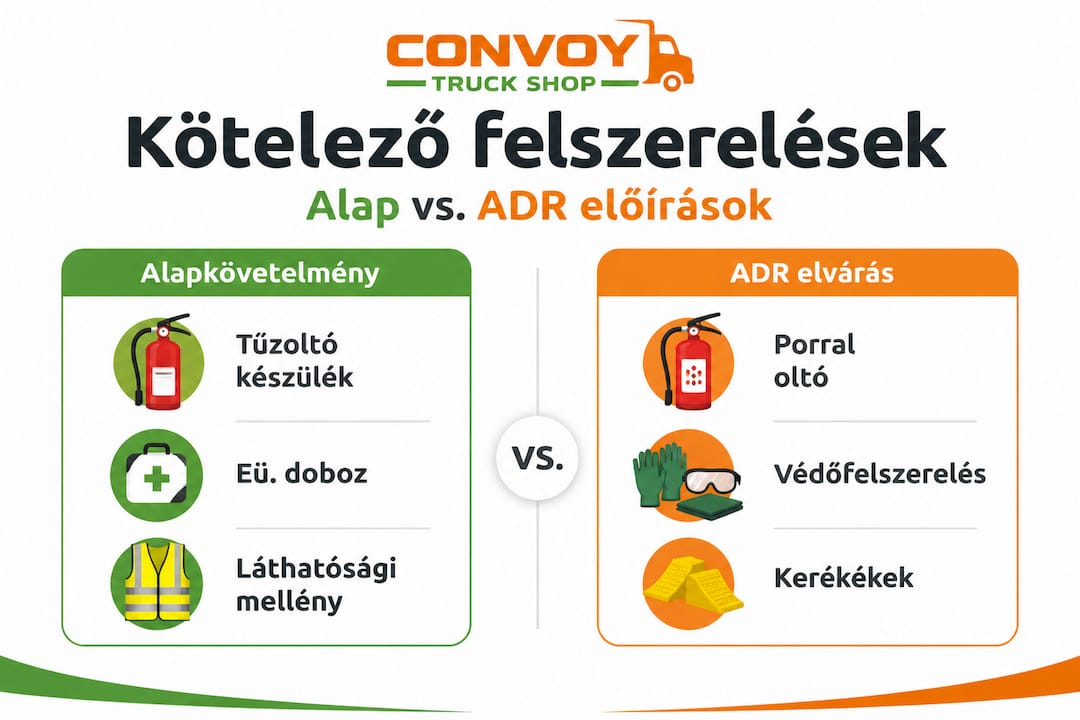
Among the mandatory equipment for ADR transport are dry powder fire extinguishers, various protective equipment, chocks, special lamps, and orange marking plates. These are not optional but are legally required elements. Failure to comply can lead to serious penalties, which may include not only fines but also the immediate cessation of transport.
Comfort and Operational Accessories
Driver comfort is not a luxury but a safety factor. A driver working in a well-lit, organized cabin is less fatigued and more focused. Appropriate cup holders, storage solutions, ergonomic seat cushions, and cabin lighting all contribute to enabling the driver to concentrate on the road.
Looking at real examples of truck accessories, it is clear that even a good quality windshield wiper matters: in poor visibility, it is the only tool that keeps the windshield clear and ensures proper visibility.
Comparison Table: Equipment Categories
| Equipment Category | Examples | Main Purpose | Mandatory? |
|---|---|---|---|
| Safety equipment | Fire extinguisher, first aid kit, high-visibility vest | Emergency management | Yes |
| ADR special tools | Dry powder extinguisher, protective gloves, chocks, orange plate | Transport of dangerous goods | Yes (for ADR) |
| Comfort accessories | Cup holder, seat cushion, storage units | Driver comfort | No |
| Operational tools | Windshield wiper, lamp, cargo restraint | Daily operation | Partially |
| Navigation and communication devices | GPS, radio, dashcam | Orientation, monitoring | Partially |
What to look for in each category?
A few important aspects are worth highlighting:
- For safety equipment, always check the expiration date and valid certification.
- For ADR equipment, the correct type and performance are mandatory; any fire extinguisher is not sufficient.
- For comfort accessories, secure fastening and compatibility with the vehicle's interior are key.
- For operational tools, regular replacement and maintenance are essential, otherwise, they become a safety risk.
- For navigation devices, up-to-date software and battery condition determine reliability.
Regulatory Compliance and Mandatory Equipment
Now that we understand the types of equipment, let's examine what specific expectations regulations set and where the most common deficiencies might occur.
During Hungarian roadside checks, authorities systematically inspect mandatory equipment. It's not enough for the device to be present in the vehicle; it's also important that it is in proper condition and of the type compliant with regulations. Every driver and fleet manager must know the detailed list of accident prevention equipment.
ADR Regulations: The Highest Expectations
ADR, the European agreement governing the road transport of dangerous goods, prescribes the strictest equipment requirements. The list of mandatory ADR equipment includes dry powder fire extinguishers, personal protective equipment, wheel chocks, special lamps, and orange marking plates. These are not optional but are strictly mandatory for all ADR shipments.
ADR regulations also include different requirements by class. Different equipment is needed for the transport of explosives than for toxic gases. Therefore, fleet managers must know exactly what shipments each of their vehicles is carrying and equip the vehicle accordingly.
Focus Points of Official Inspections
Inspectors typically focus on the following:
- Checking the presence and validity of fire extinguishers – an expired device is just as bad as having none at all.
- Examining the completeness of the first aid kit – missing materials, gloves, or bandages will be penalized.
- High-visibility vest and warning triangle – these are mandatory on all trucks, not just for ADR.
- Correctness of orange marking plates and UN numbers – for ADR transport, the data must precisely match the documents pertaining to the shipment.
- Wheel chocks and supports – particularly critical in mountainous areas and on longer inclines.
Data Table: Mandatory Equipment and Sanctions
| Equipment | Basic Obligation | ADR Obligation | Severity of Sanction |
|---|---|---|---|
| Fire extinguisher | Yes | Yes (dry powder) | High |
| High-visibility vest | Yes | Yes | Medium |
| First aid kit | Yes | Yes (extended) | Medium |
| Orange marking plate | No | Yes | High |
| Protective gloves, safety shoes | No | Yes | Medium |
| Wheel chock | Partially | Yes | Medium |
Practical Steps to Maintain Regulatory Compliance
Compliance is not a one-time task but requires continuous attention. Here are the most important steps in order:
- Compile: For each transport type and vehicle category, define the list of mandatory equipment based on current regulations.
- Procure: Purchase only certified and approved equipment, and retain invoices.
- Check: Always review the equipment list and check expiration dates before departure.
- Document: Keep a maintenance log for equipment, especially for ADR transport.
- Replace: Immediately replace expired or faulty equipment; do not postpone it.
Knowing the comfort and safety aspects of interior equipment, it is clear that these steps not only help with inspections but also establish the safety of the driver's daily work.
Impact of Truck Equipment on Safety and Functionality
If we now understand what the law prescribes, let's see exactly how these elements affect daily safety and operation, and in what specific situations they prove their worth.
Role in Accident Prevention
The accident prevention effect of equipment often becomes apparent only when it is needed. In the event of an engine fire, the right fire extinguisher can save minutes that can decide between life and death. The high-visibility vest and warning triangle, in case of a breakdown, warn other drivers of the danger, reducing the likelihood of chain collisions.
“Mandatory equipment for ADR transport – dry powder fire extinguishers, protective equipment, chocks, lamps, and orange marking plates – are not bureaucratic obligations, but tools for preserving life in the most critical moments.”
Therefore, the presence and good condition of the correct equipment directly influence whether an unexpected event will be a minor incident or a serious accident. It is no coincidence that authorities pay special attention to this during inspections.
Proper Tools Increase Efficiency
Improving functionality is less spectacular but equally important. In a well-lit, organized cabin, it is much easier to find necessary documents or tools. The correct truck lighting settings, for example, not only provide comfort but also offer a real safety advantage during night driving.
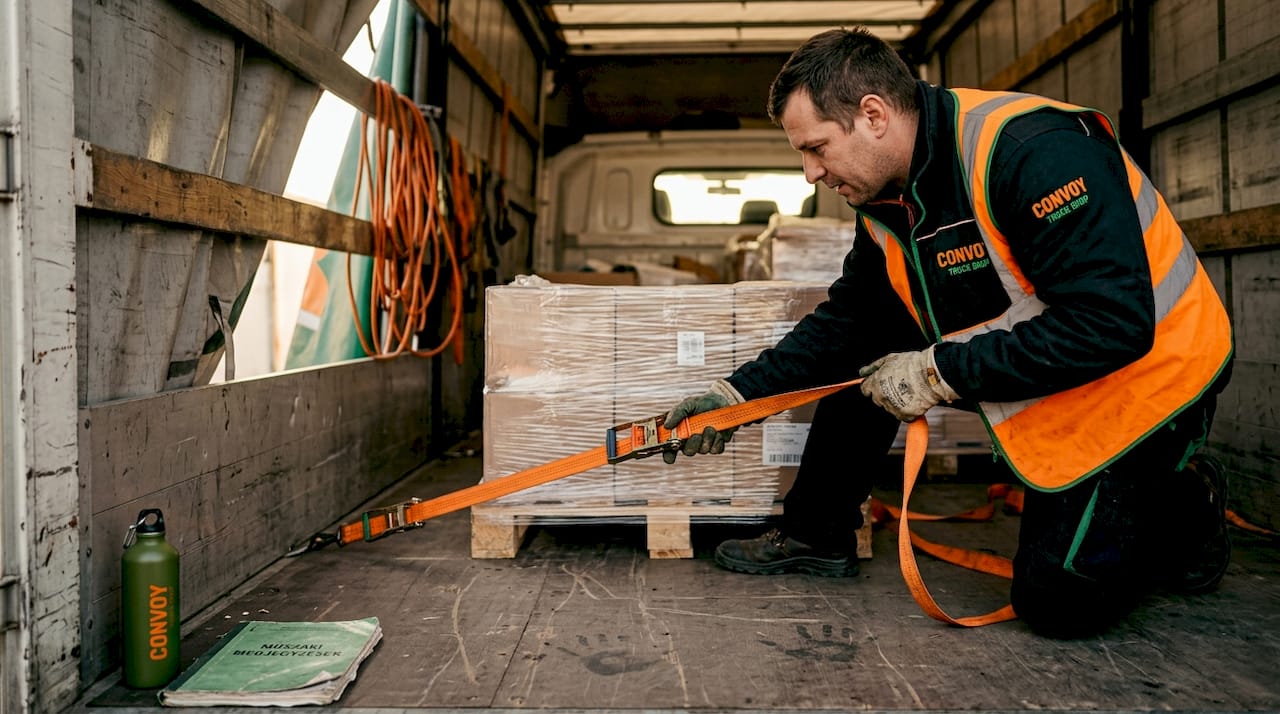
Cargo securing devices, such as lashing straps and belts, prevent the transported goods from shifting during transit. This may seem like a logistical issue at first, but an accident can actually occur if the cargo suddenly shifts and changes the vehicle's center of gravity.
Safety Impact of Comfort Equipment
Pro tip: The right seat cushion and lumbar support not only provide comfort but also reduce driver physical fatigue, which directly affects reaction time and alertness. A fatigued driver reacts 20 percent slower than a well-rested one.
Thus, comfort equipment is not a luxury category but an indirect safety tool. A cup holder, for example, prevents the driver from reaching for a drink and taking their eyes off the road. Well-placed storage units reduce the need to search in the cabin while driving.
Comfort accessories are particularly important in the following areas:
- For long hauls, ergonomic equipment prevents pain and fatigue caused by prolonged sitting.
- During night driving, proper interior lighting helps the driver orient themselves quickly if needed, without being blinded.
- In winter and summer, climate control aids maintain the appropriate temperature, preventing drowsiness.
- In city traffic, well-placed mirrors and auxiliary cameras reduce the risk of accidents caused by blind spots.
- During loading, appropriate footwear and gloves protect the driver from injuries that could lead to incapacitation.
Practical Tips for Choosing Truck Equipment
Now let's look at how to choose or replace equipment to ensure the vehicle operates safely and functionally in the long run.
Common Mistakes When Choosing Equipment
One of the most common mistakes is making decisions based on price. The cheapest fire extinguisher or first aid kit might meet basic requirements on paper, but may not perform adequately in a real situation. Quality and certification are more important considerations than momentary savings.
Another typical mistake is compiling an equipment list once and then completely neglecting it. Expired equipment is just as dangerous as missing equipment. Every item on the ADR mandatory equipment list must be a valid, well-maintained example present in the vehicle for every single journey.
Many people also neglect fitting the equipment to the vehicle type and transport task. A truck performing ADR transport needs different equipment than a standard cargo carrier. The equipment list should always be tailored to the specific task.
How to Prioritize Equipment Procurement?
We recommend the following order of prioritization:
- Legally mandatory equipment – these come first, as without them, the vehicle cannot legally depart.
- Lifesaving safety equipment – fire extinguisher, first aid kit, emergency blanket; never skimp on these.
- Accident prevention equipment – high-visibility vest, warning triangle, signal light.
- Cargo securing equipment – straps, belts, fasteners, which serve the safety of both the cargo and the driver.
A detailed presentation of accident prevention equipment helps to accurately understand which tool provides protection in what specific situation, and why it is worth investing in them.
The importance of maintenance
Pro tip: Keep a digital maintenance log where you record the condition of the equipment before each departure. A simple checklist application allows for a quick pre-departure inspection routine, and it can be life-saving not only during official inspections but also in real emergencies.
Equipment maintenance is not just about compliance with regulations. The active ingredient in an outdated fire extinguisher can settle and lose its effectiveness, even if the expiry date has not passed. Rubber items, such as gloves and seals, can harden over time and lose their protective properties.
It is advisable to check the equipment according to the following schedule:
- Before each departure: Visually check that all equipment is present and accessible.
- Once a month: More detailed inspection, including expiry dates and the condition of the tools.
- Quarterly: Pressure check of the fire extinguisher, comprehensive examination of the first aid kit's completeness.
- Annually: Full equipment audit, replacement of all tools reaching their end of life.
Expert perspective: what few consider regarding truck equipment
Experience shows that the world of truck equipment is much more nuanced than it appears at first glance. Over the years, we have realized that drivers and fleet managers who take equipment seriously do so not just for official inspections. They represent a different mindset.
Even the smallest accessory should not be neglected. A malfunctioning flashlight can create a life-threatening situation during a nighttime flat tire if the driver cannot see both the wheel and the traffic at the same time. A worn protective glove can fail exactly when it is most urgently needed, for example, during a leak from a vehicle carrying chemicals.
The routine pre-trip inspection, which many consider an unnecessary bureaucratic obligation, is actually one of the most important habits an experienced driver can develop. Those moments when you go through the checklist do not take minutes away, but can save lives. The careful selection of interior equipment also fits into this mindset: everything in the cabin has its place and purpose.
There is a lesson that can only be gained from real experience. After a long night drive, on a bad road, when the first aid equipment was exactly in place and in perfect condition, the driver does not think about regulations, but about having made a good decision by taking care of it in time. This confident knowledge is what truly matters.
Contrary to popular belief, it is not expensive equipment that makes a vehicle safe. Regularity, consistency, and meticulous attention are what make a real difference. A low-value tool that is regularly checked and replaced when necessary is worth more than expensive equipment that no one has looked at for years.
Featured equipment and accessories from Convoy Truck Shop's range
After real-world experiences, let's see how all this can be easily and quickly acquired in practice. The Convoy.hu range contains exactly the tools discussed in this article: equipment that helps with safety, functionality, and regulatory compliance.
If you're thinking about poor visibility or winter weather, the wiper blade for Mercedes trucks is exactly the right tool for keeping the windshield clean. In the event of a flat tire, when every minute counts, the tire repair kit designed for trucks offers a safe and quick solution for roadside repairs. For cargo securing, quality cargo lashing straps are essential, guaranteeing that the shipment will not move during transit with a load capacity of 250 kg. Convoy.hu supports professionals with 30 years of experience, so you can find all the necessary equipment in one place.
Frequently asked questions
What equipment is mandatory for ADR transport?
Mandatory equipment for ADR transport includes powder fire extinguishers, personal protective equipment, wheel chocks, special lamps, and orange marking plates, all of which must be valid and in appropriate condition.
What are the consequences of missing equipment?
Authorities can impose fines and even immediately halt transport, and missing equipment can also pose a direct life threat to the driver and others in an emergency.
How can the regulatory compliance of equipment be checked?
The equipment list must be compiled based on current official regulations and ADR rules, then regularly inspected and documented, preferably before every transport.
How often should equipment be checked?
It is advisable to check equipment visually before every departure, more thoroughly monthly, technically quarterly, and with a comprehensive audit annually, as expired equipment can be penalized just as much as incomplete equipment.
Recommended
- Truck safety equipment: 50% fewer accidents – Convoy Truck Shop HU
- Truck interior equipment: comfort and safety – Convoy Truck Shop HU
- Tire repair kit for trucks – Convoy Truck Shop HU
- Truck tire maintenance: longer lifespan, greater safety – Convoy Truck Shop HU
- Vehicle security: the latest innovations to combat theft