Most drivers think that vehicle lighting simply means: having light to see on the road. This is a serious misconception, leading to significant fines and even accidents every year. The reality is that modern truck lighting is a complex system encompassing safety, traffic regulations, homologation, and technological advancements. If you've installed an LED without verifying its legal compliance, you're taking a serious risk. In this guide, we'll walk you through everything you need to know about vehicle lighting: from types and regulations to maintenance.
Table of Contents
- Fundamentals of Vehicle Lighting: Role and Types
- Comparison of Traditional and Modern Lighting Technologies
- Legal Background, Homologation, and Common Pitfalls
- Tips for Maintaining and Upgrading Your Truck's Lighting System
- The Professional Approach: What Does True Lighting Safety Mean?
- Related Solutions from Convoy Truck Shop's Offerings
- Frequently Asked Questions
Key Takeaways
| Point | Details |
|---|---|
| Lighting is Essential | Proper vehicle lighting saves lives, aids visibility, and complies with regulations. |
| Advantages of Modern Technology | LED lighting is more durable and efficient, but only safe with proper adjustment and homologation. |
| Professional Maintenance | Regular checks and homologation are crucial for long-term safety. |
| Avoiding Typical Errors | Incorrect adjustment or unapproved lighting can lead to fines and accident risks. |
Fundamentals of Vehicle Lighting: Role and Types
Vehicle lighting is not just about bulbs and lights. It's a system where each element performs a specific task, and the absence or malfunction of any single element poses a direct danger to the driver and other road users.
What do we mean by vehicle lighting?
In the case of trucks and commercial vehicles, the term vehicle lighting refers to all light sources emitted or reflected by the vehicle. This includes position lights, dipped and main beam headlights, fog lights, brake lights, turn signals, license plate lighting, and often work lights. Each of the different types of lighting has its own regulations, adjustment requirements, and lifecycle.
The "see and be seen" principle
These two words best summarize the essence of vehicle lighting. The driver must see the road section, obstacles, pedestrians, and other vehicles. But it's equally important that other drivers also see the truck, especially in poor visibility conditions, fog, rain, or at night. Therefore, understanding the meaning and proper use of warning lights is fundamental safety knowledge for all professional drivers.
The role of daytime, nighttime, and special illumination
During the day, daytime running lights (DRL) and position lights ensure visibility. At night, dipped and main beam headlights take center stage. In special situations, such as warehouse work, reversing, or on foggy roads, work lights and fog lights become key elements. These should not be swapped or omitted, as each has precise regulatory and safety functions.
A brief overview of the main light sources
Currently, four main light source types dominate the truck market:
- Halogen: The classic solution, inexpensive, easy to replace, but high energy consumption and short lifespan. Still found on many older fleet vehicles today.
- Xenon (HID): Stronger and more efficient than halogen, typically used in projector headlights. More expensive, but longer lifespan.
- LED: Energy-efficient, long-lasting, quick to react. However, as the incorrect application of LED headlights demonstrates, if poorly adjusted, it can blind oncoming drivers, and in Hungary, homologation is required for legal use, otherwise you risk a fine.
- Laser and OLED: These are mainly appearing in passenger cars for now, but are slowly making their way into the heavy-duty vehicle market.
Regarding vehicle safety equipment, it must be emphasized that lighting is one of the most frequently overlooked areas, even though in the event of an accident, it is the first thing authorities check.
Comparison of Traditional and Modern Lighting Technologies
After understanding the basic types, it's worth delving into the technological differences so drivers and fleet managers can consciously decide which lighting to prefer. Not everything modern is necessarily better, and not everything traditional is necessarily outdated.
Why are fleets increasingly switching to LED?
Over the past ten years, LED technology has brought such advancements in efficiency and durability compared to halogen that fleet managers are increasingly preferring it. An average LED lamp has a lifespan of between 30,000 and 50,000 hours, while a halogen bulb typically fails between 500 and 1,000 hours. This alone represents huge maintenance savings, especially for large fleets where dozens of replacements may be needed monthly.
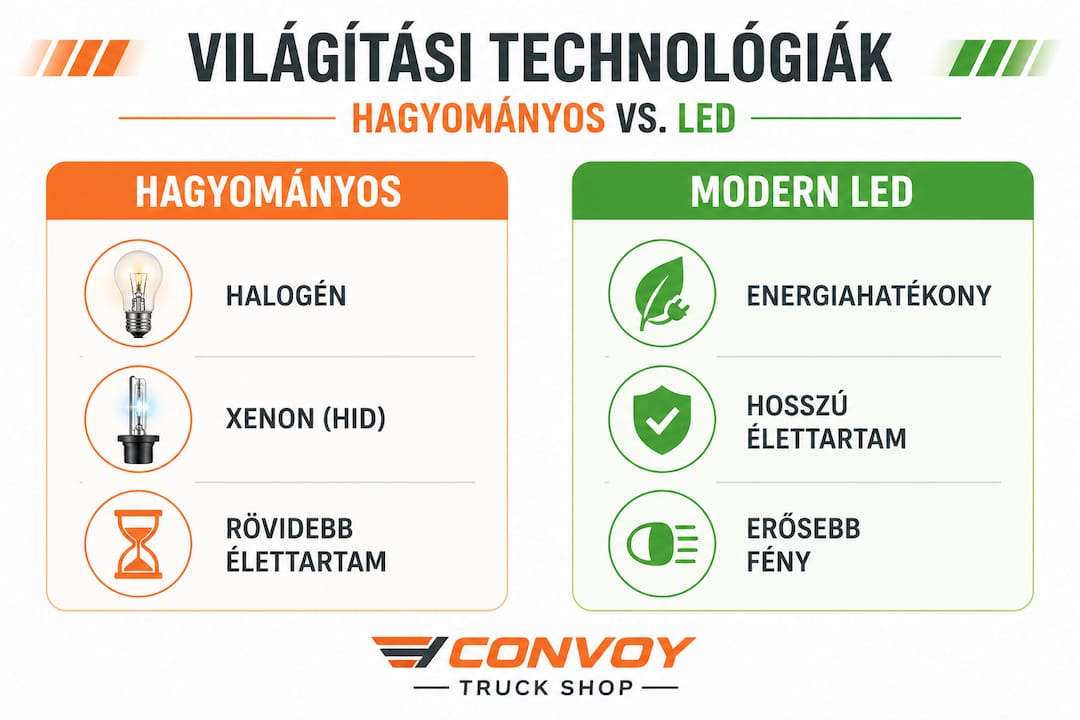
The difference in energy consumption is also noteworthy. An LED headlight typically consumes 30-50 percent less energy than its halogen counterpart, which, on trucks where the electrical system load is already high, means noticeable fuel savings in the long run.
Comparative table: halogen, xenon, and LED
| Feature | Halogen | Xenon (HID) | LED |
|---|---|---|---|
| Brightness (lumens) | 1,000 - 1,500 | 3,000 - 4,000 | 2,500 - 6,000 |
| Power Consumption | High | Medium | Low |
| Lifespan | 500 - 1,000 hours | 2,000 - 3,000 hours | 30,000 - 50,000 hours |
| Maintenance Requirement | High | Medium | Low |
| Price (unit price) | Low | High | Medium - High |
| Homologation Required? | No | Yes | Yes |
| Glare Risk | Low | Medium | High (if poorly adjusted) |
As the table shows, LED headlights clearly win in terms of lifespan and energy efficiency. However, in addition to the benefits of efficiency and durability, it should also be noted that reflector lamps are less glaring than projector solutions, which is an important aspect from a road safety perspective.
Projector versus reflector headlights
This difference is less known but extremely important. In a projector (also known as condenser) headlight, light is focused using a lens, creating a sharp cutoff line. In a reflector headlight, light scatters from mirrored surfaces. If you put an LED into a reflector lamp originally designed for halogen, the light scatters at a completely different angle and can blind oncoming drivers. This is not only dangerous but also illegal.
Pro tip: If you switch to LED, never just change the bulb: check that the light housing is compatible with LED, and have the headlight angle measured by a professional. This will help you avoid fines and the risk of accidents.

The role of lighting technologies in fleet maintenance is gaining increasing attention, and the best results always come from a combination of conscious technology choice and regular inspection.
Legal Background, Homologation, and Common Pitfalls
After the technological overview, it's important to discuss legal compliance and the most common mistakes made. In Hungary, road traffic regulations precisely define what lighting can be used on trucks and under what conditions.
What is homologation, and why is it mandatory?
Homologation is an official approval procedure where a given lamp or light source complies with European Union and Hungarian traffic standards. As indicated by legal obligations, in Hungary, homologation is required for the legal use of LED-based lighting; without it, fines can be imposed, and the vehicle may even be withdrawn from traffic.
Homologated products usually show an “E” mark and a number (e.g., E1 = Germany, E5 = Sweden, etc.), indicating which EU member state approved it. If you don't see this on the purchased lamp, it is highly likely not suitable for road traffic.
“Installing non-homologated LED headlights in a road vehicle in Hungary is considered a traffic offense and can lead to severe penalties, including the withdrawal of the vehicle from traffic.”
Typical errors that can lead to fines
The following errors are the most common based on the experience of official inspections:
- Installation of non-homologated LEDs: The most common mistake. Cheap LEDs purchased online often do not have valid homologation.
- Incorrect headlight adjustment: If the headlight angle is wrong, it can blind oncoming drivers. This can be immediately detected during an inspection.
- Damaged or discolored lamp housing: Reduces light efficiency and can be considered non-compliant.
- Improper use of fog lights: Using fog lights without actual fog can also result in a fine.
- Missing or non-functional license plate illumination: This fault is regularly discovered during night inspections, especially on older trailers.
- Absence or incorrect placement of position lights: Trucks and trailers have precise regulations regarding the number and position of position lights.
First steps towards compliant lighting
Based on lighting adjustment tips, the first and most important step before any modification is to check if the planned product has a valid E-mark. Then, it's advisable to have the headlights professionally adjusted and to repeat this check regularly.
Compliance with road safety regulations is not only a legal obligation but also directly impacts the safety of the driver and other road users. An improperly adjusted headlight can cause a night accident, the consequences of which are far more serious than a fine.
Tips for Maintaining and Upgrading Your Truck's Lighting System
After the previous section on legal and incorrect settings, here are practical steps that every truck driver or fleet manager can take to increase safety and extend the life of their lights.
What to check regularly?
Regular checks are the only way to detect faults in time, before they cause fines, accidents, or costly repairs. Pay attention to these every month:
- Condition of bulbs and LED modules: Check that all lights are working properly, and none are dimming or flickering.
- Connectors and cables: On trucks, vibrations and temperature fluctuations can loosen connectors. Regularly check for corrosion and looseness.
- Lamp housings and seals: A damaged or fogged lamp is not only less efficient but can also be non-compliant.
- Headlight adjustment angle: Have it checked by a professional at least every six months, especially if the vehicle's load profile has changed.
- Position lights and collision protection lights: On trailers, these are regularly damaged, especially on the rear sections.
- Condition and switch of fog lights: Check that they can only be turned on when truly necessary.
The fog light and main beam headlight tips provide detailed guidance on when and how to use them, ensuring not only compliance but also reducing real safety risks.
Tips for LED and traditional light sources
If you use halogen bulbs, always keep spare bulbs for each lamp type in the cabin. Halogen bulbs can be replaced easily and quickly, and a lamp that goes out on the road can be immediately replaced.
For LED systems, replacement is less frequent, but if a problem occurs, it is usually found in the control unit (driver) or connector, not in the LED module itself. In such cases, professional assistance is recommended.
If you find that your LED lamp is blinding oncoming drivers, don't just adjust the angle by trial and error. Regular professional inspection and proper adjustment are critical, because if the angle is wrong, the effect of the deviation is stronger with LED than with halogen.
Pro tip: If you install new LED headlights, for the first week, pay attention to whether you receive feedback from other drivers during evening drives (e.g., with main beam flashes). If so, have them re-adjusted immediately. Timely correction prevents both fines and accidents.
Lamp maintenance step-by-step details how to perform the most common maintenance tasks, while regarding vehicle exterior cleaning, it's important to note that regular cleaning of lamp housings alone can improve light efficiency by 20-30 percent.
When to replace, when to readjust?
Replace bulbs when the light is visibly weaker, flickering, or has gone out. Ask a professional for adjustment if the vehicle's suspension has been changed, a new loading surface has been installed, or if other drivers regularly report dazzling. Simply put: replace for bulb failure, adjust for angle error.
The Professional Approach: What Does True Lighting Safety Mean?
With thirty years of experience in the trucking market, we've learned that most drivers and fleet managers fall into two traps regarding lighting. The first: they think it's enough to do it right once and then not have to deal with it for years. The second: they believe that installing more expensive or modern technology alone solves safety issues.
Both approaches are dangerous. The reality is that even the best LED system will be ineffective or even dangerous if it's not regularly checked and properly adjusted. We've seen fleet owners who spent tens of thousands of euros on LED upgrades, only to find out six months later during an inspection that the headlights' angle was off, and all vehicles were non-compliant.
Technology is no excuse for carelessness. On the contrary: modern systems require more precise adjustment and more conscious maintenance, because if the angle deviates, the effect of that deviation is stronger than with halogen.
Another lesser-known experience is that faulty vehicle lighting can cause problems not only with the authorities but also with the insurance company. If it turns out in an accident that the vehicle was not properly lit or had illegally modified lights, claims settlement can become seriously complicated.
Regarding night driving and visibility, we always say: the question is not whether you can see the road, but whether others can see you, and whether you are blinding them in the process. This dual responsibility is what most drivers underestimate.
Our advice in a nutshell: forget about flashy advertisements and cheap online offers. Buy a homologated product, have it adjusted by a professional, and have it checked every six months. This is not a big investment, but it prevents unnecessary fines, reduces the risk of accidents, and saves money on maintenance in the long run.
Related Solutions from Convoy Truck Shop's Offer
If you want to make your vehicle's lighting safer and easier to maintain, Convoy offers many products that support daily truck operation. Whether it's replacing a position light, upgrading a high beam, or replenishing other safety equipment, you'll quickly find what you need with us.

Our offer includes, for example, the Mercedes wiper blade, which ensures proper visibility in rain and mud, the tire repair kit for trucks, which can save critical minutes in case of an accident, and the complete truck range, where you can find all safety and maintenance products in one place. With over 30 years of experience, we help your fleet in every situation.
Frequently Asked Questions
Why is homologation important for LED lighting in Hungary?
Homologation certifies that the light source complies with current traffic regulations. Without it, the use of inappropriate LEDs in Hungary can result in a fine, and the vehicle may even be withdrawn from traffic.
What lighting is mandatory for a truck?
Position lights, dipped beam, main beam headlights, turn signals, brake lights, and license plate lighting are mandatory; these can be supplemented with fog lights or work lights, but these can only be switched on under specific conditions.
How to avoid LED glare?
Precise professional adjustment and the selection of the appropriate light fixture are key. Reflector lights cause less glare than projector solutions, so LEDs should preferably be installed in a projector housing, and always check the angle.
How do I know when to change a bulb?
If a light shines weaker than usual, flickers, or does not light up at all, it is a clear sign: it's time to change it, do not delay, because it will be immediately spotted during inspection.
Can I repair truck lighting myself?
Simple bulb replacement can be done independently, but adjustment, light fixture replacement, and more complex modifications should always be entrusted to a professional to avoid irregularities and insurance problems.