Imagine two trucking businesses. One regularly services its vehicles, keeps a digital log, and uses sensors to detect faults early. The other only opens its wallet when something breaks down. Within a year, the second business spends twice as much on repairs, has twice as many days of downtime, and loses some of its customers. This is not theory, but everyday reality in domestic freight transport. Fleets experience over 4,700 damage events annually, and half of company vehicles require servicing every year. This article shows how to escape this trap and turn maintenance into a real competitive advantage.
Table of Contents
- Why is servicing critical for fleets and individual operations?
- Maintenance Strategies: Reactive, Preventive, Predictive
- What causes faulty maintenance? Risks and hidden costs
- How can efficient servicing be implemented daily?
- The real return: servicing that means profit
- What tools do we use to support fleet efficiency?
- Frequently Asked Questions
Key Takeaways
| Point | Details |
|---|---|
| Predictive advantage | Predictive maintenance offers 25-40% savings compared to traditional methods at fleet level. |
| Risk minimization | Regular servicing can significantly reduce damage events and unexpected costs. |
| Increasing service fees | Rising service fees due to staff shortages justify a thorough maintenance strategy. |
| Role of daily routine | Smart daily checks save money and time for every carrier. |
Why is servicing critical for fleets and individual operations?
Servicing is not just a mandatory administrative burden. It is the only tool that simultaneously protects the value of the vehicle, the safety of the driver, and the reputation of the business. If a truck breaks down unexpectedly on the highway, it means not only the cost of repair, but also a delayed delivery, fines, a dissatisfied customer, and possibly a lost contract.
The 4,700+ damage events occurring in fleets annually clearly show that the problem is not a matter of isolated bad luck. Nearly 60% of the most common damages fall into two categories: impact damage and parking accidents. Both could have been prevented with regular visual inspections and proper equipment.
Why isn't it enough to just repair when the damage has already occurred? Because a reactive approach is always more expensive. A missed oil change can ruin the engine, a neglected tire defect can cause an accident, and a neglected braking system poses a direct threat to life. The cost of prevention is a fraction of the cost of managing the consequences.
Connecting fleet usage with telematics is no longer a luxury, but a basic requirement for serious operators. Real-time data makes it possible to see immediately which vehicle requires intervention before the problem becomes more serious.
Key considerations that every fleet manager should take into account:
- Unexpected breakdowns cause an average of 3-5 working days of downtime per vehicle
- Impact and parking damage account for the vast majority of damages
- Half of company cars require servicing at least once a year
- Preventive maintenance reduces annual repair costs by up to 30%
- For refrigerated goods transport, due to the challenges of refrigerated goods distribution, regular inspection is particularly critical
"Maintenance is not an expense, but an investment. Anyone who doesn't understand this will eventually understand it on the bill." This simple truth guides the best fleet operators.
Among the advantages of truck rental, a serviced, reliable vehicle fleet plays an outstanding role, as renters know exactly what they are getting for their money.
Maintenance Strategies: Reactive, Preventive, Predictive
Once you understand why servicing is important, the next step is to choose the right maintenance strategy. There are three main approaches, and each has its place, but the combination yields the best results.
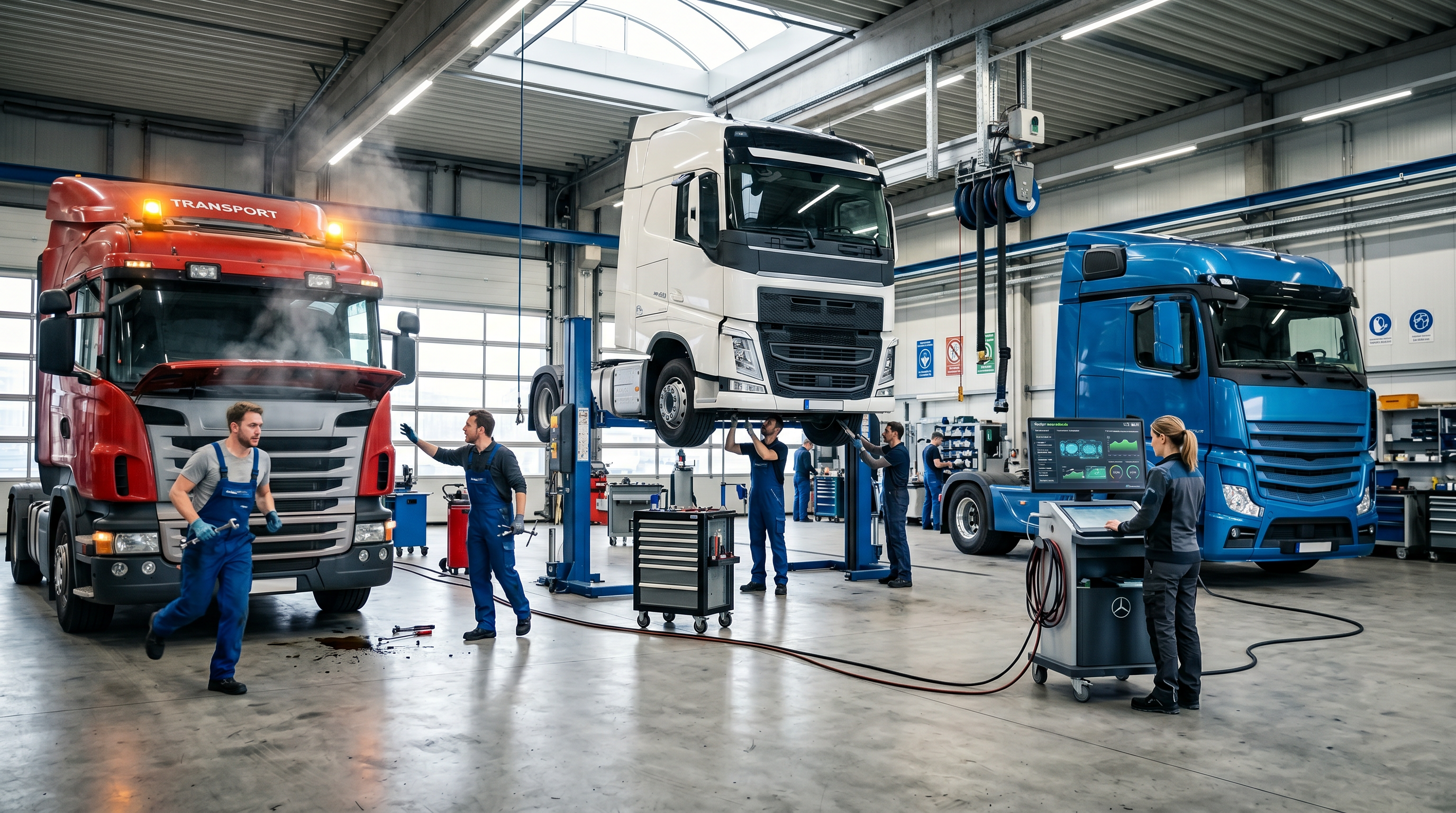
Reactive maintenance means you only act when something breaks. This is the most expensive approach in the long run, because breakdowns always happen at the worst possible moment, and the cost of emergency repairs is much higher.
Preventive maintenance means time-based regular intervention: oil change every 15,000 kilometers, tire rotation seasonally, brake pad inspection quarterly. This is much better than a reactive approach, but it does not take into account the actual condition of the vehicle.
Predictive maintenance is based on data-driven forecasting. It uses sensors, telematics, and artificial intelligence to predict when a component will fail before it actually happens. The steps of body repair are also much simpler if the problem is detected early.
| Strategy | Reliability | Cost | Difficulty of implementation |
|---|---|---|---|
| Reactive | Low | High | Minimal |
| Preventive | Medium | Medium | Low |
| Predictive | High | Low | High |
AI-based predictive maintenance can achieve a 25-40% cost reduction compared to a preventive approach, and 8-12% compared to a reactive approach. This is not theory, but measured data.
In reality, the predictive method allows for a 70-75% fault resolution rate, with a 25-30% cost reduction, albeit at the cost of a higher initial investment. Sensor systems, software, and training require significant capital.
- Assessment: which vehicle is most critical in the fleet?
- Installation of a sensor system on priority vehicles
- Data collection and analysis in the first 3 months
- Development of a decision protocol for alerts
- Gradual expansion to the entire fleet
Pro tip: The best results are achieved by combining preventive and predictive strategies. Keep time-based checks, but supplement them with sensor monitoring for critical components. This keeps investment costs lower, while savings are significant.
What causes faulty maintenance? Risks and hidden costs
After examining strategy choices, it is worth also seeing what losses are risked by those who do not pay sufficient attention to the quality of servicing. The numbers can be surprising.
An unexpected engine failure in a 40-ton truck does not just mean the cost of the part. There is also the towing fee, the service waiting time, the driver's downtime, fines for late delivery, and customer dissatisfaction. Overall, a single serious breakdown can easily lead to losses of several million forints.
The average hourly rate for heavy-duty services is $149, technicians' salaries are increasing by 10% annually, while the profession faces a 57% labor shortage. This means that service times are getting longer, prices are getting higher, and it is becoming increasingly difficult to get an appointment.
| Risk type | Direct cost | Indirect loss |
|---|---|---|
| Engine failure | 500,000-2,000,000 HUF | Customer churn |
| Brake system failure | Accident, fine | Reputational damage |
| Tire puncture while driving | Towing, replacement | Late penalty |
| Electrical fault | 200,000-800,000 HUF | Downtime, logistical disruption |
Hidden losses also include customer churn. If a carrier consistently delays deliveries, customers will look for another partner. This loss of revenue can be much greater than the cost of all missed services.
Key risks caused by faulty maintenance:
- Accidents due to technical failures, which have legal consequences
- Extra downtime, which reduces the vehicle's annual performance by 15-20%
- Increasing repair labor rates and longer waiting times
- Staff shortages can lead to waiting times of weeks in some regions
Regular inspection and replacement of truck safety equipment is a basic requirement, not an option. Knowing the details of accident reporting is not enough if the accident could have been prevented. It is also worth paying attention to the risks of hitting wildlife, which can also have serious financial consequences.
"It's not a question of whether you can afford maintenance. The question is whether you can afford not to do it."
How can efficient servicing be implemented daily?
After presenting the hidden costs, it's time to provide practical advice for establishing a modern, efficient service routine. The good news is that you don't have to change everything at once.
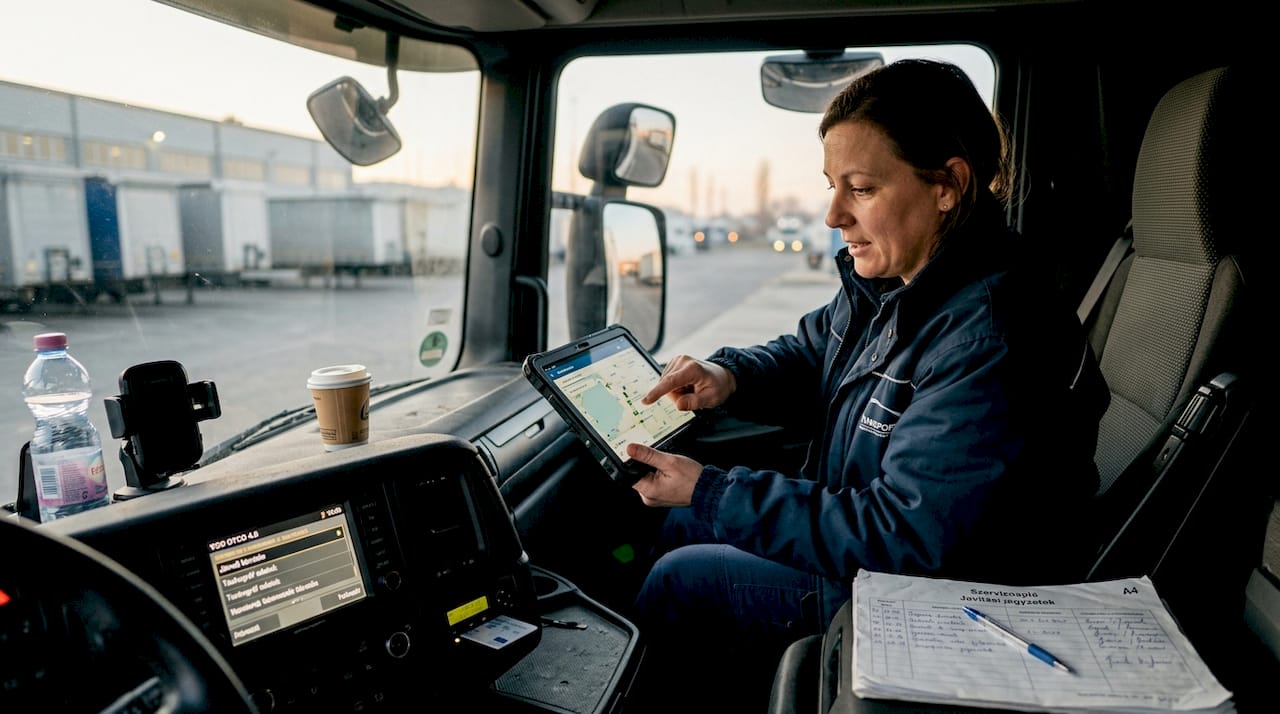
The basis of the daily routine is a simple checklist that every driver can perform before departure. This takes no more than 10 minutes, but it can prevent most unexpected breakdowns.
- Visual inspection: tire condition, damage, fluid leaks
- Sensor data retrieval: checking telematics system alerts
- Documentation: recording all observations in the digital service log system
- Level measurements: engine oil, coolant, brake fluid levels
- Lights and indicators: condition of all lights and rearview mirrors
The role of telematics systems in this process is invaluable. Real-time data allows the fleet manager to be immediately notified if a vehicle's parameters deviate from the norm, even before the driver notices the problem.
Predictive maintenance generates an average ROI of tenfold for fleets, meaning that every forint invested brings back ten times the savings. This data alone is sufficient reason to take the introduction of digital tools seriously.
Proper handling of tachograph rolls for digital systems is also part of the daily routine. Digital tachograph data not only fulfills legal obligations but also provides valuable information about vehicle and driver performance.
Pro tip: Delaying minor interventions is one of the most expensive habits in transportation. Postponing the replacement of a 5,000 forint sealing ring can easily turn into a 500,000 forint engine repair within three months. If you notice a small problem, report and fix it immediately.
The real return: servicing that means profit
Many people think that servicing is an expense. This view is one of the most costly misconceptions in freight transport. The reality is that a well-planned maintenance program does not reduce profit, but increases it.
We observe that fleet operators can be divided into two groups. The first group thinks reactively: they don't spend until they have to. The second group views maintenance as an investment: they know that every forint spent brings back many times its value. The difference is clearly visible in the annual balance sheet.
The true value of predictive maintenance lies not only in the saved repair costs. There is also better customer retention, less stress, more predictable cash flow, and a higher vehicle resale value. These "hidden profits" combined often exceed direct savings.
Body repair experiences show that early intervention is always cheaper. Those who embed this into their business culture gain a competitive advantage over those who still use a firefighting approach.
What tools do we use to support fleet efficiency?
After the theoretical and practical information, let's look at some specific product recommendations that support more professional servicing in a fleet.
At Convoy.hu, you'll find everything you need for your daily maintenance routine. 10W40 Engine Oil for trucks provides premium protection for the engine, with longer oil change intervals and better wear resistance. If you're surprised on the road, the tire repair kit for trucks offers a quick and reliable solution. You can browse the full range of maintenance and safety products on the Convoy Truck Shop website, where you can choose from hundreds of products for professional operation.
Frequently Asked Questions
How much money can be saved with predictive maintenance?
Predictive maintenance can lead to an average cost reduction of 25-40% and a tenfold ROI for fleets, especially by drastically reducing the number of unexpected breakdowns.
Why do service and spare part prices increase annually?
Due to labor shortages and inflation, service fees are rising by 7.4% annually, while technicians' salaries are also increasing by 10%, further tightening available capacity.
What should be done if damage events are frequent in a fleet?
It is worth introducing predictive maintenance, regular audits, and digital logging, as fleets experience many damages and service automation has been proven to reduce unexpected service costs.
How often should basic maintenance checks be performed?
Visual inspections should be performed daily, oil levels and fluids checked weekly, and a detailed technical inspection performed at least quarterly for all commercial vehicles.
How do we start implementing a digital service log?
Start with a simple mobile application, record all interventions and observations, then gradually integrate with telematics system data for comprehensive predictive maintenance.