Truck fleet branding is much more than just sticking a logo on the door. As a fleet manager, you've probably seen vehicles whose worn, half-peeling decals do more harm than good to the brand image. Well-designed and executed branding, however, works for you daily: it advertises, builds trust, and distinguishes you from competitors. This guide will walk you through the process from design to execution, highlight common mistakes, and explain why this area should be taken seriously.
Table of Contents
- The Essence and Business Significance of Truck Branding
- Key Steps in Truck Branding: From Design to Execution
- Surface Preparation: Common Mistakes and How to Avoid Them
- Regulatory Peculiarities: DAGO Program and Other Special Cases
- Why You Should Think Differently About Truck Branding
- Make Your Fleet More Visible with Convoy
- Frequently Asked Questions
Key Takeaways
| Point | Details |
|---|---|
| Clean surface is a basic requirement | Always thoroughly clean vehicle surfaces before branding for optimal adhesion. |
| Maximize marketing value | Truck branding is not just about image, but also about daily, free advertising space. |
| Follow special regulations | Certain programs, like DAGO, require additional specifications and maintenance. |
| Regular checks are important | Monthly check the integrity and compliance of applied branding. |
The Essence and Business Significance of Truck Branding
Many people think that truck branding is merely an aesthetic issue. In reality, it is a strategic decision that directly impacts business results. A well-branded fleet is constantly present on the road, so every mile driven is also a marketing investment.
The value of daily free exposure surpasses most static advertising formats, as the truck moves, reaches a changing audience, and cannot be "skipped" like an online ad. The DAGO program, for example, offers bonuses to drivers for participating in branding, which indicates that industry players take its value seriously.
What specific business benefits does branding bring?
- Brand building and recognition: A consistent image helps your customers immediately recognize your vehicles on the road, at a depot, or at a delivery point.
- Strengthening customer trust: A professional appearance conveys the message that the company is reliable, organized, and takes its work seriously.
- Recruitment advantage: A visually appealing, pride-inspiring fleet presents a more attractive workplace image for potential drivers.
- Differentiation from competitors: A consistent, unique design immediately sets the fleet apart from anonymous white vehicles.
- Supplementary marketing: A branded truck complements digital and print campaigns without generating extra media costs.
It is interesting to compare the effectiveness of different marketing tools:
| Marketing Tool | Daily Reach | Repeated Exposure | Moving Target Audience |
|---|---|---|---|
| Billboard | High | Yes (local) | No |
| Online banner | Variable | Yes | No |
| Branded truck | High | Yes | Yes |
| Printed flyer | Low | No | No |
The table clearly shows that truck branding is the only tool that simultaneously offers high reach, repeated exposure, and a moving audience. This is particularly valuable for regional or national transportation companies.
Truck memorabilia and branded accessories also contribute to strengthening the brand image, as they display the company beyond the fleet in office and personal spaces. Furthermore, it is worth considering that in the case of truck rental, branding opportunities and obligations may differ from those of a privately owned fleet, so it is always advisable to agree on the terms in advance.
“A branded fleet is not an advertising cost, but moving capital. Every mile it travels does marketing work for you."
Key Steps in Truck Branding: From Design to Execution
A successful branding project is not created by chance. It is backed by a well-thought-out process, each step of which influences the quality and durability of the end result.
-
Identity and design planning: The first step is to define the visual identity. What colors, fonts, and graphic elements should the fleet use? The design must be consistent with the corporate identity, but also take into account the truck's shape and dimensions. It is worth working with a graphic designer who is experienced in vehicle wrapping.
-
Material and technology selection: Decals, self-adhesive foil, full wrapping, or paint? Each has its advantages and disadvantages. Decals are flexible and easy to replace, while full wrapping provides a more uniform appearance and better protects the bodywork.
-
Surface assessment and preparation: Before anything is applied, the vehicle's surface must be thoroughly inspected. Dents, rust spots, and old adhesive residues can all cause problems. The steps for bodywork repair are essential for a lasting result.
-
Execution: The actual application or installation requires expertise. Air bubbles, wrinkles, and poorly aligned edges all degrade the end result. With a professional installer, this step is fast and precise.
-
Quality control: The work must always be checked before the vehicle is returned to service. Adhesion is particularly important along edges, corners, and curves.
-
Documentation: Photograph the completed branding and keep records of when and what materials were used. This helps in planning maintenance and meeting regulatory requirements.
Pro tip: Don't skimp on material quality. Cheaper decals fade faster, their edges lift, and after a year, replacement costs more than the initial savings were worth. Choose UV-resistant, outdoor-rated film.
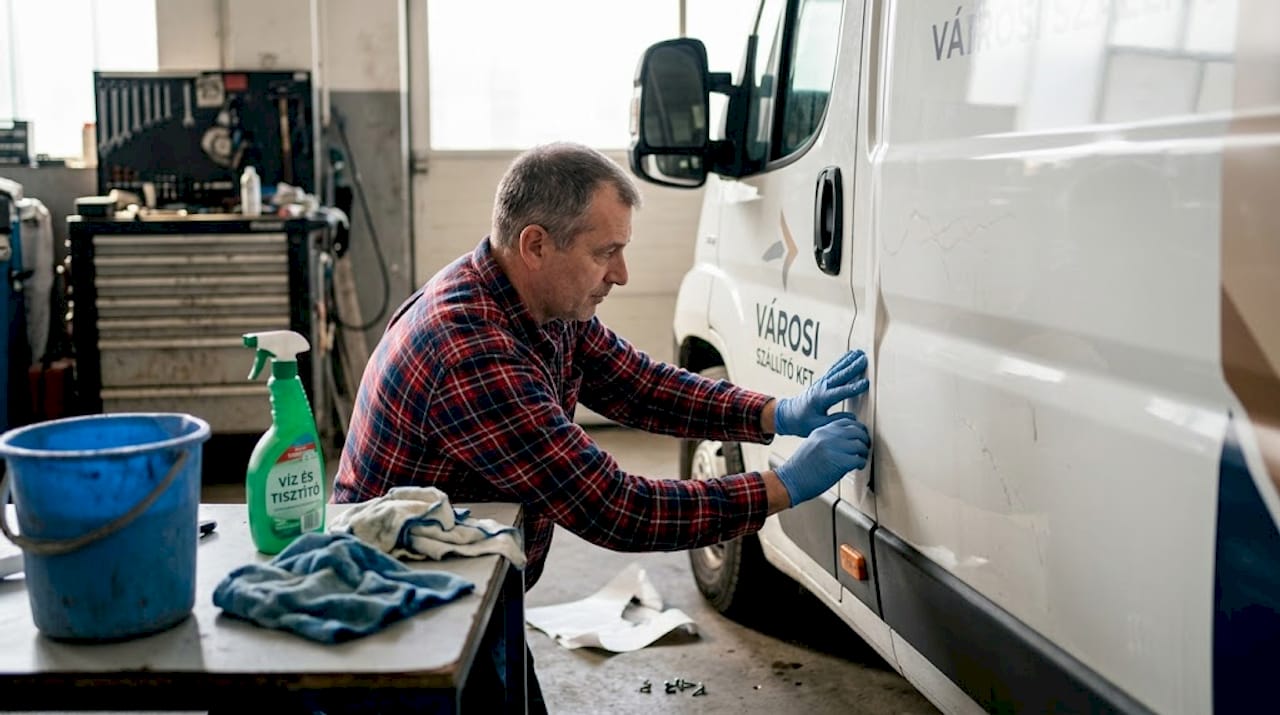
A clean surface is a basic requirement: in the presence of dust, oil, or moisture, the decal will not adhere properly and will peel off quickly. This is not only an aesthetic problem but also a safety risk if a larger film detaches on the road.
Surface Preparation: Common Mistakes and How to Avoid Them
Surface preparation is the step that most fleet managers underestimate, and its neglect leads to most branding failures. It is not enough for the truck to "look clean." The surface must be truly grease-free, dry, and dust-free.
What causes improper preparation? A contaminated surface inhibits adhesion, so the decal or film peels off sooner, bubbles, or has an uneven surface. This not only looks bad but also drastically shortens the lifespan of the branding.
The most common mistakes:
- Oily surface: Oil residue from the engine, axles, or previous lubricants prevents the adhesive from sticking.
- Condensation: If the vehicle was left out overnight, its surface may be damp in the morning, even if it appears dry.
- Dust layer: This is especially common for vehicles operating in construction areas or on dirt roads.
- Old adhesive residues: Remnants of previous decals create an uneven surface.
- Paint defects, dents: The film will not smooth out perfectly in these areas.
| Type of Error | Consequence | Prevention |
|---|---|---|
| Oily surface | Does not adhere, peels off | Clean with degreaser |
| Condensation | Bubbling | Drying, appropriate temperature |
| Dust layer | Uneven adhesion | Wet washing, then degreasing |
| Adhesive residue | Bumpy surface | Remove with solvent |
| Paint defect | Film lifts | Bodywork repair first |
Pro tip: Always perform an adhesion test with a small test piece on the given surface before branding. If it holds steadily after 24 hours, the surface is properly prepared.
Steps in the preparation process:
- Thorough wet washing with a strong jet of water
- Application of degreaser with isopropyl alcohol or a special cleaner
- Complete drying, preferably in a closed, dust-free area
- Mechanical or chemical removal of old adhesive residues
- Visual inspection under strong light to reveal all contaminants
If there are dents or damage on the bodywork, it is advisable to address them with a puncture repair kit and bodywork repair before any branding work is carried out. Film applied to a damaged surface is guaranteed to peel off, and you will pay twice as much for a re-do.
Regulatory Peculiarities: DAGO Program and Other Special Cases
Branding is not always just a creative and technical matter. In some cases, specific regulatory frameworks must also be followed, which determine what can and cannot be placed on the vehicle.
The DAGO program is one of the best examples of how branding is integrated into a complex business and regulatory system. Within the framework of the program, detailed regulations apply to the placement, size, and content of decals.
What does the DAGO program stipulate?
- Prohibition of modification: Approved decals must not be modified, repainted, cut, or combined with other elements. This ensures a uniform appearance and the credibility of the program.
- Monthly maintenance and inspection: The condition of the decals must be checked monthly. If damage, wear, or peeling is observed, it must be replaced immediately.
- Documented condition: The results of the inspections must be recorded and presented upon request.
- Placement rules: The decal may only be placed on the designated surface in a specified position.
“The DAGO program is not just a decal option, but a controlled, documented process, the observance of which is a condition for participation."
These rules may seem strict at first, but in reality, they guarantee the quality and durability of the branding. A monthly checked, well-maintained decal remains in a professional condition much longer than a solution applied once and forgotten.
Other special regulations are also worth noting. Road traffic regulations, for example, prohibit the placement of reflective or misleading elements that could be confused with traffic control signals. In some countries, there are also regulations regarding the size and placement of advertising surfaces. If vehicles are operated in international traffic, it is advisable to inquire about the regulations of the destination countries in advance.
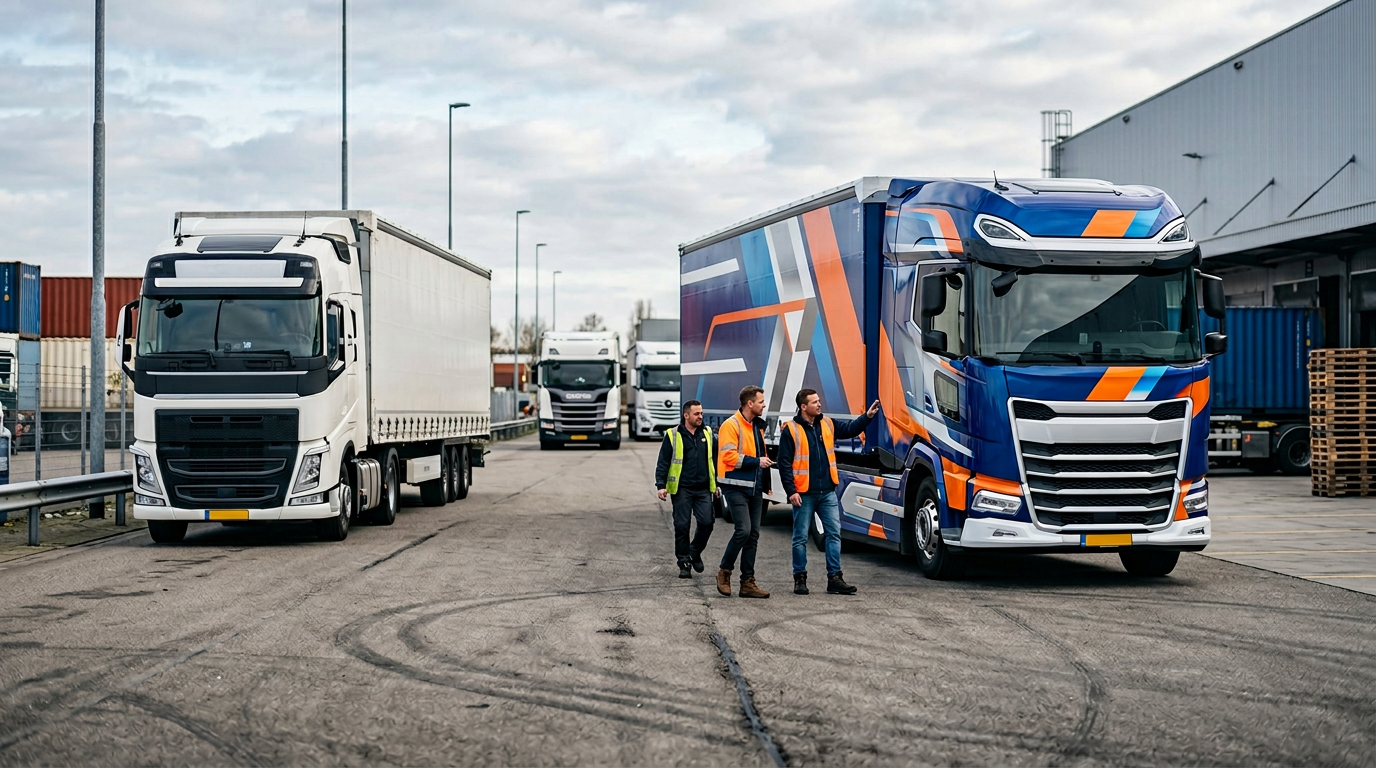
The administration of the fleet can be aided by tachograph-related devices, which assist in legal operation by precisely recording driving times and routes. Knowledge of the new tachograph regulations is also essential for modern fleet management, as legal operation and a professional image reinforce each other.
Why You Should Think Differently About Truck Branding
Most fleet managers treat branding as a one-time expense: pay for it, have it applied, done. This mindset is precisely why so many fleets look neglected after two years. Branding is not a project, but a process.
Think about it: a worn, faded logo on a truck is not neutral. It actively damages the company's reputation on every journey. The value of the investment does not peak at the moment of application, but can be maintained for years through regular maintenance.
Another misconception is that the minimum is sufficient. A plain, logoed decal meets the mandatory minimum, but it doesn't differentiate. Creative, attention-grabbing solutions that tell a story about the company, its values, or its service leave a much stronger impression. The marketing value of truck rental also partly depends on the fleet's appearance: a striking, well-maintained vehicle is worth more than ten anonymous ones.
In our experience, companies that treat branding as a strategic tool and maintain it regularly achieve higher brand awareness with lower marketing costs in the long run.
Make Your Fleet More Visible with Convoy
A branded truck is only truly effective if both its execution and maintenance are professional. Even the best design is worth little on a dusty, dirty surface.
On Convoy.hu, you will find the tools that help maintain your fleet's professional appearance day after day. Nerta Truck Cleaner Forte car shampoo is an effective cleaning agent specifically developed for trucks, which removes road grime without damaging the film or decal. The branded truck driver's towel is a practical accessory that also makes drivers' daily work easier. Check out our full range and find what your fleet needs.
Frequently Asked Questions
Which legal regulations must be observed during truck branding?
Regulations vary by program and country: for example, the DAGO program prohibits modification and requires monthly inspection, while traffic regulations prohibit elements that can be confused with traffic control signals.
Why is surface cleaning important before branding?
Dust and oil inhibit adhesion, so on a contaminated surface, the decal or film will peel off sooner, bubble, and have a shorter lifespan.
What are the marketing advantages of truck branding?
Branded trucks act as daily free advertising to a moving audience, which is more effective than static advertisements and provides continuous visibility.
How should I check the condition of branded trucks?
Most regulations, including the DAGO program, require a monthly check for integrity and compliance, and the results must be documented.
Recommended