A neglected truck not only looks bad but also costs a lot of money. Replacing rusty chassis, cracked paint, and aluminum parts damaged by salt residue can amount to hundreds of thousands of forints for a single vehicle. In contrast, a consistent exterior maintenance routine not only preserves the vehicle's value but also extends its lifespan and reduces unexpected repair costs. In this guide, we'll show you what tools you need, how to build an effective maintenance process, and what mistakes to avoid if you want to maintain the condition of your fleet in the long term.
Table of Contents
- Essential Tools and Materials for Exterior Maintenance
- Steps for Truck Exterior Maintenance
- Areas Requiring Special Attention and Common Mistakes
- Sustainable and Future-Proof Maintenance Solutions
- Practical Experiences and Lessons Learned: A Fleet Manager's Perspective
- Supported Solutions and Products for Efficient Maintenance
- Frequently Asked Questions
Key Takeaways
| Point | Details |
|---|---|
| Effective maintenance | Regular exterior maintenance significantly extends the lifespan of trucks and reduces costs. |
| Avoiding common mistakes | Paying attention to aluminum parts and washing after winter salting can help avoid expensive repairs. |
| Sustainable solutions | Implementing eco-friendly agents and a preventive routine will make the fleet more valuable in the long run. |
| Quick orientation | Professional lists, tables, and examples help understand the maintenance steps. |
Essential Tools and Materials for Exterior Maintenance
Before you start cleaning your truck's exterior, it's important to have the right tools and materials. The wrong tool or an unsuitable chemical can cause more harm than good. Good preparation is half the battle, and this is especially true for commercial vehicle maintenance.
Basic equipment includes a quality cleaning sponge and brush that won't scratch the paint surface but effectively remove dirt. Long-handled brushes are essential for reaching higher surfaces, while a soft sponge is ideal for more delicate parts of the bodywork. It's also worth acquiring microfiber cloths, as they don't leave lint and are gentle on surfaces.
In terms of materials, car wash shampoos specifically developed for trucks are the most reliable. Avoid general household detergents, as they break down wax layers and damage paint. For aluminum parts, an acidic but gentle aluminum cleaner is needed, while anti-corrosion coatings are recommended for the bodywork. Due to winter salting, regular washing is particularly important to prevent salt from remaining on the surface and initiating the rusting process.
List of the most important tools and materials:
- Soft sponge and long-handled brush for the bodywork
- Microfiber cloths for drying
- pH-neutral car wash shampoo
- Acidic aluminum cleaner for oxidized surfaces
- Anti-corrosion spray for chassis and fasteners
- Wax coating or paint protection polish for the paintwork
- High-pressure washer (in the range of 1500-2300 PSI)
The choice of eco-friendly products is becoming an increasingly important aspect of fleet management. Biodegradable cleaning agents not only protect the environment but are often more effective and do not damage tires or seals. Professional sources for truck exterior detailing also point towards eco-friendly solutions.
| Tool Type | Application | Recommended Material |
|---|---|---|
| Soft sponge | Body wash | pH-neutral shampoo |
| Aluminum brush | Rims and aluminum parts | Acidic cleaner |
| High-pressure washer | General pre-wash | Water, pre-wash agent |
| Microfiber cloth | Drying, polishing | Dry or waxed |
Pro tip: Acidic cleaning is the most effective method against aluminum oxidation, but always test the agent on a small, hidden surface before applying it to the entire component. Store materials in a dry, cool place, as temperature fluctuations can alter the effectiveness of chemicals. If you want to understand when more serious intervention becomes necessary, it's worth learning about the steps of truck body repair as well.
Steps for Truck Exterior Maintenance
After acquiring the tools and materials, the actual work begins. A well-structured maintenance process not only removes visible dirt but also protects the vehicle from long-term wear.
Steps for exterior maintenance in order:
- Pre-wash with high-pressure water: Remove coarse dirt, mud, and salt residue. Keep the nozzle at least 30 cm from the surface.
- Shampoo wash: Work from top to bottom so that dirty water doesn't run back onto already clean areas.
- Treatment of aluminum and special surfaces: Treat oxidized aluminum parts with an acidic cleaner, then rinse thoroughly.
- Rinsing and drying: Dry the surface with a microfiber cloth to avoid water spots.
- Applying paint protection: Apply wax or ceramic coating to the paint to protect it until the next wash.
- Inspection and documentation: Check the surface for cracks, rust beginnings, or damage.
Based on preventive maintenance tips, exterior maintenance should be integrated into the preventive maintenance program so that it is not overlooked or delayed. During winter, when salting is more intense, the frequency of washing should be increased, ideally every two weeks.
For paint protection, using a pressure washer below 2300 PSI is recommended to avoid damaging the paint. Too high pressure can cause micro-scratches, which absorb dirt and accelerate rusting.
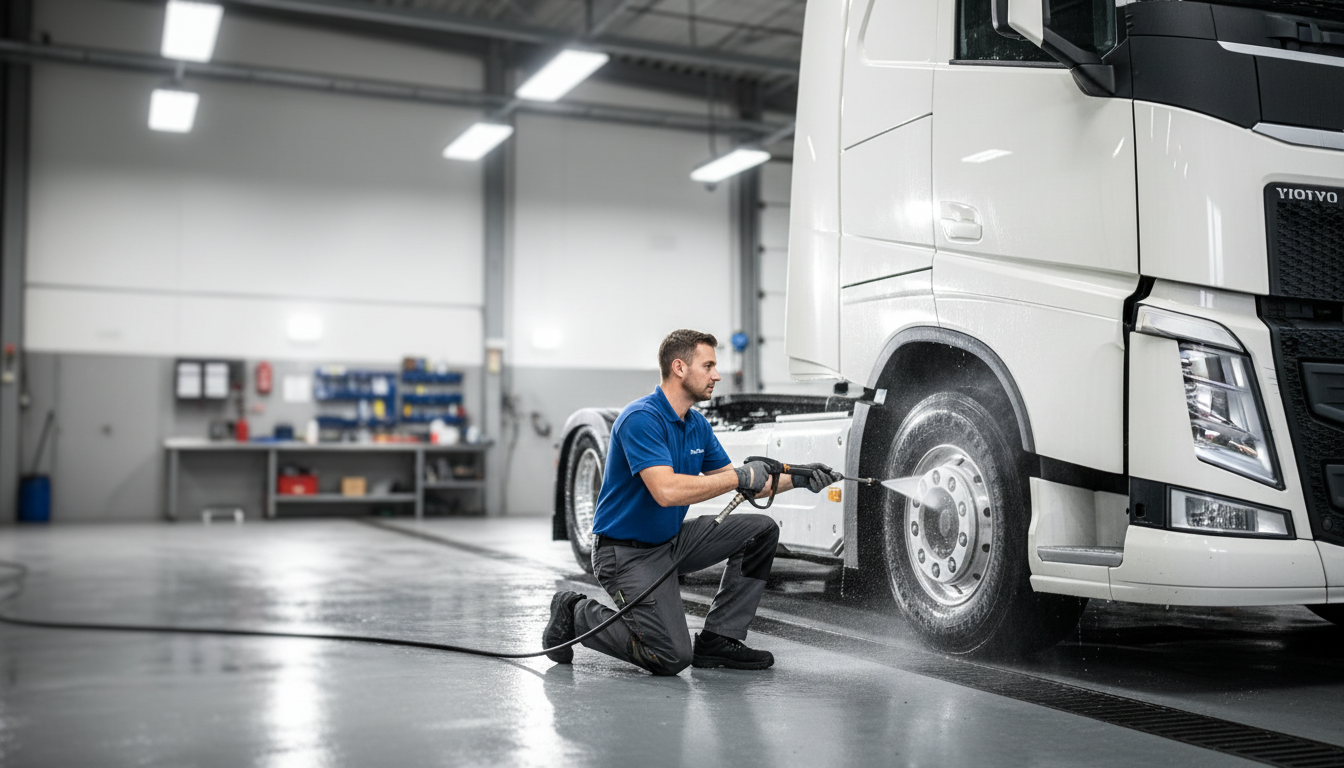
Pro tip: Do not use pressure above 2300 PSI on the bodywork. The optimal range is 1500-2300 PSI, which cleans effectively but does not scratch the paint. For heavier dirt, increase the concentration of the active ingredient rather than the pressure.
| Season | Washing frequency | Focus areas |
|---|---|---|
| Summer | Once a month | Bodywork, windows |
| Winter | Every two weeks | Chassis, wheel arches, de-salting |
| Transition period | Twice a month | Full exterior, aluminum parts |
Exterior maintenance is not a luxury, but an investment. A well-maintained truck stays on the road longer and can be sold at a higher price when it's time for replacement.
The daily tasks for truck drivers should also include checking the external condition, so that drivers also take responsibility for protecting the vehicle.
Areas Requiring Special Attention and Common Mistakes
Not all parts are equal. There are areas of the truck that deteriorate much faster if not given special attention. Most fleet managers overlook these in their routine, only to pay dearly for it later.
Areas requiring increased attention:
- Aluminum components: Rims, tanks, and decorative elements oxidize if not regularly treated. Aluminum oxidation can be effectively treated with acidic cleaning, but prevention is cheaper.
- Wheel arches: Mud, gravel, and salt solution accumulate most here. They deserve special attention during every wash.
- Tarpaulin: Tarpaulin material can crack, mold, and lose its water resistance if not cleaned regularly.
- Chassis and fasteners: Rusting starts here earliest, especially after winter salting.
- Door seals and rubbers: Chemical cleaners can damage rubber, so only gentle, pH-neutral agents should be used here.
Common mistakes include improper use of corrosive chemicals, washing with too high pressure, and neglecting aluminum surfaces. Many only address these areas when damage is already visible, but by then, repairs cost much more than prevention. These errors can be avoided by implementing preventive maintenance fleet-wide.
Replacing a neglected aluminum tank or wheel arch can cost up to 300,000-500,000 forints per vehicle, while regular maintenance costs a fraction of that. Having practical tools for maintenance greatly helps drivers perform basic cleaning tasks themselves.
Pro tip: Always wash off the tarpaulin and wheel arches after salting on the same day or the next. Salt can initiate serious corrosion within a few days, especially if the surface is already scratched or damaged.
Sustainable and Future-Proof Maintenance Solutions
Effective maintenance doesn't end with washing. Preserving long-term fleet value requires a sustainable approach and regular training.
Using eco-friendly agents and training drivers for daily inspections is one of the best investments a fleet manager can make. Biodegradable cleaning agents not only protect the environment but also the vehicle surfaces in the long run, as they do not contain aggressive chemicals.
Elements of a sustainable maintenance program:
- Use of eco-friendly, biodegradable cleaning agents
- Regular driver training for daily visual inspections
- Implementation of a digital checklist in the fleet management system
- Keeping maintenance logs per vehicle
- Developing a seasonal maintenance plan
Environmentally friendly car shampoo is available in concentrated form, which is more economical and produces less packaging waste. This results in significant savings for fleet-wide procurement.
Driver training is crucial. If the driver spends 5 minutes each day visually inspecting the external condition of the vehicle, minor damage, cracks, and rust beginnings will be detected in time. This prevents a small problem from growing into an expensive repair. A cleaning spray for fleet maintenance is a practical tool for drivers for immediate intervention.
Pro tip: Build a digital checklist into your fleet management system that drivers complete before each departure. This not only aids maintenance but also provides documentation that can be useful for insurance claims or warranty issues.
Practical Experiences and Lessons Learned: A Fleet Manager's Perspective
Most companies make the same mistake: they view exterior maintenance as an administrative task, not a real value preservation tool. It gets on the list, goes into the protocol, but no one checks if it actually happens. The result? After three years, half the fleet is rusty, the other half looks worn, and replacements become necessary much earlier.
What truly works is not a complex system, but consistency. A simple weekly routine task that the driver performs and documents is worth more than a thorough cleaning done once a year. Professional experience in body repair also shows that most serious damage could have been prevented with early intervention.
Maintenance should not be treated as a separate task. It must be integrated into the daily workflow, just like refueling or checking tire pressure. If the driver feels responsible for the vehicle's condition, the quality of maintenance automatically improves. This shift in mindset is what truly brings long-term results.
Supported Solutions and Products for Efficient Maintenance
Having the right tools and materials is the foundation of any successful maintenance program. At Convoy.hu, our team with over 30 years of experience offers products specifically developed for the needs of commercial vehicles.
Purchasing a cleaning sponge and brush can be easily done in our webshop, where you will find all the basic tools needed for professional fleet maintenance. Nerta car shampoo is a formula specifically developed for trucks that effectively removes salt, oil, and road dirt without damaging the paint. For drying and polishing, the truck towel is the perfect choice, protecting the paint surface and quickly absorbing water.
Frequently Asked Questions
How often should a truck's exterior be maintained?
It is recommended to perform it at least once a month, but due to winter salting, washing may be necessary every two weeks to prevent corrosion.
Which cleaning agents are safest for aluminum?
For aluminum components, use acidic but gentle chemicals specifically developed for this purpose, as aluminum oxidation can be effectively treated with acidic cleaning without damaging the surface.
Can exterior maintenance be integrated into a preventive maintenance program?
Yes, and this is the most effective approach: integrated exterior maintenance within the preventive program and regular driver training together yield the best results.
What pressure washer should I use to clean the truck's exterior for paint protection?
For paint protection, use a pressure between 1500-2300 PSI, as higher pressure can cause micro-scratches that accelerate rusting.