Year after year, the safety of truck traffic in Hungary poses a serious challenge for those working in the industry. The 126 truck accidents recorded by 2026, including 15 fatalities, highlight the need for hauliers and fleet managers to take active measures. The Ministry of Construction and Transport (ÉKM) has decided to redirect trucks from main roads to motorways, but this alone is not enough. In this article, we present concrete, proven safety solutions that can be applied daily to protect the fleet and drivers.
Table of Contents
- Key Safety Tips for Truckers
- Regulatory Compliance and Avoiding Fines
- Digital Data Management and Control Points for Fleets
- Special Hazards: Narrow Ramps, Weather, and Motorways
- Surprising Correlation: Why is the Motorway the Safest?
- Enhancing Safety: Expert Tools and Accessories for Truckers
- Frequently Asked Questions
Key Takeaways
| Point | Details |
|---|---|
| Regular Maintenance | Continuous technical inspection of the truck significantly reduces breakdowns and accident risks. |
| Clarifying Legal Liability | Seat belt use and proper documentation of the consignment note are essential for avoiding fines. |
| Digital Data Management | In modern fleet management, the tachograph and digital recording evidence help successfully complete official inspections. |
| Motorway Advantage | Choosing motorways significantly reduces the occurrence of accidents and hazardous situations for trucks. |
Key Safety Tips for Truckers
Most accidents are not caused by chance but by preventable reasons. Worn brake pads, neglected tires, and ignored warning lights are all factors that create predictable but avoidable hazards. The good news is that these risks can be drastically reduced with a systematic approach.
Regular maintenance is not just a legal requirement but one of the most effective investments a trucking company can make. Adherence to mandatory maintenance regulations not only reduces the number of breakdowns but also protects the fleet from serious problems during official inspections. The implementation of a pre-trip checklist is a particularly useful tool: if all drivers check the same points before departure, a consistent and reliable inspection culture will develop.
What should the pre-trip checklist include?
A well-prepared pre-trip inspection list should include at least the following items:
- Brake system condition: fluid level, brake pad thickness, air leak check
- Tires: inspection of pressure, wear, and damage on all axles
- Lighting: testing of front and rear lights, position lights, indicators, and hazard lights
- Rear-view mirrors: checking for securement and adjustability
- Load securing: inspection of tension straps, pallets, and fasteners
- Engine compartment: oil level, coolant, battery
- Windscreen and wipers: cleanliness and functionality
For fleet managers, it is particularly important to record this list digitally. If a driver skips the inspection and an accident occurs afterward, the digitally documented pre-trip checklist can also provide legal protection for the company.
Considering seasonality is also a crucial aspect that many underestimate. In winter, on frozen roads, braking distance can be up to three times longer than on dry asphalt. In autumn, fallen leaves make roads slippery, and in spring, melting snow increases the risk of potholes and wheel bearing failures due to poor road surfaces.
Pro tip: Introduce a quarterly “seasonal audit” system where the service team checks the fleet with expected weather conditions in mind. For example, in September, assessing the condition of winter tires and preparing for timely replacement is particularly important. This prevents last-minute, rushed, and error-prone tire changes.
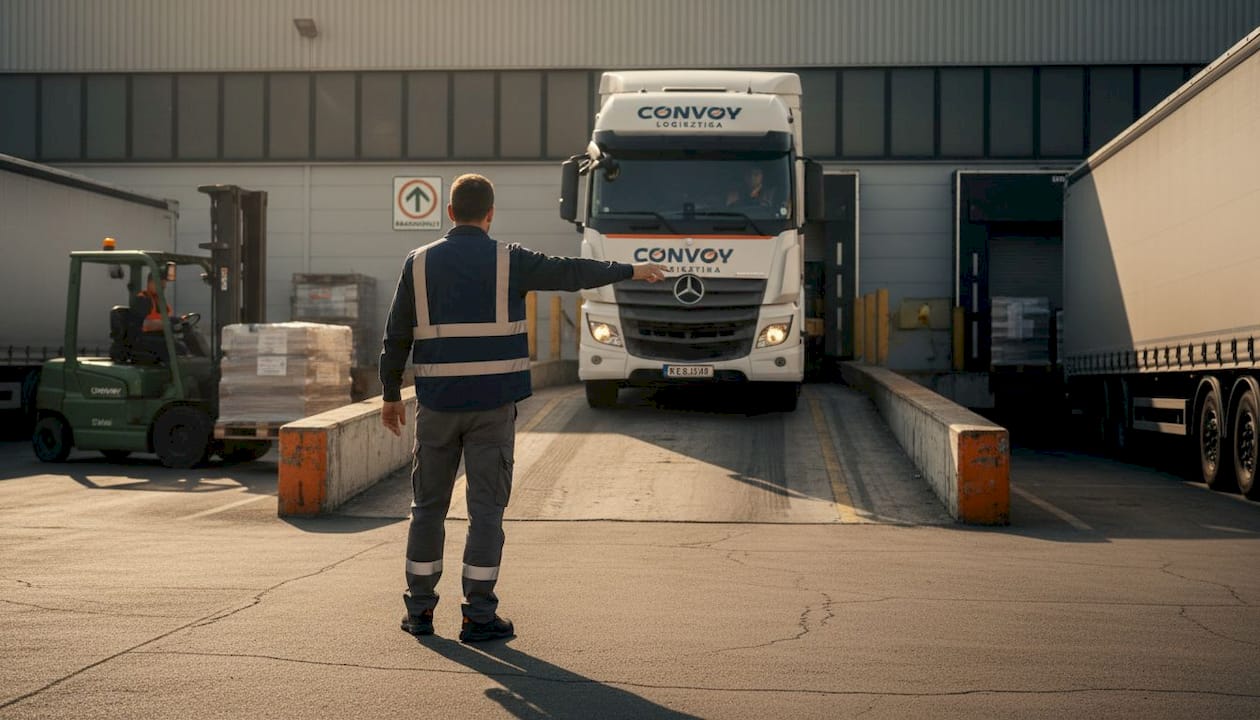
The dangers of narrow ramps and difficult terrains should also not be overlooked. Many drivers underestimate the risk posed by a wrong turn in a tight loading yard. Side mirrors, tow hooks, and trailer frames are particularly vulnerable in these places. The presence of good safety equipment and driver situational awareness training together reduce these types of accidents.
Regulatory Compliance and Avoiding Fines
Adherence to safety regulations is not only a matter of moral responsibility but also a direct financial interest. A single fine or a stop during an inspection can take a vehicle out of service for days, causing chain delays throughout the entire transportation system. Fleet managers know precisely: lack of legal compliance means not only fines but also reputational damage and business risk.
The mandatory use of seat belts is subject to strict regulation in Hungary. Based on the objective liability system, the company pays the imposed fine first, which ranges between HUF 20,000 and HUF 40,000. However, with proper completion of the consignment note, this amount can be transferred to the offending driver if it can be proven that the company took the necessary measures.
Important to know: Fines for driving without a seat belt can range from HUF 20,000 to HUF 40,000. Based on objective liability, the company pays first, but with properly documented consignment notes, liability can be shifted to the driver.
What to know about legal documentation?
The issue of documentation causes problems for many transport companies, especially when the fleet is large and driver rotation is high. Below, we summarize the most important tasks:
- Accuracy of the consignment note: an up-to-date, signed document is required for every transport
- Proof of driver training: safety training must be documented, as it may be requested during inspections
- Liability statements: a statement signed by the driver acknowledging and adhering to the rules provides important protection
- Maintenance logs: for every vehicle brought in for service, all work performed and parts replaced must be recorded
- Accident protocol: every driver must know what to do in case of an accident, and this document should be in the cabin
The presence and up-to-date condition of practical truck driver tools are also official requirements. During an inspection, the absence of a chain, ice scraper, first aid kit, or warning triangle can result in an immediate fine.
Based on the criteria listed in the truck driver job guide, both drivers and companies can prepare for what awaits them during an official inspection. This type of proactive preparation is what distinguishes a professional haulier from an occasional operator.
Digital Data Management and Control Points for Fleets
Modern fleet management is unimaginable without digital tools. During inspections by the National Transport Authority (NKH) and the police, authorities increasingly rely on digitally recorded data. Those who keep their records on paper will find it increasingly difficult to stand their ground during a thorough investigation.
The tachograph is one of the most important tools in this system. Verification of compliance with driving and rest time regulations is only possible based on tachograph data. Authorities examine, on the one hand, whether the driver adhered to the mandatory rest periods, and on the other hand, whether the data recording was continuous and untampered.
Inspection points and their consequences
The table below summarizes the official inspection points that hauliers may encounter and the consequences of non-compliance:
| Inspection Point | Responsible Authority | Consequence of non-compliance |
|---|---|---|
| Technical condition | NKH, Police | Immediate withdrawal from traffic, fine |
| Tachograph data | NKH | Fine of HUF 50,000 – 500,000, driver disqualification |
| ADR rules | Police, Fire Department | Immediate cessation of transport |
| Logbook, consignment note | Police | Fine of HUF 10,000 – 150,000 |
| Load securing | Police, NKH | Fine, reloading |
| Driver's rest time | NKH | Driver disqualification, company fine |
Fleet managers should conduct internal digital audits on a weekly or monthly basis. This means downloading and analyzing tachograph data, and taking immediate action if any irregularities are found. The appropriate presence and regular replacement of tachograph charts and data download keys are therefore not optional but a mandatory element of legal compliance.
Establishing a digital recording routine
Establishing a digital data management routine is not a one-day task, but its return on investment is quick. The first step is to assign a dedicated card and tachograph system to each vehicle and lay down a clear data download schedule. The second step is the software side: a fleet management software that automatically alerts when a driver approaches the allowed driving time limit.
The third, but perhaps most important, step is training. A tachograph will only protect you from fines if the driver handles it correctly. Many people make the mistake of forgetting to switch the card to pause, loading, or rest mode. This then causes distortions in the data, which the authority can interpret as deliberate manipulation.
Knowing the numbers is fundamental: the authority expects digital recording verification, and in the absence of it, in the most severe cases, even the revocation of the license can occur. This sanction affects not only the individual driver but also questions the operational capability of the entire company.
Special Hazards: Narrow Ramps, Weather, and Motorways
There are situations that everyday checklists do not address, yet they cause a significant portion of accidents. Narrow ramps, loading yards frozen into glaciers in winter, sudden fog, or the blinding headlights of oncoming trucks are all factors that average safety training rarely focuses on.
A large portion of the 126 truck accidents occurred on main roads, where traffic is mixed, speed differences are large, and the number of intersections is high. This is why the ÉKM is gradually redirecting trucks to motorways. The decision is based on strong safety considerations, not merely traffic management interests.
Main Road vs. Motorway: Safety Comparison
| Feature | Main Road | Motorway |
|---|---|---|
| Number of intersections | Many, frequently | Minimal, overpasses |
| Oncoming traffic | Direct contact | Separated by guardrail |
| Speed differences | Large, mixed traffic | More balanced |
| Pedestrians, cyclists | Regular presence | None |
| Winter road maintenance | Variable | Priority salting and snow plowing |
| Accident risk ratio | Higher | Lower |
| Lighting | Seldom complete | Generally continuous |
Main roads are particularly dangerous in winter and bad weather conditions. On a slippery main road, a 40-ton articulated lorry cannot stop within 150 meters even at 60 km/h if braking is not ideal. On a motorway, at least the direction of traffic and the guardrail eliminate the possibility of a head-on collision.
The danger on narrow ramps and loading yards is of a different nature. There, space, not speed, is the problem. A misjudged turn in a tight yard can take a vehicle out of service for weeks if the trailer canvas is crumpled or the chassis is damaged. Proper truck lighting adjustment reduces errors occurring in tight spaces and during night maneuvers.
Pro tip: if possible when planning your route, choose the motorway even if it means 20-30 minutes longer journey time. An accident, a breakdown, or an official stop takes days, not minutes. The extra motorway toll is a much smaller amount than the cost of an accident or a lost delivery.
Surprising Correlation: Why is the Motorway the Safest?
Many in the industry first look at the amount of the toll when comparing motorways and main roads. This is understandable, as daily motorway sections add up to a significant amount annually in a fleet's budget. But this thinking changes once the full picture is calculated.
The direct and indirect costs of an average truck accident far exceed the annual motorway toll. Repair costs, the vehicle being out of service, the driver's possible incapacitation, legal proceedings, compensation claims, and reputational damage are all items that quickly add up to thousands of forints. The digital recording required to meet official expectations is itself a valuable tool, as it immediately proves that the company acted responsibly in case of a dispute.
A haulier who consistently chooses motorways and documents carefully is not actually spending more, but rather allocating resources more intelligently. Risk reduction is always cheaper than dealing with the consequences of risk. This correlation is not new, but it is becoming increasingly evident in light of accident statistics.
There is another aspect that is rarely mentioned: the driver's mental state. On a main road, where every 15 minutes you have to watch out for oncoming traffic, cyclists, and turning cars at an intersection, concentration wears out much faster. On a motorway, the driver can better focus on their own lane and safe following distance. This makes a particularly significant difference in terms of fatigue errors over longer journeys.
The experience at Convoy.hu is that the best fleet managers do not aim to make individual transports cheaper, but rather optimize the reliability of the entire system. The basis of the accident prevention approach is that safety is considered as the primary criterion in every decision, and not just the short-term cost. This shift in mindset is what truly enables sustainable and profitable operations in the long run.
Enhancing Safety: Expert Tools and Accessories for Truckers
The advice in the article is only useful if the right tools are also available. Convoy.hu, with its decades of experience, stands by transporters and fleet managers, offering products that provide real, everyday protection.
Whether you need 10W40 engine oil for routine maintenance or a suitable tire repair kit for an unexpected flat, you'll find the solution in the webshop. They've also considered the daily comfort of drivers: for example, a premium quality trucker towel may seem like a small thing, but on long hauls, hygiene and comfort contribute to concentration and reduced fatigue. Ordering is simple, delivery is fast, and quality is guaranteed.
Frequently Asked Questions
What is the fine for not wearing a seatbelt?
The fine for not wearing a seatbelt ranges from 20,000 to 40,000 forints. Based on objective liability, the company pays first, but the penalty can be transferred to the offending driver with the waybill.
Why is it safer to drive on highways than on main roads?
On highways, opposing traffic is separated by a guardrail, the number of intersections is minimal, and winter road maintenance is prioritized. The majority of the 126 truck accidents were registered on main roads, which clearly proves the advantage of highways.
How should I document truck maintenance and inspections?
The best approach is digital recording: downloading and archiving tachograph data, supplemented by digital storage of service logs and pre-trip checklists, protects the company during an official inspection.
How often should a truck be pre-checked before departure?
A pre-trip inspection is mandatory before each departure. In addition, based on mandatory maintenance regulations, periodic technical inspections must be included in the fleet operation system annually or after a specified mileage.