Many people consider GPS to be a simple positioning device, a kind of digital map that tells them where their truck is. This approach comes at a serious cost. A modern truck GPS system is capable of much more: it reduces fuel consumption, prevents theft, improves driver behavior, and provides data that allows for truly better decisions. In this article, we'll look at how the technology works, what specific benefits it can bring to your fleet, and what managers who truly harness the potential of GPS do differently.
Table of Contents
- What is truck GPS and how does it work?
- Main advantages of truck GPS systems for fleet managers
- Truck GPS vs other tracking solutions: a comparative overview
- Practical tips: how your fleet can profit from a truck GPS system
- Beyond positioning: what most managers don't fully utilize
- Additional useful tools at Convoy alongside truck GPS solutions
- Frequently asked questions
Key Takeaways
| Point | Details |
|---|---|
| GPS System Basics | Truck GPS provides not only positioning but also detailed vehicle data. |
| Main Fleet Management Benefits | The system can reduce fuel consumption and increase vehicle safety. |
| Choosing the Right Tool | Comparing GPS systems with other tracking solutions reveals their superiority. |
| Practical Application | Training, data sharing, and process improvement maximize the benefits of the technology. |
What is truck GPS and how does it work?
Truck GPS is a tracking and data collection solution built on a global satellite positioning system, specifically designed for managing heavy goods vehicles, trucks, and vehicle fleets. It is not merely a map, but a complex system that transmits real-time data on the vehicle's location, movement, and status.
The system consists of three main elements:
- Satellite receiver unit: Receives signals from GPS, GLONASS, or Galileo satellites and determines the vehicle's position with centimeter accuracy. Modern units handle multiple satellite systems simultaneously, which increases accuracy and reduces signal interference issues.
- Communication module: Typically sends data to the fleet management software via a mobile network (4G/LTE). Some devices also use Wi-Fi or satellite communication, especially in areas with no coverage.
- Software and platform: This is where the fleet manager sees the real-time position of all vehicles, retrieves historical data, sets up notifications, and analyzes data.
How is it different from a passenger car navigation system?
The GPS in passenger cars is primarily for route guidance. It tells you when to turn, and that's it. Truck GPS performs a much more complex task. It takes into account the vehicle's height, axle weight, hazardous goods status, and offers routes that pass through tunnels and under low bridges. Moreover, it not only provides guidance to the driver but also continuously collects data for the fleet manager in the background.
Key functions include real-time positioning, route playback (allowing you to review the vehicle's exact route), geofencing (a virtual fence that alerts if the vehicle leaves a designated zone), driving and rest time logging, and automated report generation.
Pro tip: A truck GPS system provides true value when integrated with an existing dispatch or enterprise resource planning system. An isolated device provides only a fraction of the available benefits. Our materials on safety equipment for trucks also confirm that technology and physical equipment together yield the best results.
Main advantages of truck GPS systems for fleet managers
Now that we understand the basics, let's look at the specific benefits a GPS system can bring to fleet managers. The advantages are not equally important for all companies, but there are some areas where almost everyone benefits from its implementation.
1. Fuel Consumption Control
Fuel is one of the biggest expenses for most transport companies. A GPS system clearly shows which drivers are aggressive, which vehicles are idling unnecessarily, and which routes consume more fuel than necessary. This data allows for targeted interventions, such as driver training or route modification, which can lead to fuel savings of between 10 and 15 percent.
2. Vehicle Safety and Theft Prevention
Truck theft and cargo appropriation are serious problems in the industry. A GPS-based tracker immediately signals if the vehicle moves without permission, leaves a designated area, or if the engine is started. In many cases, stolen vehicles have been recovered with the help of GPS data before thieves could cause significant damage.

3. Route Optimization
The era of manual route planning is over. A modern GPS system takes into account traffic, road closures, weather, and vehicle parameters to recommend the optimal route. This not only saves fuel but also reduces delivery times, which is not negligible in terms of customer satisfaction.
4. Real-time data and automated reports
A fleet manager cannot be everywhere at once. The GPS system transmits the status of vehicles and driver activity in real-time, and automatically generates daily, weekly, or monthly summaries. There is no need for manual data entry, no distorted data reporting; the data is objective and immediate.
5. Regulatory Compliance
More efficient fleet utilization with telematics is closely linked to regulatory obligations. Accurate logging of driving and rest times, as prescribed by EU Regulation 561/2006/EC, is significantly easier with an integrated GPS system. Data is automatically recorded, ensuring it is available and verifiable in case of fines.
Pro tip: Don't just use GPS data to solve existing problems. The system can also predict maintenance needs if integrated with the vehicle's diagnostic port (OBD-II or FMS interface).
Truck GPS vs other tracking solutions: a comparative overview
After outlining the advantages, it's useful to compare the truck GPS system with other solutions. There are many alternatives on the market, and it's not always clear which is the best choice for a given situation.
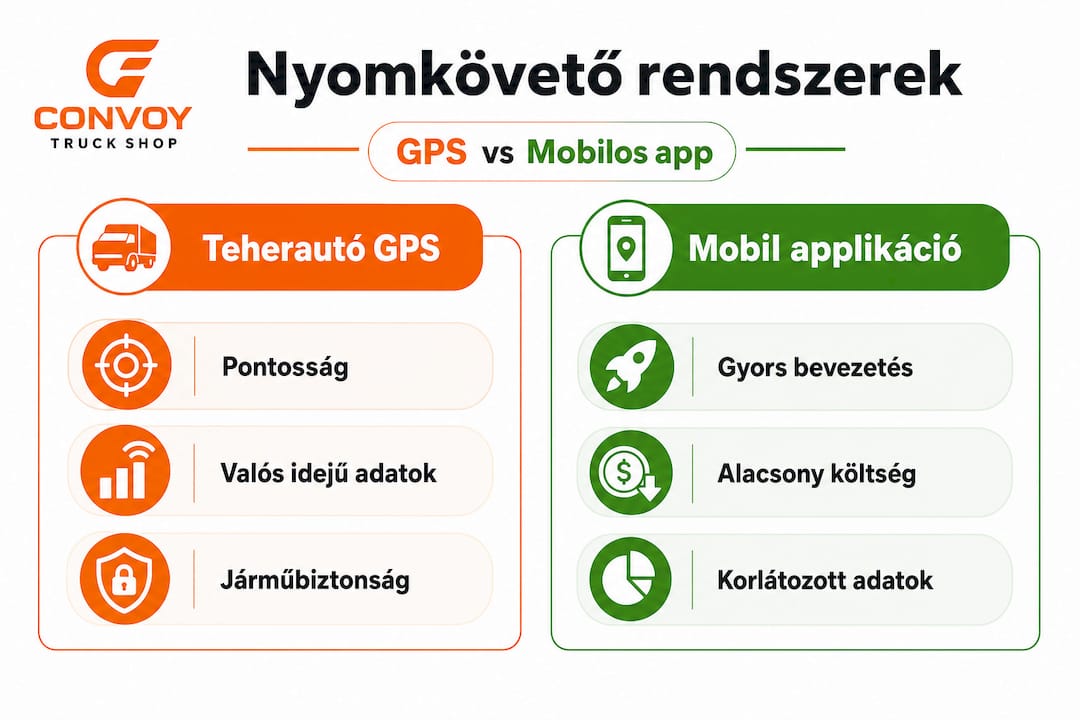
| Feature | Truck GPS | Mobile Application | Tachograph and Logbook |
|---|---|---|---|
| Accuracy | Very High | Medium | Low, Manual |
| Real-time | Yes, continuous | Partially, internet dependent | Not real-time |
| Automation | Full | Partial | Minimal |
| Regulatory Compliance | Yes, complex too | Limited | At basic requirement level |
| Data Analysis | Detailed, historical | Limited | Very Limited |
| Vehicle-specific data | Yes (speed, engine) | No | Yes (driving time) |
| Theft Prevention | Yes | Basic level only | No |
| Initial Investment | Higher | Low | Built-in or cheap |
Mobile applications
Mobile tracking applications are attractive because they are cheap and can be deployed quickly. However, they have several limitations. Smartphone batteries can run out, internet connections can be lost, and drivers can even turn off the app. Therefore, mobile solutions are more suitable for smaller fleets or individual entrepreneurs.
Tachograph and manual logbook
The role of the tachograph focuses on recording driving and rest times, which is a legal obligation. However, tachograph data does not replace real-time tracking. New developments in tachograph usage describe how smart tachographs record more and more data, but alone are not sufficient for modern fleet management needs.
Experience shows: the most effective approach is the combined use of truck GPS and smart tachographs. GPS provides positioning and route data, while the tachograph records driving times at a regulatory level. Together, they provide a complete picture of the fleet.
When is which a better choice? If a small business operates only a few vehicles and primarily handles domestic transport, a simpler mobile solution may suffice. However, if there are more than 10 vehicles in the fleet, they are involved in international traffic, and detailed data analysis is important, then a dedicated truck GPS system is clearly the better investment.
Practical tips: how your fleet can profit from a truck GPS system
After the comparison, let's look at how to get the most out of this technology in everyday use. Many companies implement a GPS system, and then after a few months, they barely use a fraction of its features. This is exactly the situation to avoid.
Common mistakes during implementation
- Not involving drivers: If drivers feel they are being watched and controlled, resistance will build. The implementation should be preceded by communication, explaining why this is beneficial for drivers too (e.g., insurance discounts, better route planning).
- No defined goals: GPS alone does nothing. The company needs to know what it wants to measure and improve.
- Not training users: The platform usually contains many more features than the team knows and uses.
- Not regularly checking data: Automatic alerts help with daily operations, but without weekly and monthly analyses, strategic improvement is missed.
How to share data with the team?
Data should not just land on the management's desk. If dispatchers see the real-time picture, they make better decisions. If drivers receive feedback on their own performance, they will be more motivated. Some systems allow drivers to see their own performance metrics on their smartphones.
User permissions and training
Not everything needs to be accessible to everyone. The dispatcher should see the real-time location and routes. The fleet manager should have access to all data and reports. Customer service should only see the delivery status. Correctly setting access levels prevents data misuse and lack of transparency.
How to improve route planning?
The role of telematics in fleet management is also evident in route planning. Historical data reveals which routes the truck was stuck in traffic for how long, which had the fewest incidents, and which had the lowest fuel consumption. This data should be applied to future route planning.
Key indicators to regularly review:
| Indicator | Why it's important | Recommended checking frequency |
|---|---|---|
| Fuel consumption per vehicle | Identifies wasteful vehicles | Weekly |
| Idling time | Direct fuel waste | Weekly |
| Number of speeding incidents | Safety and legal risk | Daily |
| Number of geofencing alerts | Indicates unauthorized use | Immediately, automatic |
| Driving time and rest time ratio | Regulatory compliance | Daily |
| Late deliveries | Customer satisfaction | Weekly |
It is important not only to measure these indicators but also to set target values for them. If fuel consumption exceeds the benchmark, an investigation can be launched immediately, without waiting for the monthly closing.
Beyond positioning: what most managers don't fully utilize
There's a common pattern we see repeatedly in the world of fleet management. A company implements a GPS system, everyone is enthusiastic, drivers' positions can be tracked in real-time, and management considers this a success. Then the system runs in the background, and no one truly delves into the data.
This mindset is fundamentally flawed, and this is where most value is left on the table. The most valuable feature of a GPS system is not knowing where the truck is, but rather showing why something is happening in the fleet.
Imagine the following situation. A company repeatedly receives complaints that deliveries are late. The fleet manager only knew until now: late. However, historical GPS data shows that 70 percent of the delays are concentrated on a single route, between 7 and 9 AM on Monday mornings. This is a specific, solvable problem. By changing the route or adjusting the departure time, delays can be drastically reduced.
This is precisely the value creation that most managers miss. The data is there; someone just needs to sit down and interpret it.
Another area where GPS receives little attention is driver behavior analysis. Based on accident prevention experience, most accidents could be prevented if risky driving habits were recognized in time: sudden braking, fast cornering, consistently high speeds. A GPS system records and flags all of these. The only question is whether someone reads this data and acts upon it.
Team involvement is also a key issue. If drivers receive feedback on their performance and see that someone receives recognition or development suggestions based on the data, their attitude will be completely different. They will not treat the system as an enemy, but as part of their work. Such a cultural shift requires a serious organizational investment, but the return far exceeds the cost of the GPS device.
The real competitive advantage, therefore, is not having GPS in the truck, but what the company does with the data.
Additional useful tools at Convoy alongside truck GPS solutions
If you've upgraded your fleet with a GPS system, the next step is to ensure proper equipment in other critical areas as well.
The Convoy.hu range includes accessories that are essential alongside GPS for safe and efficient fleet operation. For example, a tire repair kit for trucks is indispensable in every truck, as a puncture during transit can cause serious delays and costs. The safety of the cargo is also not negligible: a cargo lashing strap with a load capacity of 250 kg provides reliable securing. For visibility regardless of weather, a wiper blade for Mercedes is also an easily overlooked yet important item. All in one place, from a reliable source, based on 30 years of experience.
Frequently Asked Questions
What is the difference between truck GPS and simple mobile tracking?
Truck GPS offers real-time, more accurate positioning and extended vehicle data than a basic mobile application, and does not depend on the driver's phone status or intent.
Is GPS required by law in trucks?
For certain categories of trucks, especially when transporting hazardous goods and in international transport, the use of a GPS device may be mandatory, so it is always advisable to check current EU and national regulations.
How can a GPS system improve vehicle safety?
It helps prevent theft, allows for quick response in case of an incident, and makes the route and vehicle data verifiable in case of any official inspection.
What additional features are available in an advanced truck GPS system?
These include driving style analysis, fuel consumption monitoring, automatic report generation, OBD-II integration, and geofencing alerts.
How much initial investment does a truck GPS system require?
The price of GPS solutions varies depending on the provider and features, but experience shows that the initial investment typically pays for itself within 6 to 18 months through operational savings.