One morning, you discover that one of your trucks has been damaged in Poland, the goods are damaged, and the driver doesn't know which insurance company to contact. This isn't a theoretical scenario: it's the daily reality for trucking companies. The lack of a proper insurance mix can lead not only to administrative headaches but also to millions in damages. Designing insurance for a truck fleet requires specific decisions that can only be made well if all available insurance types, their limitations, and their combinability are precisely known. This guide helps with that.
Table of Contents
- Main Types of Truck Insurance and Their Role
- CMR and International Freight Liability Insurance
- When is it Worth Choosing Fleet Insurance?
- How Can Insurance Premiums Be Reduced?
- Unusual Perspective: The True Value of an Insurance Portfolio in the Age of Digitization
- Business Efficiency and Safety: The Next Step for Truck Fleet Managers
- Frequently Asked Questions
Key Takeaways
| Point | Details |
|---|---|
| Most Basic Insurance Types | Compulsory motor third-party liability insurance (KGFB), casco, and CMR each provide protection against different risks, and their role can be fundamental at a corporate level. |
| Benefits of Fleet Insurance | For larger fleets, fleet insurance is not only cheaper but also administratively more favorable. |
| Premium Reduction Opportunities | Insurance premiums can be significantly reduced through loss prevention, telematics systems, and broker intervention. |
| Special Protection for International Freight | For international freight, CMR insurance is legally essential for indispensable risk management. |
Main Types of Truck Insurance and Their Role
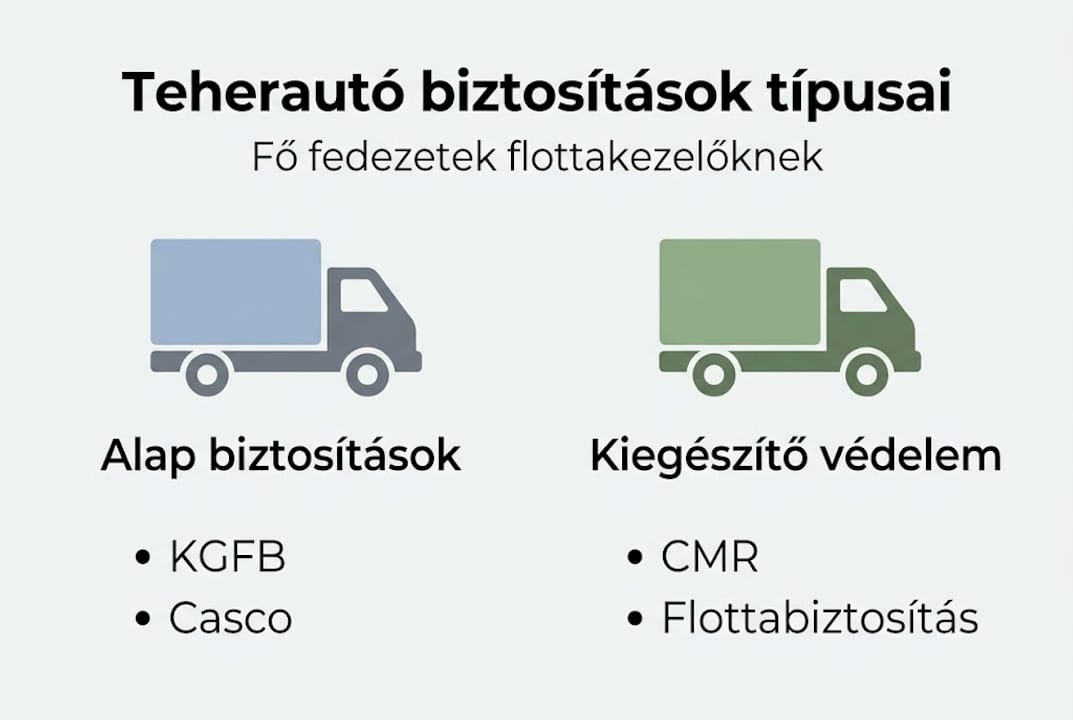
The world of truck insurance may seem simple at first glance, but the real risks lie in the details. There are four basic types of insurance that every fleet manager should know: compulsory motor third-party liability insurance (KGFB), casco, CMR liability insurance, and fleet insurance. These do not replace each other but complement each other.
KGFB is compulsory for all trucks operating in Hungary. This insurance covers only damages caused to others, meaning if another vehicle is damaged due to your driver's fault, KGFB will cover the costs. However, it does not provide protection for your own vehicle. This is where many companies make a mistake: they believe KGFB is sufficient and are surprised when they have to pay for damages to their own fleet out of pocket.
Casco insurance is voluntary but almost indispensable for large corporate fleets. It covers damages to your own vehicle, including breakage, theft, natural disasters, and vandalism. Full casco is recommended for newer trucks, while partial casco, which covers only certain risks (e.g., theft, glass breakage, or natural disaster), may be sufficient for older vehicles. The proper selection of safety equipment for trucks can also reduce casco premiums, as insurers may offer discounts for well-equipped vehicles.
CMR insurance is a completely different category. It is compulsory for all international freight and covers the carrier's liability for the goods. If the goods are lost, damaged, or arrive late, CMR insurance comes into play. It is important to understand: this is not insurance for the goods themselves, but the carrier's liability insurance.
Fleet insurance is a comprehensive solution that combines multiple vehicles under one contract. This offers administrative and financial advantages, especially for large fleets. Regarding the benefits of interior equipment, it's also worth noting that well-maintained and equipped vehicles pose a lower risk to insurers.
The bonus-malus system applies to all insurance types: claims-free driving brings discounts and is tied to the vehicle operator. This means that if your fleet's vehicles operate claims-free for years, you can expect continuously decreasing premiums.
| Insurance Type | What does it cover? | Compulsory? | Recommended for whom? |
|---|---|---|---|
| KGFB | Damage caused to others | Yes | All trucks |
| Casco (full) | Damage to own vehicle | No | Newer vehicles |
| Partial Casco | Theft, natural disaster, glass | No | Older vehicles |
| CMR | Loss or damage of goods | Yes, for international freight | International carriers |
| Fleet Insurance | Multiple vehicles, one contract | No | Fleets with 7+ vehicles |
One of the most common mistakes is that companies take out certain types of insurance with overlapping coverage, paying unnecessarily for double coverage, while other areas remain completely uncovered. Regarding the benefits of truck rental, the question also arises of who bears the insurance risk for rented vehicles: this must always be clarified in the contract.
Pro Tip: Always consider that combining different types of insurance can result in significant overlaps or uncovered areas. It is advisable to coordinate these with the help of an experienced broker who is familiar with current market offers and possible combinations.
After familiarizing yourself with the basic insurance types, it's worth taking a step further and looking at which option is most effective in which situations.
CMR and International Freight Liability Insurance
International freight transport involves special situations that can only be covered by dedicated liability insurance. CMR insurance is not optional: if a company transports goods within or outside the EU, and the freight falls under the scope of the CMR Convention, having this insurance is mandatory.
What exactly does CMR cover? The loss and damage of goods within the carrier's liability, according to the rules of the CMR Convention. This means that if the goods are damaged due to the carrier's fault, the insurance covers the compensation. However, the extent of coverage is limited: under the CMR Convention, the maximum compensation is 8.33 SDR (Special Drawing Rights, an international accounting unit) per kilogram of goods, which in many cases does not cover the true value of the goods.
Therefore, it is important to understand that CMR insurance does not cover all cases. It does not extend to the following situations:
- Force majeure event: In the event of a natural disaster, act of war, or other unavoidable external cause, the carrier may be exempt from liability, but the insurance does not pay automatically.
- Damage due to the client's fault: If the goods arrived in unsuitable packaging and are damaged as a result, neither the carrier nor the insurance is obliged to compensate.
- Handling errors of special goods: For hazardous materials or products requiring refrigeration, separate rules apply to liability.
- Delay damage: Compensation for delay can only be claimed if the client explicitly stipulated a deadline and indicated a claim for damages for its non-observance.
- Full value difference: If the market value of the goods exceeds the amount covered by the CMR limit, the carrier bears the difference themselves.
"CMR insurance does not protect the full value of the goods, but the carrier's legal liability. If the value of the goods exceeds the CMR limit, it is advisable to take out separate cargo insurance."
The filling out of the CMR consignment note is also a critical point: an incorrectly completed consignment note can also cause problems from an insurance perspective, potentially leading to the rejection of a claim for damages.
| CMR Risk Type | Covered? | Note |
|---|---|---|
| Damage to goods (due to carrier's fault) | Yes | Up to CMR limit |
| Loss of goods | Yes | Up to 8.33 SDR/kg maximum |
| Delayed delivery | Partially | Only if deadline stipulated |
| Force majeure | No | Carrier exempt |
| Packaging error (client) | No | Carrier not liable |
| Value difference | No | Separate cargo insurance needed |
The minimum premiums and limits of CMR insurance vary by insurer, but the basic rule is the same: the more valuable goods a fleet transports regularly, the higher the coverage limit should be chosen. Premium CMR packages can provide coverage up to the full value of the goods, which is essential especially for the transport of electronics, pharmaceuticals, or luxury goods.
When is it Worth Choosing Fleet Insurance?
In structuring insurance, a well-chosen fleet solution can offer significant, immediate benefits. The essence of fleet insurance is simple: insuring multiple trucks under one contract with more favorable premiums and centralized administration. But when is it really worth choosing this path?
The administrative advantages are immediately noticeable. Instead of having to manage separate contracts, separate renewal deadlines, and separate insurer contacts for each vehicle, fleet insurance brings everything together in one place. This is especially important if the fleet is constantly changing: new vehicles are added, old ones are retired. A well-negotiated fleet contract handles this flexibly.

Financial savings are the most tangible argument. For larger fleets, annual premium savings of up to 20-30% can be achieved compared to traditional, vehicle-by-vehicle insurance. This is not marketing jargon: insurers reward large customer volumes with a more favorable risk profile.
The main advantages of fleet insurance:
- Uniform pricing: The insurer assesses the risk of the entire fleet on average, not per vehicle.
- Telematics integration: More and more insurers offer telematics-based pricing, where drivers' driving styles are monitored in real time, and claims-free, safer driving results in lower premiums.
- Additional coverage: CMR, casco, and individual supplements can be added to the fleet contract, thus creating truly comprehensive protection.
- Franchise solutions: Smartly determining the amount of deductible (franchise) also reduces premiums. If the company undertakes the deductible for smaller damages, the insurer charges a lower premium.
- Broker negotiation: An experienced insurance broker is particularly valuable for fleet contracts, as market competition and volume combined provide a strong negotiating position.
Regarding the transport of refrigerated goods, it is worth noting that special vehicles (refrigerated trucks, tanker trucks) represent a separate risk category that must be handled separately in the fleet contract. Servicing and cost reduction are also related to insurance premiums: regularly maintained vehicles cause fewer damages, which pays off in the long run through the bonus-malus system.
Pro Tip: It's worth considering fleet insurance for as few as 7-8 trucks. At this number, insurers typically provide a custom offer, and the administrative savings become significant. Don't wait until your fleet reaches 20-30 vehicles.
Regarding the benefits of branded trucks, the insurance aspect also arises: for easily identifiable, branded vehicles, the risk of theft damage decreases, which also positively affects insurance premiums.
How Can Insurance Premiums Be Reduced?
Once we have decided on the insurance types and structure, the next step is to optimize and control costs. Premium reduction is not a single step but a continuous strategy with several pillars.
-
Conscious management of the bonus-malus system. Claims-free driving regularly brings discounts, and this is tied to the vehicle operator. So, if drivers are well-trained and drive safely, avoiding minor accidents, premiums will decrease year by year. It is worth establishing an internal policy on when it is advisable to settle minor damages through the insurer and when it is better to pay out of pocket, thus preserving the bonus level.
-
Driver training and accident prevention. One of the biggest drivers of insurance premiums is claims statistics. A regular, professional driver training program not only reduces the number of accidents but is also a strong argument in negotiations with the insurer. Some insurers offer discounts for documented training programs.
-
Introduction of telematics systems. GPS-based telematics is no longer a luxury but a competitive factor. The system records braking force, speed maintenance, cornering style, and adherence to rest periods. Insurers are increasingly taking this data into account when pricing premiums. Some market players offer discounts of up to 15-20% to fleets that share telematics data.
-
Regular broker consultation. Regular insurance broker consultation has been shown to save up to 18-20% on premiums. The broker is familiar with market offers and renegotiates the contract annually, considering the fleet's current claims statistics and size.
-
Optimization of deductible (franchise). A higher deductible means lower premiums. If the company is financially stable enough to handle minor damages, it is worth taking on a higher deductible, thereby reducing annual insurance expenses.
Regarding the risks of wildlife collisions, it is important to note that this is one of the most common, yet least planned risks for carriers. Adequate casco coverage and informing drivers also play a key role in this.
"In 2026, the uninsured driver fee will be 1530-9320 Ft/day, depending on the category, so continuous coverage is particularly important! Even a single day without insurance can result in a serious fine."
Overall, premium reduction strategies are not independent steps: telematics provides data for the bonus-malus system, driver training reduces claims statistics, and the broker optimizes the entire portfolio. Together, these lead to real savings.
Unusual Perspective: The True Value of an Insurance Portfolio in the Age of Digitization
Most trucking companies treat insurance as a compulsory administrative burden. They take it out, pay for it, and forget about it until a claim arises. This attitude is precisely what causes most hidden losses.
A true competitive advantage begins when an insurance portfolio is treated as a strategic asset. Digitalization now allows telematics data, claims statistics, and insurer feedback to provide a real-time picture of a fleet's risk profile. Companies that actively use this data not only pay lower premiums but also experience fewer accidents.
The real question is not which insurer to choose, but how to build a portfolio that works integrated with the entire corporate operation. Instead of a routine, "mandatory only" approach, a proactive, data-driven approach means less risk and fewer hidden costs in the long run. Every fleet manager should seriously consider this.
Business Efficiency and Safety: The Next Step for Truck Fleet Managers
Optimizing an insurance portfolio is just one side of effective fleet management. Daily operations also require tools, equipment, and accessories that increase safety, reduce the risk of breakdowns, and bring long-term savings.
At Convoy.hu, you'll find everything you need for your fleet's daily operations. Whether it's a tire repair kit for trucks, which provides a solution on the road, or trucker t-shirts for the team, the Convoy web store has over 30 years of experience serving the transport industry. Check out our current offer and find the products that truly support your fleet's safety and efficiency.
Frequently Asked Questions
What is comprehensive insurance (casco) and when is it necessary for a truck?
Comprehensive insurance (casco) protects the value of your own vehicle in case of breakage, theft, or natural disaster. Full comprehensive insurance is recommended for newer trucks, while for older vehicles, it's worth looking for partial comprehensive insurance types that only cover the most common risks.
When is CMR insurance mandatory for a carrier?
CMR insurance is mandatory for all international transport where the goods or the route fall under the scope of the CMR Convention, meaning practically all EU and cross-border shipments.
What does the bonus-malus system mean for fleets?
The essence of the bonus-malus system is that after a claim-free period, the operator receives a more favorable insurance premium, and this applies to each individual vehicle, even in large fleets.
From how many vehicles is it advisable to consider fleet insurance?
It is worth entering into a fleet insurance contract even with 7-8 trucks, as at this number, insurers provide a unique offer, and significant savings can be achieved in terms of both premiums and administration.