Most people think that if there is a first-aid kit and a warning triangle in the truck, then everything is fine. This is a mistake. Active safety systems can reduce the number of accidents by up to 50%, but if they are poorly calibrated or used without training, they can actually increase the risk. The world of safety equipment is therefore much more complex than what a mandatory equipment list suggests. This article will guide you through mandatory basic equipment, active systems, and maintenance, ensuring that you and your fleet are truly protected on the roads.
Table of Contents
- Mandatory Safety Equipment and Legal Requirements for Trucks in Hungary
- The Importance of Active and Passive Safety Systems in Truck Accident Prevention
- Truck Involvement in Fatal Road Accidents and Analysis of Key Statistics
- Equipment Selection and Maintenance: A Practical Guide for Truck Drivers and Fleet Managers
- The Expert View: What Does True Safety Mean, and Where Do Many Go Wrong?
- Purchasing Safety Equipment in One Place – Convoy Truck Shop Helps
- Frequently Asked Questions
Key Takeaways
| Point | Details |
|---|---|
| Mandatory Equipment | By law, every truck must have a first-aid kit, a warning triangle, and a reflective vest. |
| Active Systems Benefit | ADAS, such as lane-keeping systems, can reduce accidents by 30-50% with proper maintenance. |
| Statistical Importance | Trucks are involved in 15% of fatal road accidents in Europe, requiring special attention. |
| Correct Selection | For fleet managers, Euro NCAP/TRUCK SAFE certified vehicles and regular maintenance are recommended. |
| Practical Approach | Safety is not just about equipment – training, regularity, and certified gear are all key. |
Mandatory Safety Equipment and Legal Requirements for Trucks in Hungary
Before we talk about any modern technology, let's clarify the basics. In Hungary, by law, all trucks must have specific equipment, and its absence not only results in fines but also poses a real threat to life.
The mandatory basic equipment includes: a Type B first-aid kit, at least one warning triangle, and a reflective vest for every passenger. These are not recommendations but legal obligations. If any of these are missing or invalid, authorities can impose an on-the-spot fine.
First-aid kits for truck drivers fall into a special category. A Type B kit has more extensive contents than the usual Type A found in passenger cars: more bandages, a larger quantity of disinfectant, and special tools. It's crucial that all items in the kit are valid, meaning they haven't expired. This is one of the most common mistakes found during inspections.
| Equipment | Type | Mandatory? | Notes |
|---|---|---|---|
| First-aid kit | Type B | Yes | Check expiration date |
| Warning triangle | Homologated | Yes | Original, undamaged |
| Reflective vest | EN ISO 20471 | Yes | For every passenger |
| Fire extinguisher | Recommended | Not mandatory | Mandatory for dangerous goods |
Regarding reflective vests, many make the mistake of keeping only one in the cabin, even though if two drivers are traveling, both need one. When choosing a first-aid box, also pay attention to the stability of its mounting, because in case of sudden braking, a loose box can itself cause injury.
Mandatory equipment should be easily accessible. It's not enough to have them if they're buried under cargo. In an emergency, they might be needed within minutes, and a stressful situation is not conducive to searching.
Pro tip: Check the expiration date of your first-aid kit quarterly and mark it on your calendar. Don't let the authorities tell you your bandages have expired.
Among the truck shop equipment, you'll find certified products that comply with regulations, not just on paper, but also provide real protection.
The Importance of Active and Passive Safety Systems in Truck Accident Prevention
Safety systems can be divided into two main groups: passive and active systems. The difference is not just technical, but also conceptual.
Passive systems activate when an accident has already occurred. This includes seatbelts, airbags, warning triangles, and reflective vests. They don't prevent collisions, but they reduce their consequences or help secure the scene.
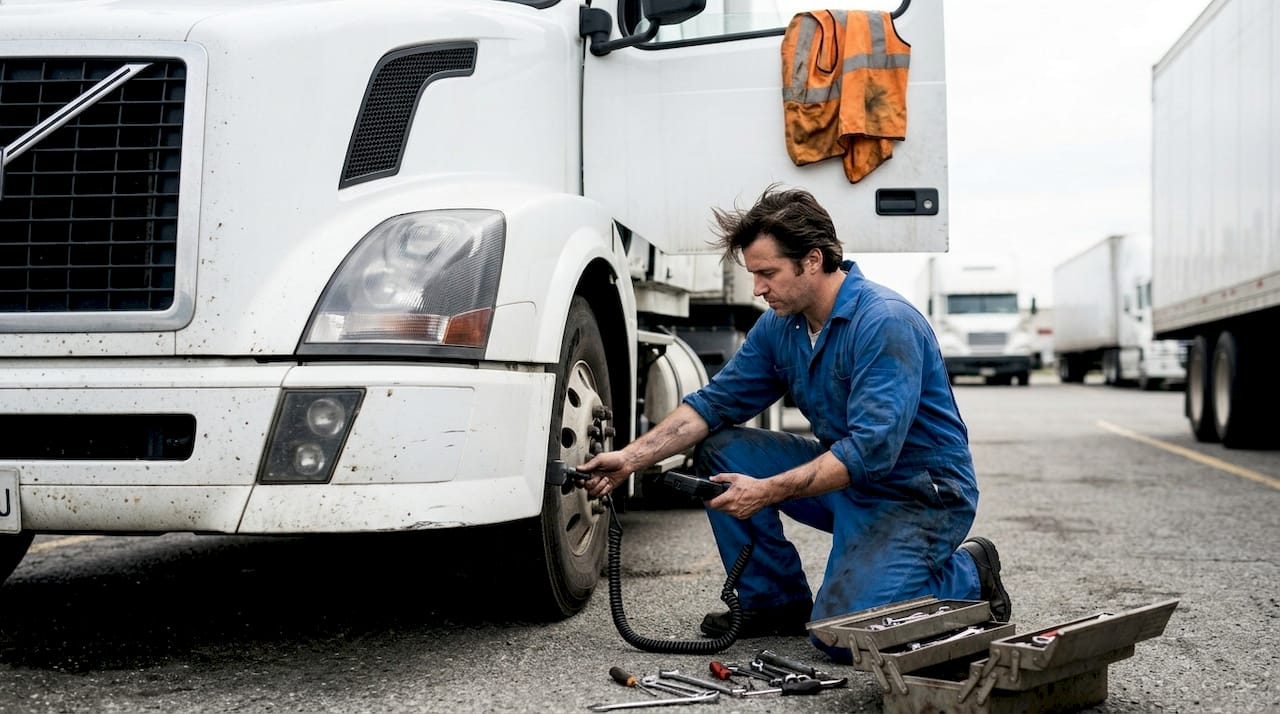
Active systems, on the other hand, work to prevent accidents. The ADAS (Advanced Driver Assistance Systems) category includes, for example, lane-keeping assist, automatic emergency braking, blind-spot monitoring radar, and reverse cameras. These monitor the vehicle's surroundings in real-time and intervene if they detect danger.
| System type | Examples | Effect | Limitations |
|---|---|---|---|
| Passive | Belt, airbag, triangle | Consequence reduction | Activates after accident |
| Active (ADAS) | Lane-keeping, emergency braking, radar | Accident prevention | Requires maintenance |
| Reverse camera | Parking camera | Parking assistance | Not reliable in all situations |
ADAS systems can reduce the number of accidents by 30-50%, which is a remarkable figure. However, it's important to know that human error plays a role in 90% of accidents, and ADAS systems can only partially compensate for this error.
"According to statistics, human error causes 90% of accidents, but ADAS systems only help when properly maintained."
Regarding reverse cameras, it's worth noting that according to ADAC tests, only four out of ten camera systems performed reliably in all conditions. In poor lighting, mud, or with calibration errors, the camera can give a false sense of security.
The risk associated with cruise control should also not be overlooked. Research suggests that cruise control can cause excessive relaxation in the driver, which reduces reaction time and increases the risk of inattentive accidents. This is a real danger, especially on long, monotonous motorway sections.
Proper use of driver assistance systems in trucks therefore requires training. It's not enough for the vehicle to have the system; the driver must understand when to trust it with a task and when to take control themselves.
Truck Involvement in Fatal Road Accidents and Analysis of Key Statistics
Numbers rarely lie, and accident statistics concerning trucks deserve serious attention. Not to incite fear, but because knowledge of reality is the best motivation for choosing proper equipment and maintenance.
In Europe, trucks are involved in 15% of fatal accidents, and more importantly, 89% of victims are not truck occupants, but other road users, pedestrians, or cyclists. This means that truck safety not only protects the driver's life but also the lives of those around them.
Statistic: 89% of victims are not truck occupants, but other road users.
These data are particularly important for fleet managers, who bear responsibility not only for their drivers but also for other road users. A poorly maintained brake or an expired first-aid kit not only presents a legal risk but can be a matter of human lives.
| Statistic | Value | Source |
|---|---|---|
| Truck involvement in fatal accidents | 15% | European data |
| Proportion of victims not truck occupants | 89% | KTI |
| Role of human error in accidents | 90% | KTI |
| ADAS systems' accident reduction potential | 30–50% | KTI |

Correct handling of the accident report is also crucial. If an accident occurs, knowledge of the information related to accident reports for trucks can save time and legal complications. Similarly important is knowledge of the regulations concerning wildlife collisions with trucks, as this is an increasingly common occurrence on Hungarian roads.
Accident prevention is not a single step, but a process:
- Check equipment before every departure: first-aid kit, triangle, vests.
- Maintain ADAS system and calibrate regularly, especially after windshield replacement.
- Driver training on the correct use of active systems, including the limitations of cruise control.
These steps together form a truly effective accident prevention system. None replaces the other.
Equipment Selection and Maintenance: A Practical Guide for Truck Drivers and Fleet Managers
Choosing the right equipment isn't just about price. Many make the mistake of choosing the cheapest option, then are surprised when they fail inspections or when the equipment fails them in a real-life situation.
The first and most important rule: always ask for a certification document. A vest complying with EN ISO 20471, a homologated triangle, and a Type B first-aid kit differ from cheap imitations not just on paper. Fire resistance, reflection angle, quality of bandages: all these matter when they are truly needed.
As a fleet manager, it's advisable to prioritize Euro NCAP and Truck SAFE rated vehicles. These ratings evaluate not only passive safety systems but also the reliability of active systems. A higher-rated vehicle is cheaper in the long run because it means fewer accidents, less compensation, and lower insurance premiums.
The most common maintenance errors include:
- Expired Type B first-aid kit that no one replaced on time.
- Non-original or damaged warning triangle that doesn't meet the standard.
- Uncalibrated ADAS system, especially after windshield replacement or a minor collision.
- Over-reliance on cruise control during long night drives.
The impact of vehicle load also affects the operation of safety systems. With a full load, braking distance increases significantly, and ADAS systems may react differently. Drivers and fleet managers alike must take this into account.
Checklist for fleet managers and drivers:
- Is all mandatory equipment present and valid?
- When was the ADAS system last calibrated?
- Has the driver received training on the correct use of active systems?
- Are all documents (registration, insurance, ADR if necessary) up-to-date?
- Does the number of reflective vests match the number of passengers?
Pro tip: As a fleet manager, keep a digital log of the condition of each vehicle's equipment. This not only helps with inspections but can also be valuable documentation for communication with insurers.
The Expert View: What Does True Safety Mean, and Where Do Many Go Wrong?
Many people think that if a truck has all mandatory equipment and is equipped with an ADAS system, safety is guaranteed. This is one of the most dangerous misconceptions in the industry.
The reality is that an expired first-aid kit and a poorly calibrated lane-keeping assist can together create a more dangerous situation than if nothing had been there at all. Without training and maintenance, active systems can be counterproductive: they give a false sense of security while the driver's attention decreases.
"True safety is not a matter of equipment, but of attitude and regularity."
With thirty years of experience, we can say that the best fleet managers don't buy the most expensive equipment, but are the most consistent in maintenance and training. The importance of driver training cannot be overstated: a well-trained driver drives safely even with the simplest tools, while an untrained driver can be dangerous even with the best technology.
Purchasing Safety Equipment in One Place – Convoy Truck Shop Helps
If you've read this article, you probably already know what to check and what to replace. The next step is to acquire appropriate, certified equipment, and we can help here.
At Convoy.hu, you'll find all mandatory and recommended safety equipment, from Type B first-aid kits to homologated warning triangles. If you need a tire repair kit for trucks or digital tachograph rolls, you can order them all in one place. With over 30 years of experience, we stand by the profession, and if you're unsure which product is right for you, our expert team will help you choose.
Frequently Asked Questions
Which safety equipment is mandatory in every truck in Hungary?
A first-aid kit, a warning triangle, and a reflective vest for each person are mandatory in the cabin. Their absence can lead to an on-the-spot fine.
How much do ADAS or lane-keeping systems reduce the risk of truck accidents?
Active systems can reduce the number of accidents by up to 30-50%, but they are truly effective only with proper training and regular maintenance.
Why is improper use of cruise control dangerous in a truck?
Cruise control can cause excessive relaxation, thus reducing the driver's attention and increasing the risk of inattentiveness-related accidents, especially on long night journeys.
What type of vehicle certification should fleet managers choose?
It is advisable to prefer trucks with Euro NCAP or Truck SAFE certification, as their active and passive safety systems provide a higher level of protection.