Many people believe that if the weight and type are roughly the same, it doesn't matter which e-vignette they buy for their truck. This is one of the most costly misconceptions that Hungarian transporters encounter. The reality is that an incorrect toll category immediately incurs a penalty fee, and from 2026, new obligations have also come into force for vehicles heavier than 20 tons in transit. This article will show you how to choose correctly, what to look out for in regulations, and how to avoid serious financial consequences.
Table of Contents
- What is the e-vignette system for trucks and why is it critically important?
- Toll categories and vignette types: How to choose correctly in 2026?
- The dangers of incorrect vignette or toll category selection
- New rules from 2026: Mandatory use of designated routes for transit trucks
- What most people overlook when it comes to truck vignettes?
- Practical products and fleet management solutions for support
- Frequently asked questions about truck vignettes
Key Takeaways
| Point | Details |
|---|---|
| Registration certificate is key | The data in the vehicle's registration certificate always determines the correct vignette type. |
| 2026 novelty: transit rules | Larger trucks over 20 tons in transit can only use designated routes. |
| Cost of incorrect toll category | An incorrectly chosen vignette can directly result in a penalty fee and significant costs. |
| Well-planned purchase saves money | Intelligent selection of the validity period makes the fleet more cost-effective. |
What is the e-vignette system for trucks and why is it critically important?
The Hungarian e-vignette system is essentially an electronic form of payment for using motorways and expressways. However, unlike passenger cars, the rules for trucks employ a much more complex category system, and the cost of errors is proportionately higher.
For a passenger car, the category is largely clear. For a truck, however, the total gross weight, the number of axles, the emission class, and the number of seats all influence which toll category the vehicle belongs to. This complexity is why the number of administrative errors in the truck segment far exceeds that of passenger cars.
Important regulation: "The e-vignette toll category must always be determined based on the data in the vehicle's registration certificate." (National Mobile Payment PLC)
This means that what you think about your vehicle is not definitive, but what is stated on the registration certificate. Even a single data discrepancy is enough to determine the wrong category.
What to pay particular attention to on the registration certificate?
- The vehicle's permissible gross weight (MTT) in kilograms
- Vehicle type: truck, tractor, special vehicle
- Number of seats, especially if over 9 (this means a different category)
- Registration date and emission class (Euro 3, 4, 5, 6)
- In case of a trailer, the gross weight of the combination
Typical errors we regularly see: the driver bases their purchase on last year's vignette, but the vehicle data has changed since then (e.g., a trailer was swapped). Or the fleet manager orders the vignette "from memory" without checking the current registration certificate. Or the vehicle is on the border of another category, and the choice is not based on actual data.
Just as with types of truck insurance, inaccurate data provision can lead not only to fines but also to insurance problems. The two areas are therefore closely linked in terms of compliance.
The e-vignette system for trucks is stricter also because heavy vehicles put disproportionately more strain on the road surface. The road wear caused by a 40-ton truck can be several hundred times that of a passenger car, according to experts. Therefore, the toll system is progressive, and the differences between categories are measured not in mere pennies, but in tens of thousands of forints.
Toll categories and vignette types: How to choose correctly in 2026?
In the system valid in 2026, the following main types of truck e-vignette categories are distinguished. The toll categories and validity periods, according to the toll table of the National Mobile Payment PLC, can be summarized as follows:
| Category | Vehicle type | Permissible gross weight | Typical use |
|---|---|---|---|
| D1M | Motorcycle, smaller vehicle | not applicable | not a freight vehicle category |
| D1 | Passenger car, light commercial vehicle | max. 3.5 t | smaller delivery vehicles |
| D2 | Truck, motorhome | over 3.5 t | medium trucks, tractors |
| U | Bus (9+ passengers) | variable | not freight transport |
| HU-GO / OBU | Heavy goods vehicle | over 3.5 t | long-haul transport, transit |
The HU-GO system and OBU (on-board unit) are not e-vignettes in the strict sense, but rather a mileage-based toll payment system that needs to be handled separately for larger trucks. This is particularly important because many confuse the two, thinking that purchasing an e-vignette fulfills all their obligations.
When is which category appropriate? Some real-world cases:
- A carrier of a 7.5-ton van: D2 category is required, not D1, even if the driver considers the vehicle a "smaller truck".
- An 18-ton tractor with a trailer, domestically: D2 e-vignette and HU-GO toll payment may be required together on certain roads.
- A foreign-registered, 24-ton transit truck: HU-GO registration and OBU use are mandatory.
- A small truck under 3.5 tons: may fall into the D1 category, but only if the registration certificate actually shows this.
Regarding duration-based types, for trucks, the annual vignette is the best solution for regular domestic transport. Daily and weekly types are suitable for shorter domestic assignments, but if someone travels to Hungary several times a week, the annual vignette is by far the most economical choice. Among truck vignette sets, there are also accessories that help in clearer identification of the vehicle during checks.
Pro tip: Purchasing aligned with the validity period is not just about choosing the cheapest. If a vehicle spends four or five days on Hungarian motorways according to a transport plan, a weekly vignette might be cheaper than five daily ones. It's worth planning ahead using fleet tracking tips to integrate vignette purchases into scheduled processes.
Typical category selection errors to avoid:
- Purchasing D1 category instead of D2 because it "looks like a small truck"
- Automatically repeating the previous year's category without checking if vehicle data has changed
- Applying the logic of a foreign system to the Hungarian system for foreign vehicles
- Ignoring the trailer's weight when calculating the gross weight of the combination
- Incorrectly specifying the emission class, resulting in a more favorable but incorrect categorization
The dangers of incorrect vignette or toll category selection
Penalty charges are not an theoretical threat. The Hungarian motorway control system is based on cameras and automated on-site checks, and incorrect data can be spotted almost immediately.
Important rule: "When selecting a toll category, the data on the registration certificate is always decisive; an error in this can lead to direct penalty fee risk."
The penalty process step-by-step:
- The control system (camera or on-site inspector) detects that the vehicle's license plate does not match the data recorded on the e-vignette, or that there is no valid, appropriate category vignette for the given road.
- The system automatically generates a penalty notice, which is delivered to the vehicle owner.
- The notice includes a reduced penalty amount that can be settled within a specified deadline (usually 30 days).
- If the penalty is not paid within the deadline, the amount increases significantly, and enforcement proceedings may begin.
- For foreign-registered vehicles, border control may also assist in collection.
The actual financial damage is not just the difference between the original vignette and the penalty. One must consider the time and cost of administrative procedures, potential legal fees, delays due to possible vehicle detention, and the impact on the fleet's reputation with clients.
Pro tip: Always check the registration certificate before buying a vignette! This is especially true if the vehicle has been serviced in the last 12 months, a trailer has been changed, or any changes have occurred in the company register. A minute's check can save hundreds of thousands of forints in penalty fees.
What is particularly painful: accident prevention equipment and safety regulations are usually more ingrained in drivers' minds than administrative obligations. No one forgets the fire extinguisher, but they do forget to update the e-vignette category. This is psychologically understandable, but the financial consequence is just as real.
It has long been a known phenomenon in the industry that companies that do not invest energy in understanding the importance of truck memorabilia also generally pay less attention to the professional development of drivers and administrative details. Company culture and professional diligence are closely linked.
New rules from 2026: Mandatory use of designated routes for transit trucks
- From January 1, 2026, an obligation will be in force in Hungary, which requires transit heavy goods vehicles weighing more than 20 tons to use designated transit routes.
"The designated transit route is mandatory for heavy goods vehicles over 20 tons in transit."
What does the term transit mean in practice? A vehicle qualifies as transit if both its origin and destination are outside Hungary's borders, and the vehicle merely passes through the country. Transport where the loading or unloading point is within Hungary is not considered transit, even if the vehicle arrives from another country.
| Aspect | Domestic transport | Transit transport (over 20 t) |
|---|---|---|
| Route obligation | Free route choice within the e-vignette framework | Mandatory designated transit route |
| E-vignette necessity | Yes, D2 or HU-GO | Yes, HU-GO + OBU |
| Special notification | Not mandatory | Yes, in specified cases |
| Control method | Camera, on-site | Camera, on-site, border crossing point |
| Fine for infringement | Penalty fee + administration fee | Penalty fee + route deviation fine |
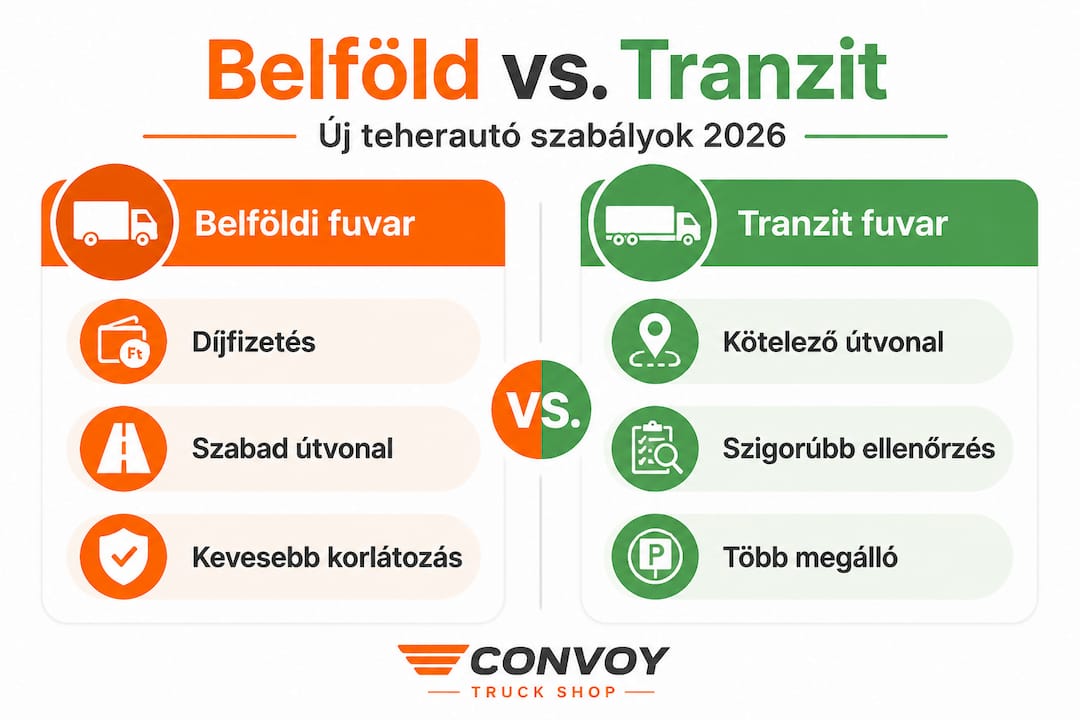
Many fleet managers believe that route obligations are merely minor administrative details. In reality, a route deviation fine is a standalone legal consequence and does not replace the amount payable for the absence of a valid e-vignette. They can be imposed simultaneously.
Typical misconceptions regarding the new transit rules:
- "The driver knows the way, the designated route is unnecessary." This is not an argument; the obligation is legal, not logistical.
- "If we have a HU-GO vignette, everything is fine." HU-GO is necessary, but not sufficient if they deviate from the designated route.
- "No Hungarian e-vignette is needed for transit." This is false: the toll payment obligation remains on the toll sections of the designated routes.
- "We have a combination under 20 tons, so it doesn't apply to us." Precise measurement is needed: the gross weight of the entire combination matters, not the individual weight of the tractor.
The new transit rules primarily affect East-West and North-South through traffic. For trucks traveling from Poland to Croatia, or from Austria to Romania, Hungary is a transit station, and exactly these routes fall under the new obligation.
On-board devices, navigation aids, and administrative supplies available in the trucking specialty store can all help drivers and dispatchers stay up-to-date with changing regulations. In the field of refrigerated goods transport, for example, the route obligation is particularly critical, as a break in the cold chain and a route deviation fine combined can lead to catastrophic financial consequences.
What most people overlook when it comes to truck vignettes?
From thirty years of experience, we've seen what truly falls into the background of daily truck operations. Not the amount, not the knowledge of regulations, but routine.
The vast majority of administrative errors don't occur because someone doesn't know how the system works. Rather, it's because a usual process changes for some reason, and no one notices in time. A vehicle changes hands within the fleet, but the vignette runs on the old one. Or when a driver changes, the paperwork isn't updated. These are not ignorant mistakes, but consequences of fast pace and inattention.
The other big trap in 2026 is that some fleet managers, especially in smaller companies, still think they can "save" on the toll category. Literally: they intentionally buy a lower category, hoping not to get caught. This is not saving; it's gambling. An incorrectly chosen category immediately incurs a penalty fee at the first check, which can be hundreds of thousands of forints, far exceeding the price of the "saved" vignette.
And with the new transit rules, it's particularly worth highlighting: the main pitfall is not toll payment, but the correct route. Many buy the appropriate HU-GO vignette, pay properly, but then the driver takes the usual, faster route, which is not the designated transit route. Result: valid vignette, yet a fine. This is the case that can be prevented with the best software and efficient fleet tracking, and only with those.
Our suggestion: introduce regular internal training for drivers and dispatchers, at least semi-annually. Don't just review the rules, but process specific cases, real penalty situations. The lifelike example teaches best. In addition, software checks that automatically signal the validity of the e-vignette and the match of the vehicle category are not just a convenience, but a mandatory investment for any fleet larger than 5 vehicles.
Practical products and fleet management solutions for support
Knowing the rules is the first step, but everyday compliance also requires practical tools. Convoy Truck Shop offers not just accessories, but also products that directly support safe and compliant truck operation.
Compliant transport doesn't end with e-vignettes. The cargo lashing strap ensures that goods arrive safely, avoiding fines for cargo inspection. A tire repair kit for trucks is standard equipment for every professional fleet. Both products contribute to ensuring that vehicles are not only legally but also physically in suitable condition for the journey. With 30 years of experience, Convoy.hu offers exactly the products and information that professional transporters need.
Frequently Asked Questions about Truck Vignettes
What determines which e-vignette to buy for a truck?
The data in the vehicle's registration certificate, such as weight and type, determine the toll category, which is a mandatory basis for all vignette purchases.
What is the difference between D2 and HU-GO (OBU) for trucks?
D2 is an e-vignette valid for trucks over 3.5 tons and some special vehicles, while among the D2 and HU-GO categories, the latter is a distance-based toll system, primarily used for larger, heavy trucks for both domestic and transit transport.
What happens if I incorrectly select a vignette based on the registration?
In case of incorrect toll category selection, the wrong category incurs a penalty fee, which can be several times the original vignette price, and repeated violations may lead to legal proceedings.
From when is the use of transit routes mandatory for vehicles over 20 tons?
- January 1st onwards, the obligation for the transit route network is already in effect and applies to all transit heavy goods vehicles over 20 tons that pass through Hungary without having a loading point in the country.