From a truck driver's seat, the road looks completely different than from a passenger car: every decision, every slowdown, every maneuver can affect lives. In 2024, 28 truck drivers died on Hungarian public roads, which clearly indicates that the consistent application of correct driving tips and rules is not a luxury, but a necessity. In this article, we will go through the most important information step by step: from rest regulations to defensive driving, fuel saving, and the intricacies of backing up, you will find everything you need to make your journeys safer and more efficient.
Table of Contents
- The most important driving and rest regulations for truck drivers
- Defensive driving with a truck: Vision, mirror use, safe following distance
- Secrets of fuel efficiency: Engine braking, tire pressure, smooth driving
- Reversing and maneuvering: G.O.A.L. and special tips for tight spaces
- Why isn't knowing the rules enough? – Our experienced advice
- Everything you might need for a safe and efficient journey
- Frequently asked questions about truck driving tips
Key Takeaways
| Point | Details |
|---|---|
| Observe driving times | Adhere to legal driving and rest periods for your safety. |
| Defensive driving routine | Always check mirrors and maintain an ideal following distance to react in time. |
| Save fuel with simple tricks | Smooth driving, correct tire pressure, and engine braking can cut costs. |
| Don't rush maneuvering | The G.O.A.L. method and meticulous attention can prevent accidents in tight spaces. |
| The safety of routine | Knowing the rules is not enough; personalized attention is worth more than anything. |
The most important driving and rest regulations for truck drivers
Seeing the number of fatalities, the question immediately arises: why are there still so many accidents? Experienced drivers also know that fatigue is one of the biggest risk factors. It is no coincidence that the European Union regulates in detail the working hours and rest obligations of truck drivers. These regulations are not bureaucratic obstacles but life-saving frameworks.
EU driving and rest times in detail
According to EU regulations, the daily driving period must not exceed 9 hours, which can be extended to 10 hours twice a week. After every 4.5 hours of continuous driving, a mandatory 45-minute break must be taken, which can be split into a 15-minute and a 30-minute break, but in that order. The standard daily rest period is 11 hours of continuous rest.
Weekly driving is also not limitless: the total weekly driving time must not exceed 56 hours, and the total bi-weekly driving time must not exceed 90 hours. The weekly rest period implies a minimum of 45 hours of continuous rest, which can be reduced to 24 hours under certain conditions, but the missing time must be made up within the following three weeks.
| Rule type | Limit |
|---|---|
| Daily driving time | 9 hours (twice 10 hours/week) |
| Break after 4.5 hours | 45 minutes (or 15 + 30 minutes) |
| Daily rest | 11 hours |
| Weekly maximum driving | 56 hours |
| Bi-weekly maximum driving | 90 hours |
| Weekly rest | 45 hours (reduced: 24 hours) |
Why breaks should not be taken lightly
Many people think they can get through a long night with coffee and an energy drink. Unfortunately, this is a mistake. Clinical studies show that after 18 hours of being awake, reaction time and judgment decline to the same level as with a blood alcohol content of 0.5 per mille. With a truck, where emergency braking can mean a braking distance of up to 100 meters, this is simply unacceptable.
For practical advice on driving and rest times, it's worth staying informed, especially for those new to the profession. Violations of the rules in Hungary can result in serious fines, and tachograph data can always be checked by the authorities.
Consequences of rule violations:
- Deterioration of reaction time due to fatigue, posing a direct risk of accident.
- Significant monetary fines during official inspections, up to 100,000-300,000 forints.
- Risk of driving license revocation in case of repeated or serious violations.
- Fines for the transport company and possible business suspension.
- Legal liability in case of serious accident.
Pro tip: Don't just spend your mandatory break in the cabin. Get out, walk for at least 10 minutes, stretch. Physical movement and fresh air refresh the mind much more effectively than passive sitting. On long journeys, this simple habit can increase your alertness by 20-30% in the first 1-2 hours after the break.
Defensive driving with a truck: Vision, mirror use, safe following distance
Now that we understand the importance of rest periods, let's look at how to best avoid accidents while driving, using defensive driving methods. The essence of defensive driving is simply this: always assume that other road users will make mistakes, and prepare for them in advance.
What does defensive driving mean in practice?
A defensive driver does not react to those on the road, but anticipates dangers. This is especially critical with a truck, because the physical parameters of the vehicle (length, weight, braking distance) differ significantly from passenger cars. The braking distance of a loaded truck at 80 km/h can reach 70-80 meters, compared to a passenger car's 30-40 meters.
According to defensive driving principles, mirrors should be checked every 5-8 seconds while driving. In terms of anticipation, in urban areas, you should monitor road events up to a distance of 12-15 seconds, and on highways, you should think on a horizon of 20-30 seconds. The recommended following distance for trucks is 8-12 seconds, which at 90 km/h means a physical distance of approximately 225-300 meters.
Mirror usage routine and hazard recognition
Mirror usage is a reflex for many drivers, but it's worth consciously developing it. With a truck, the blind spot is significantly larger than in passenger cars. Pay special attention to the right side: without back-and-forth checks, it's easy for a cyclist or motorcyclist to disappear completely from your field of vision.
| Feature | Passenger car | Truck/Articulated lorry |
|---|---|---|
| Recommended mirror check frequency | 5-8 sec | 5-8 sec (more consciously) |
| Recommended anticipation in urban areas | 10-12 sec | 12-15 sec |
| Recommended anticipation on highway | 15-20 sec | 20-30 sec |
| Braking distance at 80 km/h | 35-45 m | 70-80 m |
| Blind spot size | Small | Very large (especially on the right side) |
| Pre-turn check | One mirror check | At least two mirror checks |
To avoid accidents with a truck, it is essential to manage the risks associated with crosswinds, wet road surfaces, and reduced visibility. Attention must also be paid to bridges and underpasses where crosswinds can unexpectedly accelerate.
Summary of defensive driving principles for trucks:
- Maintain a 8-12 second following distance; do not reduce it under pressure.
- Signal in time and assertively so other road users can prepare for your maneuver.
- Never keep pace with aggressive drivers; let them pass you instead.
- In rain or fog, increase your following distance by at least 50%.
- At intersections, always check that a green light truly means a clear path.
Pro tip: On long journeys, monotony reduces alertness. At regular intervals (every 30-40 minutes), perform a conscious "scan": check the left mirror, the right mirror, the rearview mirror, and the road analysis horizon four times in a row. This simple routine keeps your brain awake amidst otherwise sedating monotony.
Secrets of fuel efficiency: Engine braking, tire pressure, smooth driving
In addition to safe driving, it's worth paying attention to fuel efficiency, as freight charges and fuel costs are closely related. With an optimally driven truck, hundreds of thousands of forints can be saved monthly with the right technique.
How do driving habits affect fuel consumption?
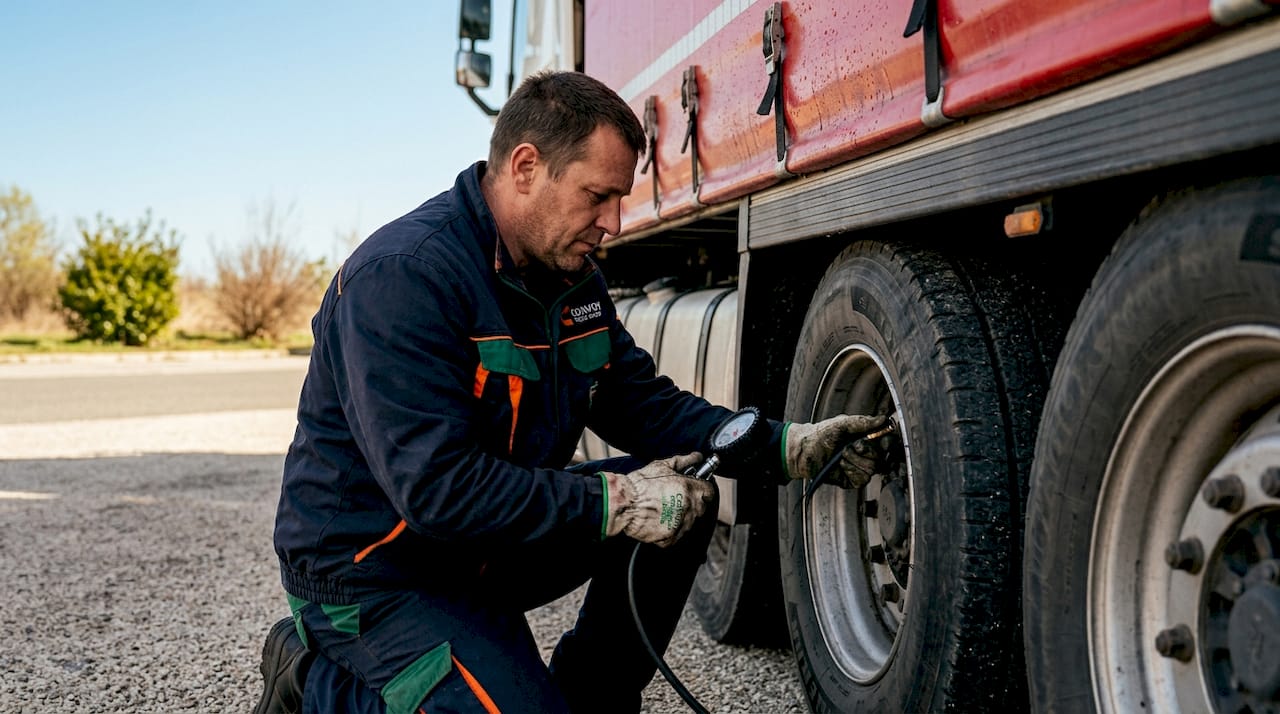
Based on research, smooth, consistent driving, correct application of engine braking, and maintaining proper tire pressure can collectively result in up to 2% fuel savings. This may sound small at first, but for a truck covering 100,000-150,000 km per year, this translates to a significant amount.
Sudden accelerations are the most expensive. When you start from a stop with maximum throttle, the engine instantly enters its highest consumption range, whereas with smooth, gradual acceleration, the same speed can be achieved with 30-40% less fuel. The same applies to decelerating: timely engine braking not only saves fuel but also preserves brake pads.
| Technique | Extent of saving | Other benefit |
|---|---|---|
| Engine braking | 0.5-1% | Extends brake pad life |
| Smooth, even acceleration | 0.5-1% | Preserves engine and transmission |
| Correct tire pressure (checked monthly) | 0.3-0.5% | Extends tire life |
| Minimized use of AC | 0.2-0.5% | Reduces engine load |
| Avoid idling | 0.2-0.4% | Reduces emissions |
The role of tire pressure and chain inspection
Many drivers underestimate the importance of regularly checking tire pressure. A tire pressure that is 1 bar lower increases consumption by 0.5-1% and also drastically reduces the lifespan of the tire. The recommended check frequency: at least once a week, and before every longer journey (over 500 km).
You can find more detailed information on the impact of driving style on consumption and the economical operation of trucks. Chain inspection (drivetrain, half-shafts, coupling links) is also part of preventive maintenance and directly affects fuel consumption.
Steps for fuel-efficient driving:
- Shifting at optimal RPM: most diesel engines are most efficient between 1200-1500 RPM.
- Applying the coasting technique: if you anticipate a red light or a slow-down zone, ease off the gas in time and let the engine coast.
- Using cruise control on highways: consistent speed minimizes unnecessary accelerations and decelerations.
- Reducing idling: turn off the engine for waits longer than 10 minutes.
- Considering aerodynamics: always close the tarpaulin roof, and if possible, avoid sections of road with full windscreens.
Pro tip: Before an incline, observe the gradient from below and, if possible, accelerate slightly before reaching the summit. Maintaining a consistent speed on an incline requires much less fuel than having to rev the engine after slowing down halfway up the hill.
Reversing and maneuvering: G.O.A.L. and special tips for tight spaces
When it comes to correct driving technique, we cannot omit the biggest challenges: reversing and maneuvering in tight spaces. Statistics show that reversing maneuvers are disproportionately responsible for accidents and injuries occurring in loading areas and depots.
The G.O.A.L. method: The simple but life-saving basic technique
The acronym G.O.A.L. stands for “Get Out And Look.” This method is fundamental, especially for semi-trailers and articulated vehicles. The expectation is simple: always get out before backing up, walk around the vehicle, and make sure there are no obstacles, people, or objects in the direction of travel.
According to expert advice on reversing an articulated truck, it is advisable to stop multiple times, get out, and re-check the situation while reversing, then adjust the angle if necessary. This is not a sign of weakness or unprofessionalism, but a proven routine for the best drivers.
Reference points and angle correction technique
One of the most common mistakes in reversing is that the driver starts and then tries to correct when the vehicle has already deviated significantly from the desired direction. At this point, it is much harder to bring the angle back, and there is a risk that the semi-trailer or trailer will "jackknife," which could even cause it to overturn.
The correct technique: identify reference points using the mirrors. Observe the proportion in which the rear corner of the trailer appears in the left and right mirrors. If these proportions change, immediately correct with small steering movements; do not wait until the situation becomes irreversible.
| Situation | Incorrect approach | Correct approach |
|---|---|---|
| Needs to back into a narrow gate | Goes in and corrects on the fly | G.O.A.L., then slow, gradual backing |
| Trailer starts to form a "V" | Waits for the driver to "get out" of it | Stops immediately, pulls forward, recalibrates the angle |
| Unknown loading area | Dives right in | Walks around the area, identifies obstacles |
| Night maneuver | Only works with cabin lights | Ensures all truck lighting is properly adjusted |
Basic rules for backing up in tight spaces:
- Never rush: 10 extra minutes of caution is worth far less than a damaged loader or a broken cradle.
- If you feel uncertain, stop and ask for help. Asking for a spotter is not a shame, but a professional decision.
- The key to preventing maneuvering accidents is primarily reducing speed and careful mirror checking.
- To prevent cargo damage, especially with fragile goods, also ask for feedback from warehouse staff during maneuvering.
- If possible, perform more difficult maneuvers in daylight, not after dark.
Pro tip: Never attempt to back up in a tight angle in one go. First, pull forward as far as the road allows, so you can start backing up from the straightest possible position. From a straight starting point, it's much easier to control the trailer's angle, and the entire maneuver requires fewer corrections.
Why isn't knowing the rules enough? – Our experience-based advice
We have learned the most important rules, techniques, and comparisons. But there is a question that is rarely asked: why do even experienced, rule-abiding drivers have accidents? The answer is not in the rules, but somewhere else.
We find that the best truckers not only follow the rules but also actively think about the reasons behind the rules. A 9-hour daily limit is not because the legislator arbitrarily chose such a number. It's because that's the average time after which fatigue levels start to rise critically. If you are already seriously tired after 7 hours, simply following the rule is not enough: you need to take a break earlier.
The routine comfort zone is another major source of danger. Many veteran drivers make inattentive mistakes precisely on those sections they know best. The "I've driven this road 200 times" mindset reduces alertness, even though the road surface, weather, and traffic are different every time. A familiar road creates a false sense of security.
It's worth deliberately looking for new perspectives. Listen to the experiences of younger drivers: they see dangers with fresh eyes that seasoned drivers have long "gotten used to." Maintaining physical and mental fitness is not an additional activity, but the foundation of safe driving.
We also find that small habit changes bring much more long-term results than rigid adherence to rules. A short, 10-minute walk at every break, one more glass of water a day, a weekly group meeting with team members: these are not "soft" factors, but measured, proven methods for accident prevention.
Pro tip: Keep an "accident prevention log": each day, write down one situation you learned something from on the road. This could be a well-executed maneuver, a dangerous situation you noticed in time, or a wrong decision you would handle differently next time. After three months, you will know surprisingly much about your own driving patterns.
Everything you might need for a safe and efficient journey
A good driver's knowledge is valuable, but without the right equipment, even the best technique can fail. Just as a professional carpenter wouldn't work with shoddy tools, you shouldn't embark on a long journey without having all the necessary equipment at hand in the cabin.
At Convoy.hu, you'll find the tools that truly matter when something doesn't go according to plan. Whether it's quick tire repair on the road, for which the tire repair kit for trucks offers a perfect solution, or keeping the windshield clean in deteriorating visibility: the windshield cleaning wet wipes solve the problem quickly and efficiently. If you want to be thoroughly prepared for all eventualities, check out the full range at the Convoy store, built on the principle of home on the roads. We have over 30 years of experience supporting truckers and transporters.
Frequently asked questions about truck driving tips
How long can a truck driver drive in one day?
The daily driving time is a maximum of 9 hours, which can be extended to 10 hours twice a week, and a mandatory 45-minute break must be taken after every 4.5 hours.
What is the ideal following distance for a truck on the highway?
For trucks, an 8-12 second following distance is recommended on the highway, which means a physical distance of 225-300 meters at 90 km/h.
How can I increase the fuel efficiency of a truck?
Smooth driving and engine braking, complemented by maintaining correct tire pressure, can improve fuel consumption by up to 2%, resulting in significant savings over a hundred thousand kilometers per year.
How often should mirrors be checked while driving?
It is recommended to check mirrors every 5-8 seconds so that all blind spots regularly come into your field of vision and you can detect approaching dangers in time.
What should I pay attention to when backing up in a tight space?
Apply the G.O.A.L. method: get out, walk around the vehicle, and if necessary, pull forward to correct the trailer's angle before attempting to back up again.
Recommended
- Trucker safety tips to reduce accident risk – Convoy Truck Shop HU
- Practical trucking tools for everyday work – Convoy Truck Shop HU
- Truck lighting adjustment: steps and professional tips – Convoy Truck Shop HU
- Truck driver job guide – 7 things every truck driver and haulier should pay attention to – Convoy Truck Shop HU